

Aadrikaa Legal Services (ALS)- Law I Litigation I Arbitration
Date: 18.08.2026
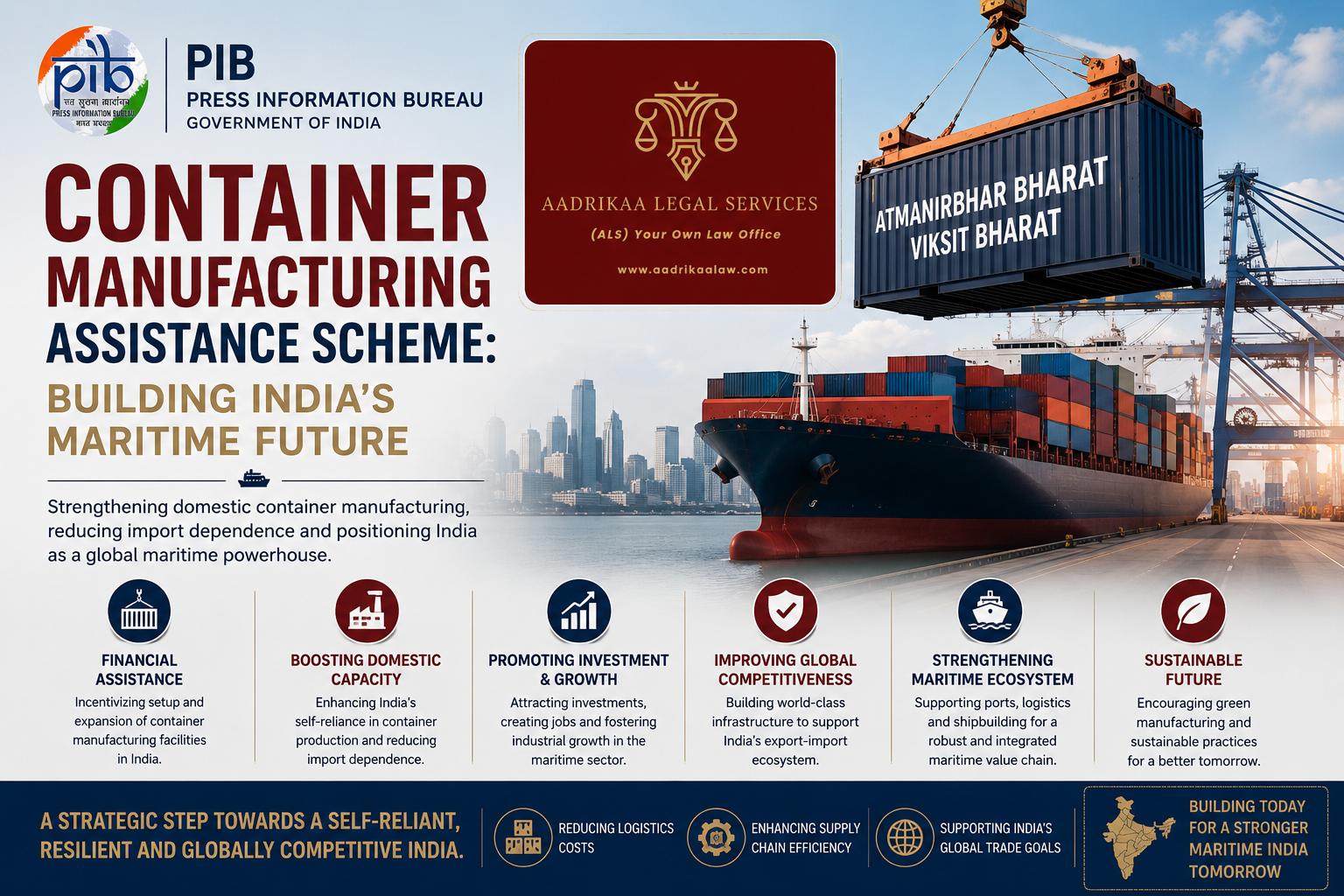
Container Manufacturing Assistance Scheme: Building India’s Maritime Future
This Short Article has been prepared & written by Advocate Ravi Shekhar Jha-Delhi High Court, New Delhi. The views expressed are based on his interpretation of the law. He can be reached at his email id intelconsul@gmail.com .
India is accelerating its maritime ambitions with the Container Manufacturing Assistance Scheme (CMAS), a transformative initiative designed to establish a robust domestic container manufacturing ecosystem. This article provides a comprehensive overview of CMAS, its strategic importance, recent milestones, and the broader reforms shaping India’s maritime sector, with direct links to official sources and references.
The Need for Domestic Container Manufacturing
Maritime transport is the backbone of global trade, with about 80% of merchandise trade by volume carried by sea (UNCTAD Review of Maritime Transport). Containerized cargo accounts for nearly two-thirds of the value of international trade, making efficient container logistics critical for supply chains. Recent disruptions and geopolitical tensions have exposed vulnerabilities in global shipping, prompting countries like India to focus on domestic manufacturing of critical logistics assets such as shipping containers.
India currently imports nearly 2 million empty containers annually, making it susceptible to global market fluctuations and supply-chain disruptions. The CMAS aims to reduce this dependence, strengthen supply-chain resilience, and support India’s long-term trade ambitions. The scheme complements initiatives like Make in India, Maritime Amrit Kaal Vision 2047, and multimodal logistics development.
What is the Container Manufacturing Assistance Scheme (CMAS)?
Announced in the Union Budget 2026–27, CMAS is a targeted initiative with a ₹10,000 crore outlay over five years. Its objectives include:
- Establishing new Greenfield manufacturing facilities
- Expanding existing Brownfield units
- Providing operational support to enhance competitiveness
- Supporting testing infrastructure, skilling, and capacity building
The scheme targets an annual domestic manufacturing capacity of up to 7.5 lakh Twenty-foot Equivalent Units (TEUs)—about ten times the current capacity. This is expected to create a market opportunity of nearly ₹80,000 lakh crore and position India as a reliable global supplier of shipping containers.
For more details, see the Ministry of Ports, Shipping and Waterways official document.
Building an Integrated Maritime Ecosystem
CMAS is part of a broader strategy to create an integrated, domestically anchored container ecosystem. In February 2026, the Ministry of Ports, Shipping and Waterways signed an MoU to establish the Bharat Container Shipping Line (BCSL), bringing together major public sector stakeholders. The initiative includes investments of around ₹99,149 crore in fleet development and domestic container procurement.
This approach complements other government initiatives:
- PM Gati Shakti: Enhancing connectivity between ports, railways, highways, and industrial centers
- National Logistics Policy: Supporting operational efficiency
- Sagarmala Programme: Promoting port-led development
These efforts collectively support a resilient logistics network for India’s growing trade volumes.
Employment and Industrial Growth
CMAS is expected to generate around 3,000 direct jobs and over 50,000 indirect jobs in container manufacturing and allied industries. The scheme will also stimulate growth in ancillary sectors such as corner castings, wooden frames, and Corten steel production.
Recent Progress and Industry Response
A major milestone was achieved in July 2026 with the rollout of India’s first domestically manufactured EXIM shipping container for A.P. Moller–Maersk. Manufactured to international ISO and CSC standards, this container is suitable for global deployment. Maersk’s subsequent order for 1,000 additional Made-in-India containers with DCM Shriram Group signals growing confidence in India’s manufacturing capabilities. For more, see the DG Shipping address.
Part of Wider Maritime Transformation
CMAS is complemented by a series of legislative, institutional, and infrastructure reforms:
- Merchant Shipping Act, 2025; Coastal Shipping Act, 2025; Indian Ports Act, 2025: Modernizing the legal framework for shipping and port governance
- Digital Initiatives: One Nation One Port Process (ONOP), Maritime Single Window, and e-Samudra to streamline regulatory procedures (PIB Press Release)
- Shipbuilding Financial Assistance Package: A ₹70,000 crore package to boost domestic shipbuilding
- Major Infrastructure Projects: Vadhavan Port, International Container Transshipment Port at Galathea Bay, Tuna Tekra Container Terminal, and Outer Harbour Container Terminal at V.O. Chidambaranar Port
Three Indian ports are now ranked among the world’s top 30 in the Container Port Performance Index (CPPI) 2025, reflecting improvements in port efficiency and India’s growing stature in global maritime trade.
Way Forward
The Container Manufacturing Assistance Scheme is a pivotal step in building a globally competitive maritime manufacturing ecosystem. By fostering domestic container production, reducing import dependence, and supporting broader maritime reforms, CMAS is set to enhance India’s supply-chain resilience, generate employment, and position the country as a leading maritime and logistics hub.
References:
- Ministry of Ports, Shipping and Waterways
- PIB Press Release 1
- DG Shipping Address
- PIB Press Release 2
- PIB Press Release 3
- UNCTAD Review of Maritime Transport
- UNCTAD Review of Maritime Transport 2025
Listen to this on our #YouTube Channel
How Aadrikaa Legal Services Can Help Manufacturers Navigating a ₹10,000 crore government subsidy and complex railway infrastructure policies requires a mix of regulatory, commercial, and legal expertise.
Here is how your firms can add massive value to container manufacturers and MSMEs:
1. Strategic Advisory & Government Liaison CMAS Subsidy Roadmap: Guide manufacturers through the application process for the Container Manufacturing Assistance Scheme (CMAS). Ensure all documentation aligns with performance-linked milestones to secure the capital or operational assistance.
- EXIM & Logistics Optimisation: Help businesses leverage the Bharat Container Shipping Line (BCSL) and local supply chains. Provide advisory on minimizing import dependence for raw materials (like high-grade Corten steel).
- Scheme Aggregation: Assist MSMEs in combining CMAS benefits with other relevant incentives like the PLI Scheme for Steel, CGTMSE loans, or MSME-specific grants.
2. Infrastructure & Regulatory Approvals (Aadrikaa Legal Services) Gati Shakti Cargo Terminal (GCT) Licensing: Assist companies looking to build Greenfield or Brownfield units with direct rail connectivity. Help them apply for and secure In-Principle Approvals (IPAs) from Indian Railways under the GCT Policy.
- Land & Environmental Compliances: Facilitate clear land acquisition, licensing, and environmental clearances required for setting up large-scale manufacturing plants and rail-linked cargo facilities.
3. Legal Risk Management & Contracting (Aadrikaa Legal Services) Joint Ventures & MoUs: Draft and review joint venture agreements between domestic manufacturers, international technology partners, or public entities like CONCOR and port authorities.
- EPC & Infrastructure Contracts: Structuring sound Engineering, Procurement, and Construction (EPC) contracts for setting up state-of-the-art manufacturing facilities.
- Compliance & Dispute Resolution: Safeguard manufacturers against regulatory hurdles, freight handling disputes, or contract enforcement challenges under the Gati Shakti and maritime ecosystem framework.
Aadrikaa Legal Services is a trusted legal and regulatory support partner providing end-to-end legal solutions to law firms, corporate organizations, and businesses across India. We specialize in paralegal services, litigation support, tax and regulatory matters, delivering reliable, efficient, and result-oriented legal assistance.
Our services include comprehensive paralegal support, drafting and documentation, legal research, case management, litigation handling, and representation support across various judicial and quasi-judicial forums. We also assist in direct and indirect tax matters, customs, GST, corporate regulatory compliance, and legal advisory.
Source: PIB Publications, UNCTAD
Handy Download:
Write to us at office@aadrikaalaw.com
Tel: +91-11-4999 2707