
Aadrikaa Legal Services (ALS)- Law I Litigation I Arbitration
Date: 13.08.2026
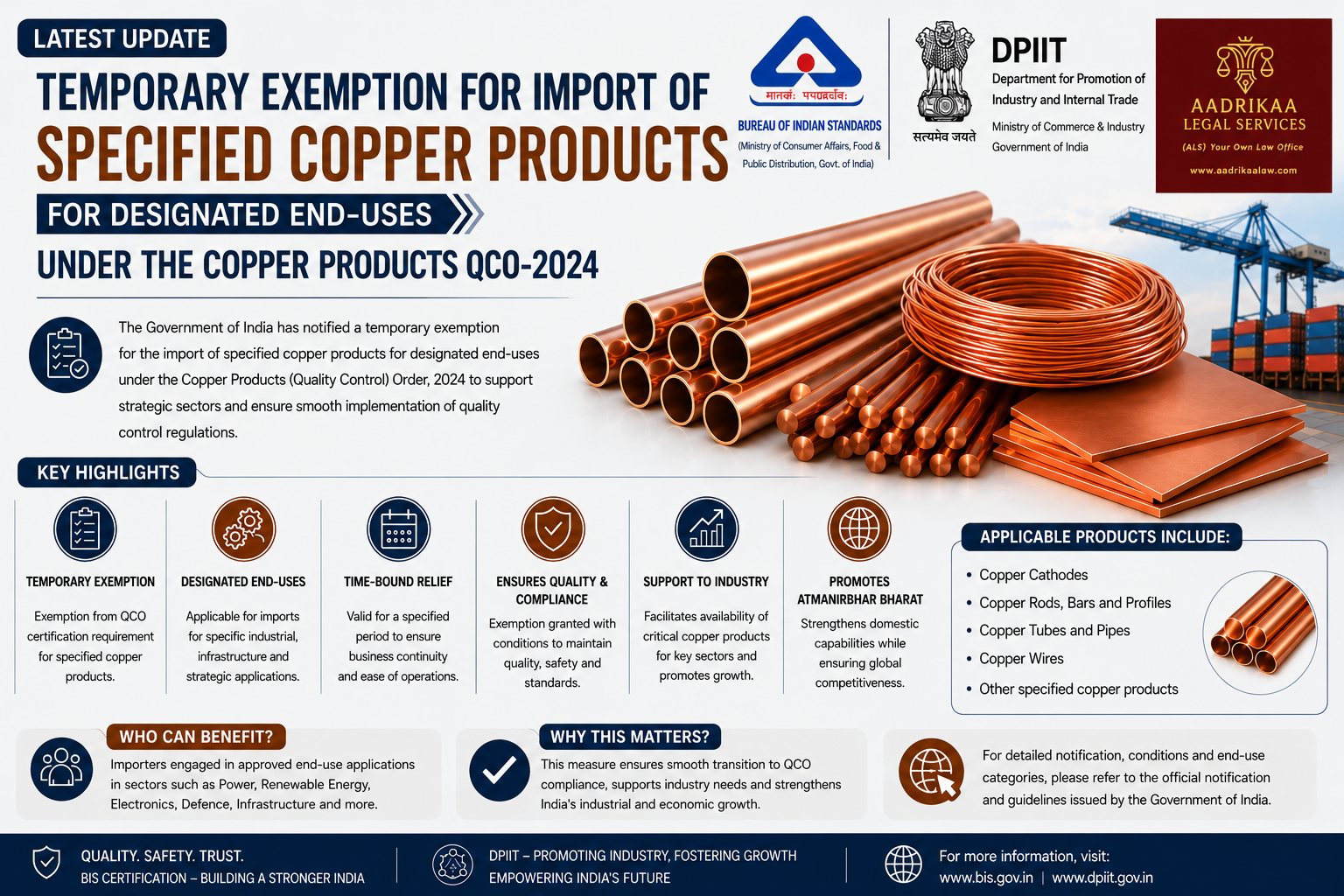
Temporary Exemption for Import of Specified Copper Products for Designated End-Uses under the Copper Products QCO-2024
This Short Article has been prepared & written by Advocate Ravi Shekhar Jha-Delhi High Court, New Delhi. The views expressed are based on his interpretation of the law. He can be reached at his email id intelconsul@gmail.com .
The Government of India has issued a significant order granting temporary exemptions for the import of specific copper products, addressing the needs of various industrial sectors. This move aims to bridge the gap between domestic supply and specialized requirements not currently met by Indian manufacturers or covered under the Copper Products (Quality Control) Order, 2024.
Background and Rationale
Industry stakeholders and associations highlighted challenges in sourcing certain high-purity and specialized copper products domestically, either due to lack of standards coverage or insufficient quality and quantity. Responding to these concerns, the Department for Promotion of Industry and Internal Trade (DPIIT), in consultation with the Bureau of Indian Standards (BIS), has provided a one-year exemption for select copper products, strictly for designated end-uses.
List of Exempted Copper Products and Their End-Uses
The exemption covers a range of copper products, each tied to a specific industrial application. Here’s a summary of the key products and their permitted uses:
- Oxygen Free Copper rods, bars, strips, and sheets (min. purity 99.995%, max. oxygen 5 PPM)
- End-use: Vacuum interrupters
- Silver bearing Oxygen Free Copper, Zirconium Copper, High Conductivity Phosphorous-Deoxidised Copper rods, bars, and strips
- End-use: Generator rotor coils, generators, electrical shunts
- Beryllium Alloy Copper Bar (End Wadge/Rotor Center Wedge-material grade)
- End-use: Generators
- Oxygen Free Copper strips (min. purity 99.995%, max. oxygen 5 PPM)
- End-use: Automotive bus bars for battery packs
- OFC Grade Copper Tape (0.18 mm x 81 mm and 0.095 mm x 85 mm)
- End-use: RF feeder cables
- Billet & Section of Copper Alloy Grades (CuCr 90:10, CuZr 50:50, CuSi 90:10, CuP 85:15, CuTe 50:50)
- End-use: Electrical contacts, short circuit rings, rotor bars for industrial and traction motors
- Copper Alloys C15000 (Zirconium Copper) and C18150 (Chromium Zirconium Copper) billets
- End-use: Short circuit rings and rotor bars for traction and industrial motors
- Copper Alloy Strips (TRKFC 4, C151, DK Alloy, DSC-3N 1/2H, DK-3)
- End-use: Bus bars for automobiles
- ETP Copper Plate in Coils (Grade C11000, Cu-ETP)
- End-use: Electrical applications
- Hard Drawn Grooved Copper Tin alloy (150 sqmm and above, GT-SN)
- End-use: Overhead electrical conductors
- Hard-Drawn Copper Wire (Dia 2.6mm, 99.9%+ purity)
- End-use: Wiring harnesses for the automobile industry
- Enameled Copper Wire/Magnet Wire (0.01 to 0.16 mm, various grades)
- End-use: Electrical wound components
- Copper Finned Tubes (externally and internally finned, various grades)
- End-use: Chillers
- High Strength Copper Alloy Tubes (multiple grades)
- End-use: Air-conditioning systems and electrical applications
Conditions for Availing the Exemption
To ensure traceability and promote future indigenization, importers must comply with the following conditions:
- Notification to BIS: Inform the Bureau of Indian Standards within 7 days of consignment clearance, using company letterhead and authorized signatory, via email.
- Quarterly Reporting: Maintain and submit quarterly records of imported goods to Central Government authorities, again on company letterhead and signed, via email.
- Indigenization Plan: Submit a plan for local manufacturing (indigenization) of the imported goods to the Central Government.
Scope and Limitations
- The exemption is valid for one year from the date of the order’s publication.
- It applies strictly to the products and end-uses listed, and only to actual users (not traders or resellers).
- The government reserves the right to review and amend the list of products and end-uses as needed.
Implications for Industry
This exemption provides immediate relief to sectors reliant on specialized copper products, such as electrical, automotive, and industrial equipment manufacturers. It also encourages importers to plan for future domestic production, aligning with the government’s broader Make in India initiative.
For further details or compliance queries, stakeholders should contact the relevant government departments as specified in the official order.
This proactive measure is expected to support critical industries while paving the way for enhanced domestic capabilities in the copper sector.
Related Article
Aadrikaa Legal Services is a trusted legal and regulatory support partner providing end-to-end legal solutions to law firms, corporate organizations, and businesses across India. We specialize in paralegal services, litigation support, tax and regulatory matters, delivering reliable, efficient, and result-oriented legal assistance.
Our services include comprehensive paralegal support, drafting and documentation, legal research, case management, litigation handling, and representation support across various judicial and quasi-judicial forums. We also assist in direct and indirect tax matters, customs, GST, corporate regulatory compliance, and legal advisory.
Source: BIS, DPIIT
Handy Download:
Write to us at office@aadrikaalaw.com
Tel: +91-11-4999 2707