Tag: #FTP

  • Confiscation of Burnt and Damaged Imported Cars Set Asideβ€”Burnt Vehicles Held to Be Scrap, Not Restricted Automobiles, Under Customs Act and Import Policy

    Confiscation of Burnt and Damaged Imported Cars Set Asideβ€”Burnt Vehicles Held to Be Scrap, Not Restricted Automobiles, Under Customs Act and Import Policy

    Date: 22.08.2026

    In a significant judgment, the Gujarat High Court resolved a long-standing dispute involving the import of approximately 3,900 Japanese-manufactured cars that were extensively damaged by fire while being transported on the vessel M.V. Mangolia ACE. The case, Commissioner of Customs (Preventive) vs. ITC Global Holdings Pvt Ltd, revolved around whether these burnt vehicles should be classified as restricted automobiles or as scrap, and whether their importation violated Indian customs law.

    The Incident and Legal Proceedings

    • Fire and Salvage: In November 1994, the vessel carrying the cars caught fire off the Sri Lankan coast. The owners abandoned the vessel and cargo to the salvors, who later sold the vessel and its cargo to ITC Global Holdings Pvt Ltd, with the contractual condition that both would be scrapped.
    • Arrival at Alang: The vessel was brought to Alang, Gujarat, a major ship-breaking yard. Customs authorities seized the vessel and cargo, alleging that the cars were imported without a valid license and landed at a non-notified port, violating customs regulations.
    • Confiscation Orders: The Adjudicating Authority ordered confiscation of the burnt cars and the vessel, imposing penalties on the parties involved. ITC Global Holdings appealed to the Customs, Excise & Service Tax Appellate Tribunal (CESTAT), which ruled in their favor, leading the Revenue to challenge the decision in the High Court.

    Key Legal Questions

    The High Court considered several substantial questions, including:

    1. Whether the burnt and damaged cars should be classified as restricted vehicles or as scrap under the Import & Export Policy 1992-97.
    2. Whether the confiscation of the cars and vessel under various sections of the Customs Act was justified.
    3. Whether the import required a license, and if landing at Alang constituted a violation of customs law.

    Court’s Analysis and Findings

    • Nature of the Cargo: The Court, affirming CESTAT’s findings, held that the cars had suffered such extensive fire damage that they lost their identity and utility as vehicles. Multiple agreements and survey reports confirmed that the cargo was only suitable for scrapping, not for use as vehicles or spare parts.
    • Import Policy Application: Since the burnt cars were considered scrap, they did not fall under the category of restricted commercial or passenger vehicles. Therefore, no import license was required for their entry as scrap.
    • No Unlawful Unloading: The Court found that the cars were not physically unloaded until after seizure by customs, and only during the ship-breaking process. Thus, there was no violation of the provisions regarding unloading at a non-notified port.
    • No Grounds for Confiscation: The Court concluded that the confiscation of both the cars and the vessel was not justified under Sections 111(d), 111(h), or 115 of the Customs Act, as the goods were not prohibited or improperly imported.

    Final Decision

    The Gujarat High Court ruled in favor of ITC Global Holdings Pvt Ltd, upholding the CESTAT’s decision. The confiscation orders and penalties were set aside, and the burnt cars were confirmed to be scrap, not subject to import restrictions or confiscation.

    Implications

    This judgment clarifies the legal treatment of extensively damaged goods under Indian customs law. It underscores the importance of factual assessment in determining the classification of imported goods and highlights that import restrictions do not apply to goods that have lost their original commercial identity due to damage.

    The case also reinforces procedural safeguards for importers and ship-breakers, ensuring that genuine salvage and scrapping operations are not unduly penalized under customs regulations.

    This decision is a significant precedent for future cases involving the import of damaged or salvaged goods into India.

    Aadrikaa Legal Services is a trusted legal and regulatory support partner providing end-to-end legal solutions to law firms, corporate organizations, and businesses across India. We specialize in paralegal services, litigation support, tax and regulatory matters, delivering reliable, efficient, and result-oriented legal assistance.

    Our services include comprehensive paralegal support, drafting and documentation, legal research, case management, litigation handling, and representation support across various judicial and quasi-judicial forums. We also assist in direct and indirect tax matters, customs, GST, corporate regulatory compliance, and legal advisory.

    Handy Download:

  • Exempted from SWS on Imports Where Basic Customs Duty is Discharged via MEIS/SEIS Scrips

    Exempted from SWS on Imports Where Basic Customs Duty is Discharged via MEIS/SEIS Scrips

    Date: 21.08.2026

    The Customs, Excise and Service Tax Appellate Tribunal (CESTAT) Hyderabad recently delivered a significant judgment in a series of appeals filed by Emami Agrotech Ltd against the Customs Department. The case revolved around the levy of Social Welfare Surcharge (SWS) on imports where the Basic Customs Duty (BCD) was exempted under specific government notifications and paid using duty-credit scrips under the MEIS/SEIS schemes.

    Background of the Case

    Emami Agrotech Ltd, a major player in the edible oil industry, imports crude edible oil for refining at its Krishnapatnam port facility. Between July and September 2019, the company imported 13 consignments and claimed exemption from BCD under Notification Nos. 24/2015-CUS and 25/2015-CUS. These notifications allow importers to discharge BCD liability by debiting MEIS/SEIS duty-credit scrips instead of paying in cash.

    However, while processing the imports, customs authorities also levied SWS at 10% of the BCD amount, even though the BCD itself was not paid in cash but debited from the scrips. Emami Agrotech challenged this, arguing that since BCD was exempted and not actually collected, SWS should not be applicable.

    Legal Arguments

    Appellant’s Stand (Emami Agrotech Ltd)

    1. No Actual Collection of BCD: The company argued that SWS, as per Section 110 of the Finance Act, 2018, is calculated as a percentage of customs duties actually levied and collected. Since BCD was exempted and not collected in cash, the base for SWS was nil.
    2. Support from Judicial Precedents: Emami cited several favorable judgments, including its own previous cases and Supreme Court rulings, emphasizing that ‘collection’ means actual realization of duty by the exchequer.
    3. CBIC Circular Support: The company relied on CBIC Circular No. 03/2022-CUS, which clarified that SWS is nil when the underlying customs duty is zero, even if SWS is not separately exempted.
    4. Retrospective Application of Beneficial Circulars: Emami argued that beneficial circulars should apply retrospectively, supporting their claim for refund or re-credit of SWS.

    Respondent’s Stand (Customs Department)

    1. Duty Discharged via Scrips: The department maintained that debiting BCD in MEIS/SEIS scrips is an alternative method of payment and constitutes actual discharge of duty, forming a valid base for SWS.
    2. Strict Interpretation of Exemptions: The department argued that since the exemption notifications did not specifically mention SWS, it should still be levied.
    3. Reliance on Other Judicial Decisions: The department cited cases where payment through scrips was treated as duty discharge and where exemptions were interpreted strictly in favor of the revenue.

    Tribunal’s Analysis and Decision

    The CESTAT Hyderabad bench examined the statutory provisions, relevant notifications, and judicial precedents. Key findings include:

    1. Nature of SWS: SWS is not an independent duty but a surcharge calculated as a percentage of customs duties actually levied and collected. If the base (BCD) is nil due to exemption, SWS is also nil.
    2. Debit in Scrips vs. Actual Collection: Debiting BCD in duty-credit scrips under an exemption scheme does not amount to actual collection by the government. The exemption notifications clearly grant full exemption from BCD, and the mechanism of debit is just a procedural aspect.
    3. CBIC Circular is Clarificatory: The tribunal accepted that the CBIC circular, being clarificatory and beneficial, applies to past transactions and supports the appellant’s case.
    4. Judicial Precedents: The tribunal followed its own previous decisions and those of higher courts, which consistently held that SWS is not payable when BCD is exempted under MEIS/SEIS schemes.
    5. Distinguishing Revenue’s Cited Cases: The tribunal found that the cases cited by the department were factually and legally distinguishable and did not apply to the present issue.

    Final Outcome

    The CESTAT set aside the order of the Commissioner (Appeals), allowed all 13 appeals filed by Emami Agrotech Ltd, and directed consequential relief, including refund or re-credit of SWS with applicable interest.

    Implications of the Ruling

    • For Importers: This judgment provides clarity and relief to importers using MEIS/SEIS scrips for BCD payment, confirming that SWS is not payable when BCD is exempted.
    • For Customs Administration: The ruling reinforces the need for strict adherence to the statutory base for SWS and the application of beneficial circulars retrospectively.
    • For Future Disputes: The decision sets a strong precedent for similar cases, ensuring uniformity in the treatment of SWS on exempted imports.

    Conclusion

    The CESTAT Hyderabad’s decision in favor of Emami Agrotech Ltd marks a significant development in customs law, particularly regarding the computation of SWS on imports exempted from BCD under MEIS/SEIS schemes. Importers can now confidently claim exemption from SWS in such scenarios, backed by clear legal and judicial support.

    Aadrikaa Legal Services is a trusted legal and regulatory support partner providing end-to-end legal solutions to law firms, corporate organizations, and businesses across India. We specialize in paralegal services, litigation support, tax and regulatory matters, delivering reliable, efficient, and result-oriented legal assistance.

    Our services include comprehensive paralegal support, drafting and documentation, legal research, case management, litigation handling, and representation support across various judicial and quasi-judicial forums. We also assist in direct and indirect tax matters, customs, GST, corporate regulatory compliance, and legal advisory.

    Handy Download:

  • Interest for Delayed Refund of Pre-Deposit in Customs

    Interest for Delayed Refund of Pre-Deposit in Customs

    Date: 20.08.2026

    A recent judgment by the Calcutta High Court in the case of Rajendra Kumar Jain vs. Commissioner of Customs (Port) Kolkata & Anr. has clarified the legal position regarding the rate of interest payable on delayed refunds of pre-deposits in customs matters. This article provides a detailed overview of the case, the legal arguments, and the implications for taxpayers and authorities.

    Background of the Case

    • Seizure and Pre-Deposit: On August 20, 1998, authorities seized Rs. 9,93,200 from Rajendra Kumar Jain, alleging it was the sale proceeds of goods liable for confiscation. The Customs, Excise and Service Tax Appellate Tribunal (CESTAT) later directed that this amount be treated as a pre-deposit under Section 129E of the Customs Act, 1962.
    • Appeal and Refund: After a successful appeal, the confiscation and penalty were set aside, making the pre-deposit refundable. However, the refund was delayed, prompting the appellant to seek judicial intervention.
    • Interest Dispute: The refund was eventually sanctioned with interest at 6% per annum. Dissatisfied, the appellant sought a higher rate, referencing Supreme Court and High Court precedents where 12% interest was awarded in similar circumstances.

    Legal Issues and Arguments

    Substantial Question of Law

    The core legal question was:

    “Whether the Learned Tribunal is justified in law in not allowing the interest at the rate of 12 per cent per annum on the refund amount of pre-deposit?”

    Appellant’s Arguments

    1. No Statutory Rate Pre-2008: At the time of the events, there was no statutory provision specifying the rate of interest for delayed refunds of pre-deposits.
    2. Supreme Court Precedent: In Commissioner of Central Excise, Hyderabad v. ITC Limited (2005), the Supreme Court awarded 12% interest on delayed refunds.
    3. High Court Consistency: The Calcutta High Court in Madura Coats Private Limited v. Commissioner of Central Excise, Kolkata – IV (2012) also granted 12% interest in a similar context.
    4. Amendment Not Retrospective: The amendment to Section 35FF of the Central Excise Act (effective May 10, 2008) and subsequent notifications fixing interest at 6% per annum do not apply retrospectively.

    Respondents’ Arguments

    • The respondents contended that the seized amount was not originally a pre-deposit and that the applicable rate should be 6% as per later notifications.
    • They acknowledged the absence of a statutory rate during the relevant period but argued for the lower rate based on subsequent government notifications.

    Court’s Analysis and Findings

    • Undisputed Facts: The Court noted that the amount was treated as a pre-deposit by CESTAT and that there was no statutory rate of interest for delayed refunds at the relevant time.
    • Precedent Application: The Court relied on the Supreme Court’s decision in ITC Limited and its own earlier decision in Madura Coats, both of which awarded 12% interest in the absence of a statutory rate.
    • Notification Not Retrospective: The notification fixing 6% interest (dated August 12, 2014) was held not to apply to periods before its issuance.

    Final Judgment

    The Calcutta High Court set aside the lower tribunal’s order and held that:

    • The appellant is entitled to interest at 12% per annum on the delayed refund of the pre-deposit.
    • The interest must be paid within one month from the date of production of the certified copy of the order.

    Implications of the Judgment

    1. Clarity for Taxpayers: Taxpayers whose refunds of pre-deposits were delayed before the statutory rate was notified can claim interest at 12% per annum, based on judicial precedent.
    2. Guidance for Authorities: Customs authorities must follow judicial directions and precedents in similar cases, especially for periods before statutory rates were notified.
    3. Legal Certainty: The judgment reinforces the principle that, in the absence of a statutory provision, courts may rely on precedent to ensure fairness and parity.

    Conclusion

    This ruling by the Calcutta High Court is a significant development in customs jurisprudence, ensuring that taxpayers are fairly compensated for delayed refunds of pre-deposits. It underscores the importance of judicial precedent in filling legislative gaps and provides clear guidance for both taxpayers and authorities in similar disputes.

    Aadrikaa Legal Services is a trusted legal and regulatory support partner providing end-to-end legal solutions to law firms, corporate organizations, and businesses across India. We specialize in paralegal services, litigation support, tax and regulatory matters, delivering reliable, efficient, and result-oriented legal assistance.

    Our services include comprehensive paralegal support, drafting and documentation, legal research, case management, litigation handling, and representation support across various judicial and quasi-judicial forums. We also assist in direct and indirect tax matters, customs, GST, corporate regulatory compliance, and legal advisory.

    Handy Download:

  • CESTAT Mumbai Overturns Customs Penalty: Brass Scrap Classification and Valuation

    CESTAT Mumbai Overturns Customs Penalty: Brass Scrap Classification and Valuation

    Date: 20.08.2026

    The Customs, Excise & Service Tax Appellate Tribunal (CESTAT) Mumbai recently delivered a significant order in the case of A.P. Trading Company versus the Commissioner of Customs (Import), Nhava Sheva. This case revolved around the classification, valuation, and confiscation of imported brass scrap, raising important questions about customs procedures, the interpretation of tariff entries, and the evidentiary standards for mis-declaration.

    Background of the Case

    A.P. Trading Company, based in Bhiwandi, Maharashtra, is engaged in the import and sale of brass scrap. In May 2013, the company imported a consignment described as ‘Brass Scrap Pallu as per ISRI’ from a UAE supplier. The goods were declared under Customs Tariff Item (CTI) 7404 0022, with a declared value of Rs. 62,27,262. However, upon examination, customs officers found that only 25% of the consignment was brass scrap, while 75% consisted of secondary defective brass pipes, which they considered serviceable and not scrap.

    Customs Department’s Actions

    The customs authorities alleged mis-declaration, rejected the transaction value, and re-determined the value based on contemporary prices and London Metal Exchange (LME) rates. They imposed a differential duty of Rs. 5,25,460, confiscated the goods (allowing release on payment of a Rs. 1,50,000 redemption fine), and levied a penalty of Rs. 75,000 on the importer. The company appealed, but the Commissioner (Appeals) upheld the original order, prompting a further appeal to the CESTAT.

    Key Legal Issues

    The Tribunal identified two main issues:

    1. Whether the re-determination/enhancement of the assessable value and duty demand was sustainable.
    2. Whether the imposition of redemption fine and penalty was legally justified.

    Arguments by the Appellant

    • The importer argued that the entire consignment was ordered as per ISRI specifications for brass scrap, and the contract, invoice, and packing list supported this.
    • A Chartered Engineer’s report stated the goods were rejected/discarded heat exchanger/boiler tubes, not serviceable, and thus qualified as scrap.
    • The customs officers’ contrary assessment was based on visual inspection, not expert analysis.
    • The department failed to provide evidence of contemporaneous prices or identical goods to justify value enhancement under Rule 5 of the Customs Valuation Rules, 2007.

    Tribunal’s Analysis and Findings

    1. Classification and Valuation

    • The Tribunal noted that ISRI specifications and customs tariff entries cover a wide range of brass scrap types, including ‘pallu’, ‘ebony’, and ‘melon’.
    • The contract and documentation clearly indicated the goods were ordered as brass scrap.
    • There was a contradiction between the customs officers’ assessment and the Chartered Engineer’s expert report regarding the serviceability and nature of the goods.
    • The customs tariff and ISRI guidelines do not prescribe strict size or length limits for brass scrap unless mutually agreed by buyer and seller.

    2. Mis-declaration and Penalty

    • The Tribunal found no concrete evidence of mis-declaration. The department relied solely on visual inspection, without expert corroboration or documentary proof of serviceability.
    • Precedents (e.g., Prateek Traders v. Commissioner of Customs, Ahmedabad) establish that visual inspection alone is insufficient to classify goods as serviceable when expert opinion suggests otherwise.
    • The request for mutilation by the importer, if accepted, would have further supported the claim that the goods were indeed scrap.

    3. Procedural Lapses

    • The authorities did not adequately discuss the grounds for reclassification or provide details of contemporaneous values for identical goods.
    • There was no evidence of additional consideration or flow-back to justify value enhancement.

    Final Order and Implications

    The CESTAT set aside the impugned order, ruling in favor of A.P. Trading Company. The Tribunal held that the duty demand, fine, and penalty were unsustainable due to lack of evidence and improper procedure. This decision underscores the importance of:

    • Relying on expert reports over mere visual inspection for classification disputes.
    • Providing concrete evidence when alleging mis-declaration or enhancing value.
    • Adhering to procedural fairness and transparency in customs adjudication.

    Conclusion

    The A.P. Trading Company case serves as a crucial precedent for importers and customs authorities alike. It highlights the need for objective, evidence-based assessments and reinforces the legal protections available to importers against arbitrary or unsupported customs actions. Importers should ensure thorough documentation and, when necessary, seek expert opinions to support their case in classification and valuation disputes.

    Aadrikaa Legal Services is a trusted legal and regulatory support partner providing end-to-end legal solutions to law firms, corporate organizations, and businesses across India. We specialize in paralegal services, litigation support, tax and regulatory matters, delivering reliable, efficient, and result-oriented legal assistance.

    Our services include comprehensive paralegal support, drafting and documentation, legal research, case management, litigation handling, and representation support across various judicial and quasi-judicial forums. We also assist in direct and indirect tax matters, customs, GST, corporate regulatory compliance, and legal advisory.

    Handy Download:

  • Constitutional Limits on Bail Conditions for Foreign Nationals under the NDPS Act

    Constitutional Limits on Bail Conditions for Foreign Nationals under the NDPS Act

    Date: 19.08.2026

    The Supreme Court of India delivered a significant order in the case of Frank Vitus v. Narcotics Control Bureau, addressing the legality and practicality of certain bail conditions imposed on foreign nationals under the Narcotic Drugs and Psychotropic Substances Act, 1985 (NDPS Act). The judgment not only impacts the appellant, a Nigerian national, but also sets important precedents for bail jurisprudence in India, especially concerning the rights of accused foreign nationals.

    Background of the Case

    Frank Vitus, a Nigerian national, was arrested in May 2014 and prosecuted under Sections 8, 22, 23, and 29 of the NDPS Act. After several years in custody, he was granted bail in May 2022, subject to stringent conditions, including:

    1. Furnishing a certificate of assurance from the Nigerian Embassy/High Commission that he would not leave India and would appear before the trial court as required.
    2. Dropping a PIN on Google Maps to make his location available to the investigating officer.

    Vitus challenged these conditions, arguing that they were either impossible to comply with or infringed upon his fundamental rights.

    Legal Issues Considered

    The Supreme Court examined two primary issues:

    1. Whether the requirement for a certificate of assurance from the Embassy/High Commission is feasible or necessary in every case involving a foreign national.
    2. Whether the condition to drop a PIN on Google Maps violates the right to privacy under Article 21 of the Constitution.

    Analysis by the Court

    1. Certificate of Assurance from Embassy/High Commission

    • The Court noted that the precedent for this condition came from the 1994 Supreme Court Legal Aid Committee case, which was intended as a one-time direction for undertrials facing prolonged detention due to delayed trials.
    • The Court clarified that such a certificate should not be a mandatory condition in every case involving a foreign national. If the Embassy/High Commission refuses or fails to issue the certificate within a reasonable time, the court must have the power to dispense with this requirement.
    • The Court emphasized that an accused cannot be denied bail for failing to comply with a condition that is impossible to fulfill, especially when the grant of such a certificate is beyond the accused’s control.

    2. Dropping a PIN on Google Maps

    • The Court examined technical details provided by Google LLC, which clarified that dropping a PIN does not enable real-time tracking and is under the user’s control.
    • However, the Court held that any bail condition enabling the police to track every movement of an accused via technology would violate the right to privacy under Article 21.
    • The Court found the Google Maps PIN condition redundant and unnecessary, as it neither serves the purpose of bail conditions nor respects the privacy of the accused.

    3. Principles for Imposing Bail Conditions

    • The Court reiterated that bail conditions must not be arbitrary, fanciful, or so onerous as to frustrate the grant of bail itself.
    • The object of bail conditions is to ensure the accused does not interfere with the investigation, remains available for trial, and does not tamper with evidence.
    • The accused’s constitutional rights, including the presumption of innocence and the right to privacy, must be curtailed only to the minimum extent necessary.

    Final Decision

    The Supreme Court ordered the deletion of the following bail conditions imposed on Frank Vitus:

    • The requirement to obtain a certificate of assurance from the Nigerian Embassy/High Commission.
    • The requirement to drop a PIN on Google Maps to share his location.

    The Court directed that the case be listed on July 15, 2024, for further orders regarding compliance with other bail conditions. The appellant remains on bail, and the judgment sets a clear precedent that bail conditions must be reasonable, practical, and respectful of fundamental rights.

    Implications of the Judgment

    • For Foreign Nationals: Courts must consider the practicality of bail conditions and cannot impose requirements that are impossible for the accused to fulfill, such as obtaining certificates from foreign embassies.
    • For All Accused: Bail conditions must not infringe upon fundamental rights, especially the right to privacy. Technological monitoring as a bail condition is generally impermissible.
    • For the Legal System: The judgment reinforces the principle that bail conditions should serve the interests of justice without being arbitrary or excessively restrictive.

    Conclusion

    The Supreme Court’s order in Frank Vitus v. Narcotics Control Bureau is a landmark in protecting the rights of accused persons, particularly foreign nationals, and ensuring that bail conditions remain just, reasonable, and constitutionally compliant. This decision will guide lower courts in framing bail conditions that are both effective and respectful of individual liberties.

    Aadrikaa Legal Services is a trusted legal and regulatory support partner providing end-to-end legal solutions to law firms, corporate organizations, and businesses across India. We specialize in paralegal services, litigation support, tax and regulatory matters, delivering reliable, efficient, and result-oriented legal assistance.

    Our services include comprehensive paralegal support, drafting and documentation, legal research, case management, litigation handling, and representation support across various judicial and quasi-judicial forums. We also assist in direct and indirect tax matters, customs, GST, corporate regulatory compliance, and legal advisory.

    Handy Download:

  • CESTAT Kolkata Orders 12% Interest on Delayed Customs Refund

    CESTAT Kolkata Orders 12% Interest on Delayed Customs Refund

    Date: 19.08.2026

    The Customs, Excise & Service Tax Appellate Tribunal (CESTAT), Kolkata, recently delivered a significant judgment in the case involving M/s Atcorp Global Pvt. Ltd. and the Commissioner of Customs (Port), Kolkata. The dispute centered on the rate and period of interest payable on a substantial customs duty refund, highlighting key legal principles and procedural delays in customs administration.

    Background of the Case

    • Parties Involved:
      • Appellant: M/s Atcorp Global Pvt. Ltd.
      • Respondent: Commissioner of Customs (Port), Kolkata
    • Nature of Dispute:
      • Atcorp Global imported Yellow/Green peas between December 2017 and February 2018, initially paying 50% Basic Customs Duty (BCD).
      • Later, they discovered eligibility for NIL BCD under Notification No. 93/2017-Cus dated 21.12.2017 and sought re-assessment and refund of excess duty paid.
      • The refund process was marred by significant delays and multiple rounds of litigation.

    Chronology of Events

    1. Import and Duty Payment:
      • Goods imported under five Bills of Entry (Dec 2017–Feb 2018).
      • Excess duty paid due to initial misclassification.
    2. Re-assessment Request:
      • Application for re-assessment filed on 18.09.2018 under Section 149 of the Customs Act, 1962.
      • No timely response from Customs authorities.
    3. Refund Claim:
      • Refund application filed on 19.11.2018.
      • Initial rejection due to pending re-assessment.
    4. Litigation and Delays:
      • Multiple appeals and reminders from 2019 to 2025.
      • Final re-assessment order passed only on 17.09.2025.
      • Refund of Rs. 2,89,56,399 sanctioned on 01.12.2025, credited on 20.01.2026.
    5. Interest Dispute:
      • Commissioner (Appeals) granted interest at 6% from 20.02.2019.
      • Atcorp Global appealed for 12% interest, citing consistent High Court and Tribunal precedents.
      • Revenue appealed, arguing interest should accrue only from the date of re-assessment.

    Legal Issues and Arguments

    1. Date from Which Interest is Payable

    • Importer’s Stand: Interest should accrue from three months after the initial refund application (i.e., from 20.02.2019), as per Supreme Court rulings (Ranbaxy Laboratories Ltd. vs. Union of India).
    • Revenue’s Stand: Interest should start only after re-assessment (17.09.2025).

    2. Applicable Rate of Interest

    • Importer’s Stand: Sought 12% interest, referencing multiple High Court and Tribunal decisions (e.g., Riba Textiles Ltd., Green Valley Industries Pvt. Ltd., Parle Agro Pvt. Ltd.).
    • Revenue’s Stand: Argued for 6% interest, citing statutory provisions and notifications.

    Tribunal’s Analysis and Findings

    • Delay Attributed to Revenue: The Tribunal noted that the delay in re-assessment and refund was due to inaction by Customs authorities, not the importer.
    • Interest Period: Following Supreme Court precedents, the Tribunal held that interest is payable from three months after the refund application date (20.02.2019), not from the date of re-assessment.
    • Interest Rate: The Tribunal relied on recent High Court and Tribunal rulings, especially the Calcutta High Court’s decision in Rajendra Kumar Jain vs. Commissioner of Customs (Port), Kolkata, which established 12% as the appropriate rate in the absence of a statutory provision for pre-deposit refunds.

    Key Judgments Cited

    • Ranbaxy Laboratories Ltd. vs. Union of India (2012): Interest on delayed refunds accrues from three months after the refund application.
    • Sandvik Asia Ltd. vs. CIT, Pune: Compensation for inordinate delay in refund, supporting higher interest rates.
    • Recent High Court/Tribunal Decisions: Consistently awarded 12% interest in similar cases (Riba Textiles Ltd., Green Valley Industries Pvt. Ltd., Parle Agro Pvt. Ltd., Berger Paints India Ltd.).

    Final Order and Impact

    • Revenue’s Appeal Dismissed: Tribunal upheld that interest is payable from 20.02.2019.
    • Importer’s Appeal Allowed: Tribunal enhanced the interest rate from 6% to 12% for the period from 20.02.2019 until the date of refund.
    • Direction: Revenue to pay the balance 6% interest within eight weeks of the order.

    Significance of the Ruling

    1. Clarifies Interest Computation: Reinforces that interest on delayed customs refunds accrues from three months after the refund application, not from the date of re-assessment.
    2. Sets Precedent for Higher Interest: Affirms 12% as the appropriate rate in cases of administrative delay, especially where no statutory rate is prescribed.
    3. Accountability for Delays: Highlights the need for timely action by customs authorities and provides compensation for importers facing undue delays.

    Conclusion

    The CESTAT Kolkata’s decision in the Atcorp Global case is a landmark for importers seeking timely refunds and fair compensation for administrative delays. It underscores the judiciary’s commitment to upholding statutory rights and ensuring accountability in customs administration.

    Aadrikaa Legal Services is a trusted legal and regulatory support partner providing end-to-end legal solutions to law firms, corporate organizations, and businesses across India. We specialize in paralegal services, litigation support, tax and regulatory matters, delivering reliable, efficient, and result-oriented legal assistance.

    Our services include comprehensive paralegal support, drafting and documentation, legal research, case management, litigation handling, and representation support across various judicial and quasi-judicial forums. We also assist in direct and indirect tax matters, customs, GST, corporate regulatory compliance, and legal advisory.

    Handy Download:

  • Supreme Court on Import Licensing, Ownership of Imported Goods, and Customs Confiscation under Indian Customs Law

    Supreme Court on Import Licensing, Ownership of Imported Goods, and Customs Confiscation under Indian Customs Law

    Date: 19.08.2026

    This article provides a comprehensive overview of the Supreme Court of India’s decision in the case of Union of India vs. Sampat Raj Dugar and Another (1992), a pivotal judgment interpreting the interplay between import licensing, property rights in imported goods, and the powers of customs authorities under Indian law.

    Background of the Case

    • Parties Involved:
      • Petitioner: Union of India (Customs Authorities)
      • Respondents: Sampat Raj Dugar (exporter, based abroad) and Ms. Renu Pahilaj (importer, based in India)
    • Subject Matter: Import of raw silk under an advance import licence, subsequent non-fulfillment of licence conditions, and the question of ownership and confiscation of goods.

    Key Facts

    1. Advance Import Licence: Ms. Renu Pahilaj obtained a licence to import raw silk, with the condition that the imported silk would be used to manufacture garments for export.
    2. Non-Compliance: She received three consignments but failed to fulfill the export condition.
    3. New Consignments: Sampat Raj Dugar, an exporter from Hong Kong, sent four more consignments to Ms. Pahilaj. The documents of title were to be released only upon payment.
    4. Abandonment: Due to ongoing proceedings and alleged misrepresentation, Ms. Pahilaj did not pay or collect the documents, effectively abandoning the goods.
    5. Customs Action: The customs authorities confiscated the goods and imposed penalties, arguing that the importer was deemed the owner and responsible for violations.
    6. Exporter’s Claim: Mr. Dugar claimed ownership of the goods (since payment was not made and documents not collected) and sought permission to re-export them.

    Legal Issues Examined

    1. Ownership of Imported Goods

    • Clause 5(3)(ii) of Imports (Control) Order, 1955: Deems the licensee as the owner of goods from import until customs clearance.
    • Supreme Court’s Interpretation:
      • This legal fiction is created to hold the licensee responsible for compliance with import regulations.
      • However, if the importer abandons the goods (by not paying or collecting documents), the fiction does not override actual ownership rights. The exporter retains title if the importer never takes possession or pays.

    2. Confiscation and Validity of Import

    • Customs Act, 1962 – Section 111(d) & (o):
      • Goods can be confiscated if imported contrary to law or if conditions of exemption are violated.
      • The Court held that since the goods were imported under a valid licence (which was cancelled only after import), the import was not illegal at the time.
      • Non-compliance with licence conditions may justify cancellation of the licence or penalties, but does not retroactively make the import illegal or justify confiscation.

    3. Right to Re-Export

    • The exporter, who retained ownership, was entitled to re-export the goods, provided the import was not contrary to law and subject to payment of applicable dues.

    Court’s Ruling and Reasoning

    • Ownership: The Supreme Court clarified that the deeming provision in the Imports (Control) Order is limited to regulatory compliance and does not transfer actual ownership if the importer abandons the goods.
    • Confiscation: Confiscation under the Customs Act requires that the import be contrary to law at the time of import. Subsequent cancellation of the licence does not retrospectively taint the import.
    • Exporter’s Rights: The exporter, not being party to any fraud or misuse, retains the right to reclaim or re-export the goods if the importer fails to take delivery.
    • Policy Implications: The judgment protects exporters from losing goods and payment due to the importer’s default, supporting fair international trade practices.

    Key Takeaways for Importers, Exporters, and Legal Practitioners

    1. Import Licensing Conditions: Importers must strictly comply with licence conditions to avoid penalties or cancellation.
    2. Ownership and Title: Actual transfer of title depends on payment and receipt of documents, not just regulatory definitions.
    3. Customs Powers: Confiscation is not automatic upon licence cancellation; the legality of import is judged at the time of entry.
    4. Exporter Protections: Exporters can reclaim or re-export goods if the importer defaults, provided the import was lawful.
    5. Legal Fiction vs. Reality: Regulatory fictions serve administrative purposes but do not override substantive property rights in all circumstances.

    Conclusion

    The Supreme Court’s decision in Union of India vs. Sampat Raj Dugar sets a significant precedent on the limits of regulatory fictions in import law, the protection of exporters’ rights, and the proper scope of customs authorities’ powers. It underscores the importance of distinguishing between regulatory compliance and actual ownership, ensuring fairness in international trade transactions.

    Aadrikaa Legal Services is a trusted legal and regulatory support partner providing end-to-end legal solutions to law firms, corporate organizations, and businesses across India. We specialize in paralegal services, litigation support, tax and regulatory matters, delivering reliable, efficient, and result-oriented legal assistance.

    Our services include comprehensive paralegal support, drafting and documentation, legal research, case management, litigation handling, and representation support across various judicial and quasi-judicial forums. We also assist in direct and indirect tax matters, customs, GST, corporate regulatory compliance, and legal advisory.

    Handy Download:

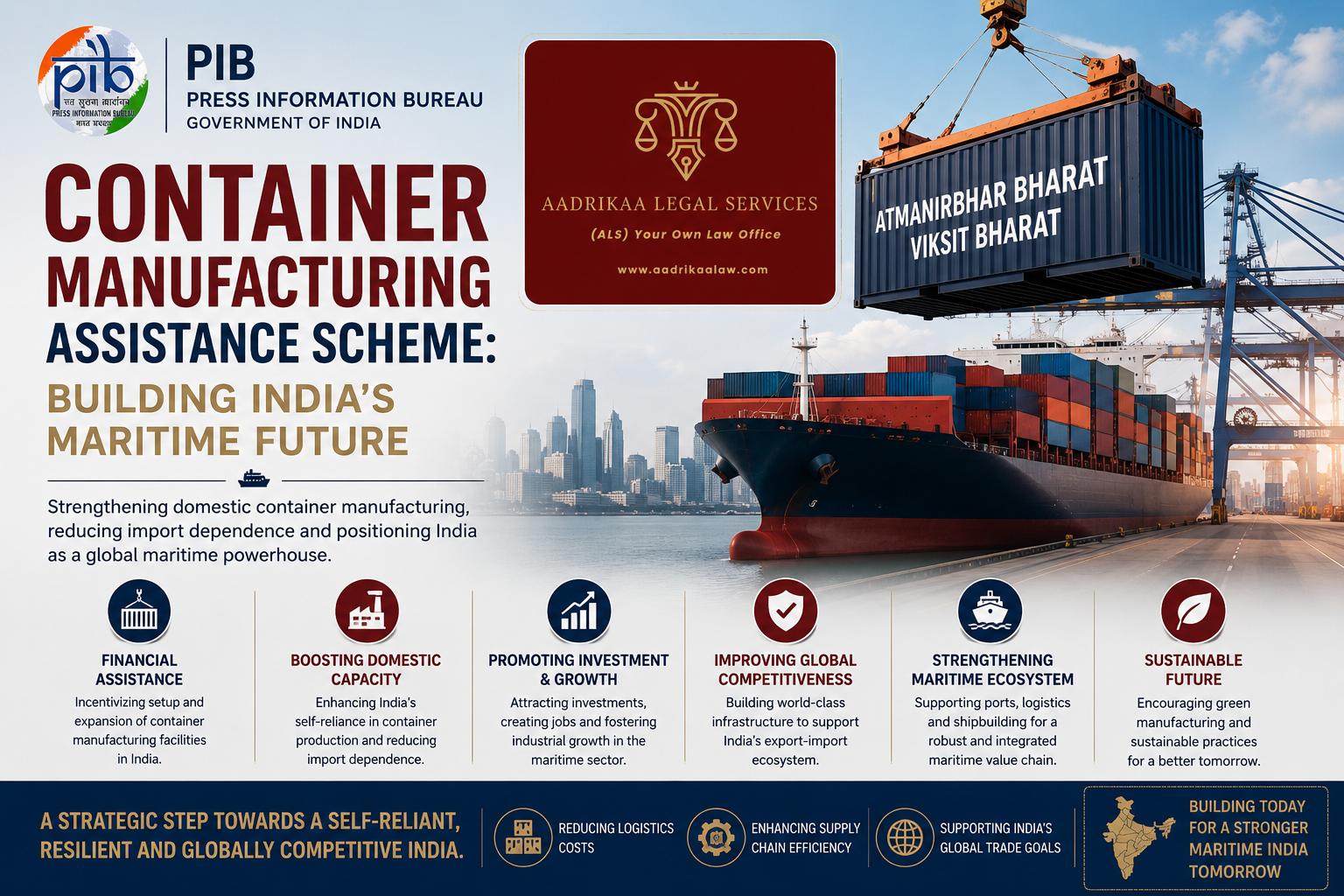
  • Container Manufacturing Assistance Scheme: Building India’s Maritime Future

    Container Manufacturing Assistance Scheme: Building India’s Maritime Future

    Date: 18.08.2026

    India is accelerating its maritime ambitions with the Container Manufacturing Assistance Scheme (CMAS), a transformative initiative designed to establish a robust domestic container manufacturing ecosystem. This article provides a comprehensive overview of CMAS, its strategic importance, recent milestones, and the broader reforms shaping India’s maritime sector, with direct links to official sources and references.

    The Need for Domestic Container Manufacturing

    Maritime transport is the backbone of global trade, with about 80% of merchandise trade by volume carried by sea (UNCTAD Review of Maritime Transport). Containerized cargo accounts for nearly two-thirds of the value of international trade, making efficient container logistics critical for supply chains. Recent disruptions and geopolitical tensions have exposed vulnerabilities in global shipping, prompting countries like India to focus on domestic manufacturing of critical logistics assets such as shipping containers.

    India currently imports nearly 2 million empty containers annually, making it susceptible to global market fluctuations and supply-chain disruptions. The CMAS aims to reduce this dependence, strengthen supply-chain resilience, and support India’s long-term trade ambitions. The scheme complements initiatives like Make in India, Maritime Amrit Kaal Vision 2047, and multimodal logistics development.

    What is the Container Manufacturing Assistance Scheme (CMAS)?

    Announced in the Union Budget 2026–27, CMAS is a targeted initiative with a β‚Ή10,000 crore outlay over five years. Its objectives include:

    • Establishing new Greenfield manufacturing facilities
    • Expanding existing Brownfield units
    • Providing operational support to enhance competitiveness
    • Supporting testing infrastructure, skilling, and capacity building

    The scheme targets an annual domestic manufacturing capacity of up to 7.5 lakh Twenty-foot Equivalent Units (TEUs)β€”about ten times the current capacity. This is expected to create a market opportunity of nearly β‚Ή80,000 lakh crore and position India as a reliable global supplier of shipping containers.

    For more details, see the Ministry of Ports, Shipping and Waterways official document.

    Building an Integrated Maritime Ecosystem

    CMAS is part of a broader strategy to create an integrated, domestically anchored container ecosystem. In February 2026, the Ministry of Ports, Shipping and Waterways signed an MoU to establish the Bharat Container Shipping Line (BCSL), bringing together major public sector stakeholders. The initiative includes investments of around β‚Ή99,149 crore in fleet development and domestic container procurement.

    This approach complements other government initiatives:

    • PM Gati Shakti: Enhancing connectivity between ports, railways, highways, and industrial centers
    • National Logistics Policy: Supporting operational efficiency
    • Sagarmala Programme: Promoting port-led development

    These efforts collectively support a resilient logistics network for India’s growing trade volumes.

    Employment and Industrial Growth

    CMAS is expected to generate around 3,000 direct jobs and over 50,000 indirect jobs in container manufacturing and allied industries. The scheme will also stimulate growth in ancillary sectors such as corner castings, wooden frames, and Corten steel production.

    Recent Progress and Industry Response

    A major milestone was achieved in July 2026 with the rollout of India’s first domestically manufactured EXIM shipping container for A.P. Moller–Maersk. Manufactured to international ISO and CSC standards, this container is suitable for global deployment. Maersk’s subsequent order for 1,000 additional Made-in-India containers with DCM Shriram Group signals growing confidence in India’s manufacturing capabilities. For more, see the DG Shipping address.

    Part of Wider Maritime Transformation

    CMAS is complemented by a series of legislative, institutional, and infrastructure reforms:

    • Merchant Shipping Act, 2025; Coastal Shipping Act, 2025; Indian Ports Act, 2025: Modernizing the legal framework for shipping and port governance
    • Digital Initiatives: One Nation One Port Process (ONOP), Maritime Single Window, and e-Samudra to streamline regulatory procedures (PIB Press Release)
    • Shipbuilding Financial Assistance Package: A β‚Ή70,000 crore package to boost domestic shipbuilding
    • Major Infrastructure Projects: Vadhavan Port, International Container Transshipment Port at Galathea Bay, Tuna Tekra Container Terminal, and Outer Harbour Container Terminal at V.O. Chidambaranar Port

    Way Forward

    The Container Manufacturing Assistance Scheme is a pivotal step in building a globally competitive maritime manufacturing ecosystem. By fostering domestic container production, reducing import dependence, and supporting broader maritime reforms, CMAS is set to enhance India’s supply-chain resilience, generate employment, and position the country as a leading maritime and logistics hub.

    References:

    Aadrikaa Legal Services is a trusted legal and regulatory support partner providing end-to-end legal solutions to law firms, corporate organizations, and businesses across India. We specialize in paralegal services, litigation support, tax and regulatory matters, delivering reliable, efficient, and result-oriented legal assistance.

    Our services include comprehensive paralegal support, drafting and documentation, legal research, case management, litigation handling, and representation support across various judicial and quasi-judicial forums. We also assist in direct and indirect tax matters, customs, GST, corporate regulatory compliance, and legal advisory.

    Handy Download:

  • Authenticity of Country of Origin Certificates, Preferential Duty Exemption, and Customs Valuation Dispute

    Authenticity of Country of Origin Certificates, Preferential Duty Exemption, and Customs Valuation Dispute

    Date: 18.08.2026

    The Customs, Excise & Service Tax Appellate Tribunal (CESTAT) Allahabad recently delivered a significant judgment in the case of M/s SSN Steel Impex, a New Delhi-based importer and trader of stainless steel products. The case revolved around the denial of preferential customs duty benefits, allegations of unauthentic Country of Origin (COO) certificates, undervaluation of goods, and imposition of penalties. This article provides a detailed analysis of the case, the Tribunal’s findings, and its broader implications for importers and customs administration in India.

    Background of the Case

    M/s SSN Steel Impex imported stainless steel cold rolled sheets, coils, and circles, primarily from Malaysia, to avail preferential duty benefits under Notification No. 46/2011-Cus (ASEAN-India Free Trade Agreement). The customs authorities alleged that many COO certificates submitted by the appellant were unauthentic, leading to the denial of duty exemption and the imposition of differential duty, interest, and penalties. The appellant challenged these actions, arguing that due process was not followed and that most COOs were genuine.

    Key Issues Examined

    1. Authenticity of COO Certificates
      • Customs authorities, based on communications from Malaysia’s MITI, claimed that 87 out of 143 COOs were unauthentic.
      • SSN Steel Impex submitted 38 COOs; only one was found unauthentic, for which the company had already paid the differential duty.
      • The Tribunal found that the remaining 37 COOs were not listed as unauthentic and thus should be accepted.
    2. Eligibility for Preferential Duty
      • The Tribunal held that since the majority of COOs were authentic and verified at the time of import, the appellant was eligible for duty exemption under Notification No. 46/2011-Cus.
      • The Tribunal emphasized that subsequent communications from MITI could not retroactively invalidate COOs that were valid and verified at the time of import.
    3. Allegations of Undervaluation
      • Customs authorities alleged undervaluation based on statements from third parties and price comparisons.
      • The Tribunal found no evidence that SSN Steel Impex paid amounts over and above the declared invoice prices or that the declared values were not at arm’s length.
      • The Tribunal relied on Supreme Court precedents, holding that transaction values could not be rejected without concrete evidence.
    4. Imposition of Penalties
      • Penalties were imposed for alleged mis-declaration and undervaluation.
      • The Tribunal found no evidence of intent to evade duty or collusion and set aside all penalties.

    Tribunal’s Final Order

    The CESTAT Allahabad ruled in favor of SSN Steel Impex, with the following key directives:

    • All 37 COOs (except the one already settled) were deemed authentic and acceptable.
    • The appellant was entitled to the benefit of duty exemption for all consignments covered by these COOs.
    • The declared transaction values were accepted; the enhanced values determined by customs were set aside.
    • All penalties imposed on the appellant were quashed.

    Legal Precedents and Principles Affirmed

    • Due Process: The Tribunal reiterated the importance of natural justice, including the right to cross-examination and proper consideration of evidence.
    • Finality of Assessment: Once goods are assessed and cleared based on valid documents, subsequent doubts cannot retroactively deny benefits unless clear evidence emerges.
    • Burden of Proof: The onus is on customs authorities to provide concrete evidence for allegations of mis-declaration or undervaluation.

    Implications for Importers and Customs Administration

    1. Reliance on Valid COOs: Importers can rely on COOs issued and verified by competent authorities at the time of import, unless there is clear evidence of fraud or forgery.
    2. Protection Against Retroactive Actions: Subsequent communications or doubts from foreign authorities cannot, by themselves, invalidate benefits already granted unless accompanied by formal revocation or evidence.
    3. Importance of Documentation: Importers should maintain comprehensive records of all import documents, including COOs, invoices, and customs clearances.
    4. Customs’ Investigative Standards: Customs authorities must adhere to due process and provide substantive evidence before denying benefits or imposing penalties.

    Conclusion

    The CESTAT Allahabad’s decision in the SSN Steel Impex case sets a strong precedent for the protection of importers’ rights and the importance of procedural fairness in customs adjudication. It underscores the need for robust evidence and adherence to natural justice before denying statutory benefits or imposing penalties. This ruling will likely influence future disputes involving preferential duty claims and the authenticity of COO certificates in India.

    Aadrikaa Legal Services is a trusted legal and regulatory support partner providing end-to-end legal solutions to law firms, corporate organizations, and businesses across India. We specialize in paralegal services, litigation support, tax and regulatory matters, delivering reliable, efficient, and result-oriented legal assistance.

    Our services include comprehensive paralegal support, drafting and documentation, legal research, case management, litigation handling, and representation support across various judicial and quasi-judicial forums. We also assist in direct and indirect tax matters, customs, GST, corporate regulatory compliance, and legal advisory.

    Handy Download:

  • Supreme Court Clarifies Extended Limitation in Excise Valuation for Motor Vehicle Body Building

    Supreme Court Clarifies Extended Limitation in Excise Valuation for Motor Vehicle Body Building

    Date: 18.08.2026

    The Supreme Court of India recently delivered a significant judgment in the case of Audi Automobiles & Ors. vs. Commissioner of Central Excise and Service Tax, Indore, addressing the applicability of the extended period of limitation under Section 11A of the Central Excise Act, 1944, in disputes involving the valuation and assessment of motor vehicle chassis and body-building services.

    Background of the Case

    Audi Automobiles and other appellants are engaged in the business of body building for motor vehicles on a job work basis. Manufacturers supply them with chassis, on which the body is built. The excise duty on the chassis is paid by the manufacturer at 110% of the cost of manufacture, as per Rule 8 of the Central Excise Valuation Rules, 2000. Once the body is built, the completed vehicle is returned to the manufacturer, and excise duty is computed by the job worker on the total value, including the cost of raw materials, job work charges, and profit.

    A dispute arose regarding whether the 10% profit margin (included in the 110% valuation of the chassis) should also be included in the assessable value when the job worker clears the completed vehicle. The Department issued a Show Cause Notice (SCN) demanding duty for the period 01.11.2004 to 31.03.2007, invoking the extended limitation period under Section 11A.

    Key Legal Issues

    1. Valuation of Completed Motor Vehicles
      • The core issue was whether the 10% profit margin, already included in the chassis valuation, should be added again when computing the assessable value of the completed vehicle.
      • The Supreme Court referred to earlier landmark decisions (such as Ujagar Prints and Eicher Motors) and clarified that the value of the completed vehicle must include the full value of the chassis (including the 10% margin), the cost of raw materials, job work charges, and the job worker’s profit. However, profits made by the manufacturer after receiving the completed vehicle are not to be included.
    2. Applicability of Extended Limitation under Section 11A
      • The Department sought to invoke the extended limitation period, alleging suppression of facts by the assessee.
      • The Court emphasized that for the extended period to apply, there must be a wilful suppression or misstatement with intent to evade duty. Mere omission or non-inclusion, when facts are known to both parties, does not amount to suppression.
      • In this case, since the Department was aware of the valuation method and the 10% margin, the invocation of the extended limitation was not justified.

    Supreme Court’s Decision

    • The Supreme Court set aside the orders of the Tribunal and lower authorities, holding that the demand raised by the Department was time-barred as the SCN was issued beyond the one-year limitation period.
    • The Court reaffirmed that the assessee’s liability to include the entire cost price (including the 10% margin) in the assessable value is correct, but the demand for the subject period could not be sustained due to limitation.

    Implications of the Judgment

    1. Clarity on Valuation: The judgment provides clear guidance on how to compute the assessable value for motor vehicles built on job work basis, ensuring that the 10% profit margin included in the chassis valuation is not omitted.
    2. Limitation Safeguards: The decision reinforces the principle that the extended limitation period under Section 11A can only be invoked in cases of wilful suppression or fraud, protecting assessees from arbitrary and delayed demands.
    3. Precedent for Similar Cases: This ruling will serve as a precedent for future disputes involving valuation and limitation in excise matters, especially in job work scenarios.

    Conclusion

    The Supreme Court’s judgment in the Audi Automobiles case brings much-needed clarity to the valuation of motor vehicles in body-building job work and sets strict standards for invoking the extended limitation period under the Central Excise Act. This ensures fairness and legal certainty for both the industry and the tax authorities.

    Aadrikaa Legal Services is a trusted legal and regulatory support partner providing end-to-end legal solutions to law firms, corporate organizations, and businesses across India. We specialize in paralegal services, litigation support, tax and regulatory matters, delivering reliable, efficient, and result-oriented legal assistance.

    Our services include comprehensive paralegal support, drafting and documentation, legal research, case management, litigation handling, and representation support across various judicial and quasi-judicial forums. We also assist in direct and indirect tax matters, customs, GST, corporate regulatory compliance, and legal advisory.

    Handy Download: