
Aadrikaa Legal Services (ALS)- Law I Litigation I Arbitration
Date: 31.08.2026
Advocate Ravi Shekhar Jha conducts a corporate Masterclass for Syngenta India on FTAs, CAROTAR 2020, Customs compliance, Rules of Origin, RoDTEP, export incentives and Foreign Trade Policy

This Short Article has been prepared & written by Advocate Ravi Shekhar Jha-Delhi High Court, New Delhi. The views expressed are based on his interpretation of the law. He can be reached at his email id intelconsul@gmail.com .
From Trade Benefits to Trade Readiness — Compliance Must Come First
It was a privilege to conduct an intensive Masterclass on Free Trade Agreements (FTAs), Customs Compliance, RoDTEP and Export Incentives for the Syngenta India team at its Pune headquarters, with professionals participating across functions and geographies.
The programme focused on an increasingly important reality of international trade: trade benefits can be effectively realised only when they are supported by strong regulatory compliance, documentation and internal controls.
The session brought together professionals from Trade Compliance & Customs, R&D, Logistics, GST, Trade Finance and Procurement, resulting in highly engaging discussions around the practical application of Customs law, Foreign Trade Policy and FTA requirements.

From FTA Benefits to Compliance Readiness
A major focus of the programme was the effective utilisation of preferential tariff benefits under India’s Free Trade Agreements.
FTA benefits are not simply about claiming a lower rate of Customs duty. Businesses must consider the complete compliance framework surrounding the transaction, including:
- correct tariff classification;
- applicable Rules of Origin and Product Specific Rules (PSR);
- origin documentation and supporting records;
- importer due diligence;
- valuation and Customs compliance; and
- preparedness for subsequent verification by Customs authorities.
The discussions also examined Section 28DA of the Customs Act, 1962 and CAROTAR 2020, including the importer’s responsibility to exercise reasonable care and maintain sufficient information to substantiate the origin criteria applicable to preferential imports.
The underlying message was clear: a proof/certificate of origin should form part of a wider origin-compliance framework rather than being treated as the sole basis for an FTA claim.
Classification, Valuation and Origin: Connected Compliance Controls

Another important theme was the relationship between tariff classification, Customs valuation and origin. Although these are legally distinct concepts, they frequently interact in determining the ultimate Customs duty exposure, availability of preferential tariff treatment and overall transaction risk.
Businesses therefore need to examine these issues before imports are undertaken, rather than addressing them only when a query is raised during Customs assessment or a subsequent audit or investigation.
RoDTEP & Export Incentives
The programme also covered RoDTEP and India’s export remission and incentive framework, with emphasis on evaluating benefits strategically. Exporters should assess eligibility, notified rates, documentation requirements, product classification and applicable conditions before structuring their claims.
The objective should not merely be to identify available benefits, but to establish processes capable of supporting those benefits during subsequent regulatory scrutiny.
Compliance Should Begin Before the Transaction
Perhaps the most important takeaway from the Masterclass was simple:
Compliance should begin before the transaction — not after Customs raises a query.
Effective trade compliance requires coordination between law, policy and actual business operations. Procurement, logistics, finance, taxation, R&D and trade-compliance teams therefore need to work together rather than treating Customs and FTA compliance as isolated functions.

The quality of participation, practical questions and cross-functional discussions from the Syngenta India team made the programme particularly rewarding. My sincere appreciation to the entire participating team for investing in continuous capability development and for the thoughtful and highly engaging discussions throughout the programme.
Customised Corporate Trade Compliance Programmes
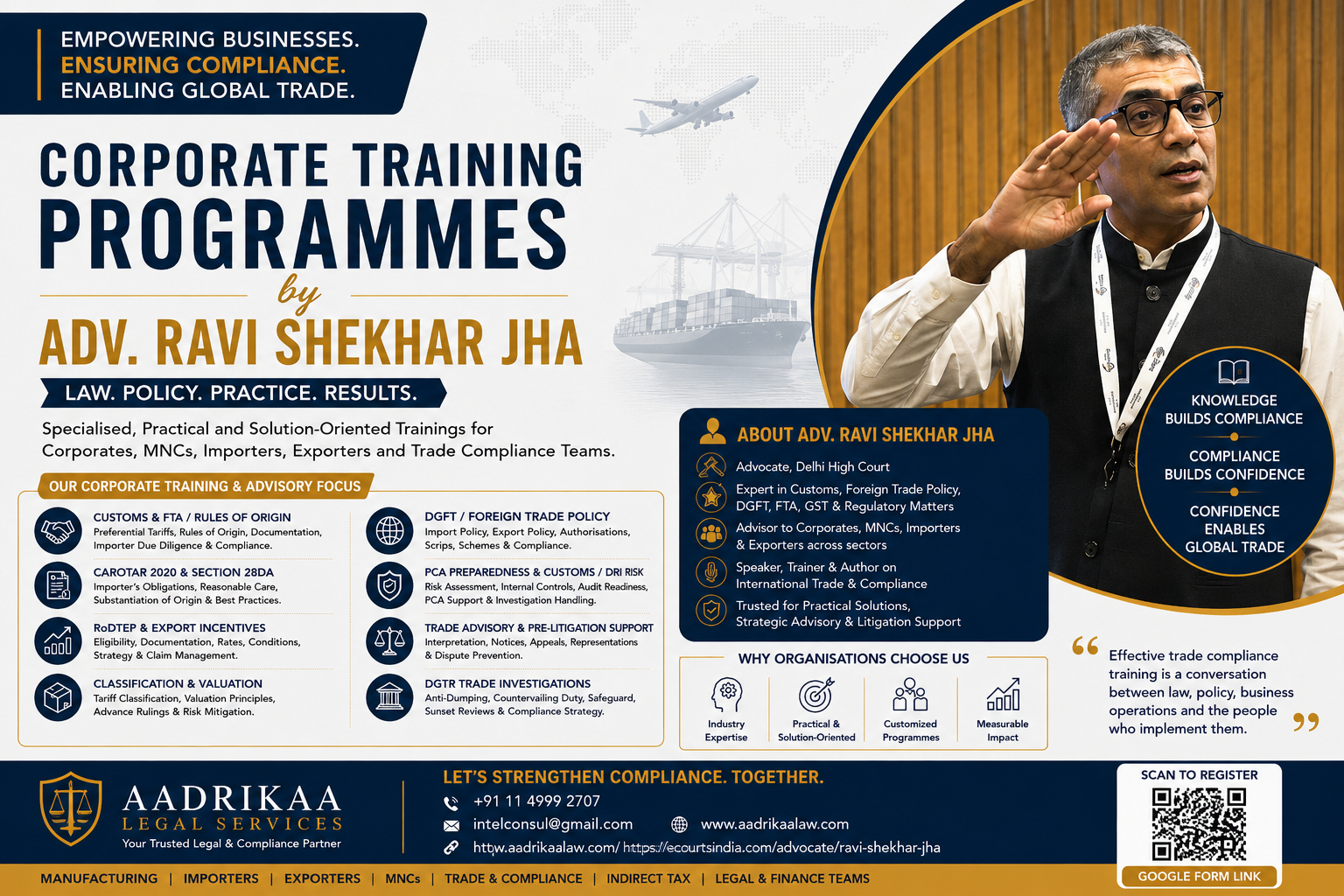
Through Aadrikaa Legal Services, customised executive workshops, corporate training and advisory programmes can be structured for MNCs, manufacturers, importers, exporters and trade-compliance teams covering
a. FTA , CAROTAR 2020 & Section 28DA
b. RoDTEP & export incentives,
c. Classification & General Rules of Interpretation (GRI)
d. Valuation
e. DGFT/Foreign Trade Policy- EPCG/Advance License
f. Customs Special Programmes- SVB, AEO, MOOWR, EMI
g. PCA preparedness and Customs/DRI risk
h. trade advisory and pre-litigation support
i. DGTR trade investigations
j. Customs & allied regulatory laws (PGAs)
Secure your operations. Strengthen compliance. Reduce cross-border friction.
Listen to this on our #YouTube Channel
Advocate Ravi Shekhar Jha
Customs | Foreign Trade Policy | FTA | Trade & Regulatory Advisory
🌐 Aadrikaa Legal Services
📧 intelconsul@gmail.com
⚖️ Professional Profile – Advocate Ravi Shekhar Jha
Knowledge builds compliance. Compliance builds confidence. Confidence enables global trade.
Aadrikaa Legal Services is a trusted legal and regulatory support partner providing end-to-end legal solutions to law firms, corporate organizations, and businesses across India. We specialize in paralegal services, litigation support, tax and regulatory matters, delivering reliable, efficient, and result-oriented legal assistance.
Our services include comprehensive paralegal support, drafting and documentation, legal research, case management, litigation handling, and representation support across various judicial and quasi-judicial forums. We also assist in direct and indirect tax matters, customs, GST, corporate regulatory compliance, and legal advisory.