Aadrikaa Legal Services (ALS)- Law I Litigation I Arbitration
Date: 23.11.2026
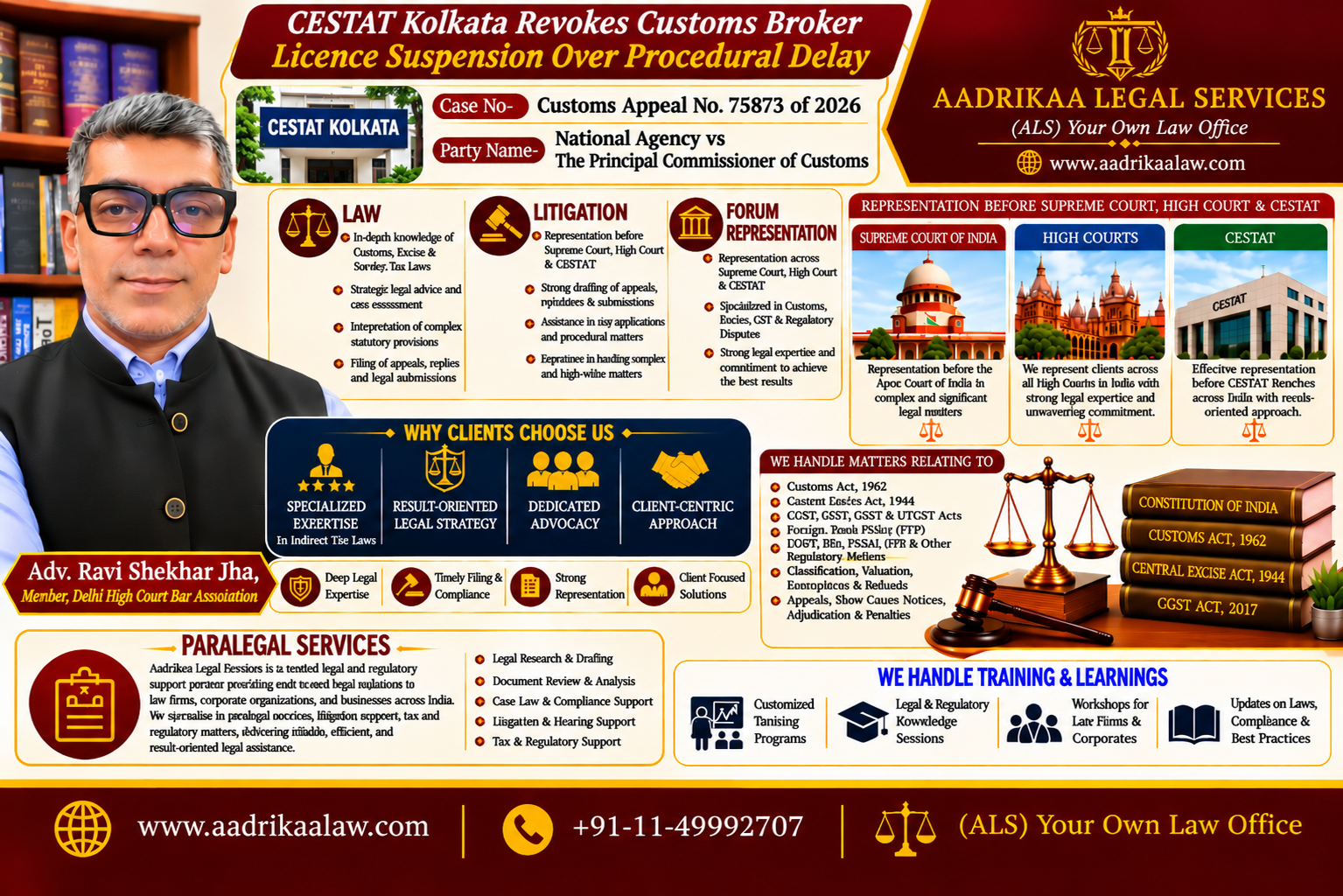
CESTAT Kolkata Revokes Customs Broker Licence Suspension Over Procedural Delay
This Short Article has been prepared & written by Advocate Ravi Shekhar Jha-Delhi High Court, New Delhi. The views expressed are based on his interpretation of the law. He can be reached at his email id intelconsul@gmail.com .
The Customs, Excise and Service Tax Appellate Tribunal (CESTAT), Kolkata has set aside the continued suspension of National Agency’s customs broker licence after finding that Customs authorities issued the original suspension order beyond the mandatory timeline prescribed by the Central Board of Indirect Taxes and Customs.
Background of the dispute
National Agency, a Kolkata-based customs broker holding Licence No. N-23, challenged an order that continued the suspension of its licence pending a formal inquiry under the Customs Brokers Licensing Regulations, 2018 (CBLR).
The case arose from an investigation by the Directorate of Revenue Intelligence (DRI), Mumbai into imports made in the name of Mithila Quality Products Private Limited. DRI examined three consignments and alleged that they involved misdeclaration and the import of prohibited or restricted goods, including electronic cigarettes, footwear and metal chair parts.
National Agency had filed one Bill of Entry, dated 6 May 2026, for a container declared as carrying metal chair parts. On examination, Customs allegedly found restricted footwear concealed with the declared goods.
Based on its investigation, DRI issued an offence report alleging that the broker’s credentials and electronic filing facility had been made available to unauthorised persons. The report alleged breaches of several CBLR obligations, including duties related to authorisation, verification and supervision.
Suspension and appeal
Customs received the DRI offence report on 27 July 2026. The Commissioner suspended National Agency’s licence with immediate effect on 20 August 2026 under Regulation 16(1) of the CBLR. A subsequent order dated 4 September 2026 continued the suspension under Regulation 16(2), pending an inquiry under Regulation 17.
National Agency appealed the continuation order. It argued that the suspension process was legally defective because the authorities did not comply with the timeline in Circular No. 9/2010-Cus. It also contended that the continuation order was non-speaking, that material witness statements had not been supplied, and that it was being held responsible for other consignments that it had neither filed nor been authorised to handle.
Customs argued that the allegations were serious and that allowing the broker to continue operating during the inquiry could jeopardise revenue and the integrity of the customs-clearance process.
Tribunal’s finding: 15-day limit was mandatory
The Tribunal focused on the timing of the first suspension order. Under the Board circular, where immediate suspension is considered necessary, the licensing authority must take suspension action within 15 days of receiving the investigating authority’s report.
Since Kolkata Customs received the offence report on 27 July 2026, the suspension order should have been issued by 11 August 2026. Instead, it was issued on 20 August 2026.
CESTAT held that the delay breached the mandatory timeline. Relying on earlier decisions, including Krishna Shipping and Allied Services and Chatterji & Co., the Tribunal found that non-compliance with the prescribed period makes the suspension order void from the outset.
Because the original suspension order was invalid, the later order continuing that suspension could not survive. The Tribunal therefore set aside the 4 September 2026 order and allowed National Agency’s appeal, with consequential relief in accordance with law.
Key legal takeaway
The ruling reinforces that procedural timelines in customs broker licensing matters are not merely administrative guidance. Where Customs seeks to use its emergency suspension power, it must comply strictly with the prescribed deadlines. A delay in issuing the initial suspension order can invalidate the later continuation of that suspension.
Importantly, CESTAT did not decide whether National Agency was involved in the alleged misdeclaration or whether the evidence ultimately supported the allegations. The decision was limited to the procedural defect in the suspension process.
Why the decision matters
For customs brokers, the order highlights the importance of tracking every date in a licensing proceeding, particularly the date on which the licensing authority receives an offence report. For Customs authorities, it confirms that concerns about the seriousness of an alleged offence do not override mandatory procedural safeguards.
Aadrikaa Legal Services is a trusted legal and regulatory support partner providing end-to-end legal solutions to law firms, corporate organizations, and businesses across India. We specialize in paralegal services, litigation support, tax and regulatory matters, delivering reliable, efficient, and result-oriented legal assistance.
Our services include comprehensive paralegal support, drafting and documentation, legal research, case management, litigation handling, and representation support across various judicial and quasi-judicial forums. We also assist in direct and indirect tax matters, customs, GST, corporate regulatory compliance, and legal advisory.
Aadrikaa Legal Services (ALS)- Law I Litigation I Arbitration
Date: 19.10.2026
Madras HC: Non-Parent Customs Commissioner Cannot Suspend Customs Broker Licence Under Regulation 16 of CBLR 2018
This Short Article has been prepared & written by Advocate Ravi Shekhar Jha-Delhi High Court, New Delhi. The views expressed are based on his interpretation of the law. He can be reached at his email id intelconsul@gmail.com .
The Madurai Bench of the Madras High Court has held that only the Customs authority that issued a Customs Broker’s licence—the “Parent Commissionerate”—may suspend it under the Customs Brokers Licensing Regulations, 2018.
In M/s. Sasha Shipping Pvt. Ltd. v. Commissioner of Customs, decided on 4 November 2025, Justice G.R. Swaminathan set aside orders by the Commissioner of Customs, Tuticorin suspending and continuing the suspension of Sasha Shipping’s Customs Broker Licence. The Court found that Tuticorin was not the licence-issuing authority and therefore lacked jurisdiction to invoke the suspension power.
Background of the dispute
Sasha Shipping Pvt. Ltd. received its Customs Broker Licence from the Principal Commissioner of Customs, Chennai, in 2011. It subsequently began operating within the jurisdiction of the Tuticorin Customs Commissionerate from 21 June 2022 through a Form C intimation.
In August 2025, the Commissioner of Customs, Tuticorin formed the view that the company had committed irregularities relating to certain imports. On 20 August 2025, the Commissioner suspended Sasha Shipping’s licence with immediate effect under Regulation 16(1) of the Customs Brokers Licensing Regulations, 2018. A further order dated 3 September 2025 continued that suspension under Regulation 16(2).
Sasha Shipping challenged both orders. Its central argument was that Tuticorin, being a non-parent commissionerate, could not suspend a licence issued by Chennai.
The jurisdictional question before the Court
The case turned on the distinction between two Customs authorities:
Parent Commissionerate: The Commissionerate that grants the Customs Broker Licence.
Non-Parent Commissionerate: A Commissionerate where the broker operates under a Form C intimation after obtaining its original licence elsewhere.
The Court noted that a broker can transact business at Customs stations beyond its original Commissionerate, subject to the Form C process. However, Form C is only an intimation of the broker’s intention to operate at another station; it is not a fresh licence or an authorization issued by that non-parent Commissionerate.
Initially, the Tuticorin order appeared to operate across all Customs stations. A corrigendum dated 14 October 2025 limited its reach to areas within the jurisdiction of the Tuticorin Custom House. Even after that correction, the principal issue remained: whether Tuticorin could suspend the licence at all.
Regulation 15 and Regulation 16 serve different purposes
The Court analysed the scheme of the 2018 Regulations, particularly Regulations 15, 16 and 17.
Regulation 15: Local prohibition by a non-parent Commissionerate
Regulation 15 allows a Commissioner other than the licence-issuing authority to prohibit a Customs Broker from working in one or more sections of the relevant Customs station if the broker has failed to meet its obligations. This is a limited local measure. The prohibition cannot continue for more than one month.
According to the Court, this provision equips a non-parent Commissionerate to respond immediately to misconduct occurring within its own jurisdiction.
Regulation 16: Suspension of the licence
Regulation 16 permits suspension of a Customs Broker Licence where immediate action is necessary and an inquiry is pending or contemplated. The Court held that this power belongs only to the Parent Commissionerate because that authority issued the licence in the first place.
The reasoning was straightforward: the authority that grants a licence has the inherent authority to amend, vary, rescind or suspend it. A non-parent Commissionerate, which has received only a Form C intimation, has not issued the licence and cannot suspend it.
Regulation 17: Further disciplinary process
Where suspension continues, Regulation 17 provides the procedure for notice, inquiry, evidence, representation and final action, including revocation or penalty. The Court read Regulations 15, 16 and 17 together as a coordinated framework:
A non-parent Commissionerate may impose a temporary local prohibition.
It should communicate the alleged violations to the Parent Commissionerate.
The Parent Commissionerate may then initiate suspension, revocation or penalty proceedings under the applicable regulations.
Why the Court rejected the Customs department’s argument
The Customs department argued that Regulation 16 uses the broad phrase “Principal Commissioner or Commissioner of Customs,” unlike Regulation 15, which specifically refers to Commissioners other than those mentioned in Regulation 7. It contended that this wording allowed any Commissioner to suspend a broker’s licence.
The Court did not accept that interpretation. It held that the regulations must be read as a whole, rather than treating Regulation 16 in isolation. The existence of Regulation 15 showed that the regulatory framework already gives non-parent Commissionerates a defined remedy: temporary prohibition within their own Customs station.
Allowing a non-parent Commissionerate to suspend the licence itself would blur the statutory distinction between local prohibition and licence-level suspension.
Reliance on the 2010 CBIC circular
The Court also relied on CBIC Circular No. 9/2010-Cus., dated 8 April 2010. Although issued under the earlier Customs House Agents Licensing Regulations, 2004, the Court found it remained applicable because its principles were consistent with the 2018 Regulations and it had neither been superseded nor withdrawn.
The circular states that where a Customs broker operating under Form C is found to have committed violations at another Customs station:
The Commissionerate at that station should report the violations to the Commissionerate that issued the licence.
The licence-issuing Commissionerate should initiate suspension or revocation action.
The non-parent Commissionerate may, in appropriate cases, prohibit the broker from working locally.
This approach avoids duplicative proceedings and ensures uniform disciplinary action against Customs Brokers operating at multiple stations.
Court’s decision
The High Court concluded that the Commissioner of Customs, Tuticorin was a non-parent Commissionerate because Sasha Shipping’s licence had been issued by Chennai. Consequently, Tuticorin could not exercise the suspension power under Regulation 16.
The Court set aside:
Order No. 15/2025 dated 20 August 2025, suspending Sasha Shipping’s Customs Broker Licence; and
Order No. 16/2025 dated 3 September 2025, continuing the suspension.
Both writ petitions were allowed, with no order as to costs.
Significance for Customs Brokers and Customs authorities
The ruling clarifies the limits of regulatory authority where a Customs Broker operates across India through Form C intimations. A non-parent Commissionerate can address suspected wrongdoing at its station through a short-term local prohibition, but it cannot suspend the underlying licence.
For licence suspension, revocation or broader disciplinary action, the matter must be taken up by the Commissionerate that originally issued the Customs Broker Licence.
The decision reinforces a clear division of powers, supports procedural consistency and prevents multiple Customs formations from taking overlapping action against the same licence.
Aadrikaa Legal Services is a trusted legal and regulatory support partner providing end-to-end legal solutions to law firms, corporate organizations, and businesses across India. We specialize in paralegal services, litigation support, tax and regulatory matters, delivering reliable, efficient, and result-oriented legal assistance.
Our services include comprehensive paralegal support, drafting and documentation, legal research, case management, litigation handling, and representation support across various judicial and quasi-judicial forums. We also assist in direct and indirect tax matters, customs, GST, corporate regulatory compliance, and legal advisory.
Aadrikaa Legal Services (ALS)- Law I Litigation I Arbitration
Date: 29.08.2026
Train for your CBLR Exams 2027 under the most with Prolific Trainer in India: Enrollment Now Open
This Public Announcement by NACIN has been further shared by the most prolific and versatile Trainer in Customs Law Advocate Ravi Shekhar Jha, Advocate at Delhi High Court (DHCBA Member). He can be reached at his email id intelconsul@gmail.com.
The National Academy of Customs, Indirect Taxes and Narcotics (NACIN) has officially set the stage for the Customs Brokers Licensing Regulations (CBLR) Examination 2027. This lifetime-valid Regulation 6 license is the golden ticket to top-tier career opportunities in global logistics, customs clearance, and international trade compliance.
This critical public announcement has been picked up and advanced by India’s most prolific and versatile customs law trainer: Advocate Ravi Shekhar Jha. Practicing at the Delhi High Court and an esteemed DHCBA Member, he is launching the highly anticipated CBLR 2027 Preparation Batch-2. This intensive program bridges complex legal statutory frameworks with practical port compliance rules.
🚀Key Highlights of the CBLR 2027 Exam
Massive Weightage: Written paper consists of 150 Multiple Choice Questions (MCQs).
Negative Marking: Features a strict +3 for correct and -1 for incorrect marking scheme.
Passing Benchmark: Requires a mandatory score of 60% (270 out of 450 marks) to pass.
Strict Attempt Cap: Candidates are permitted a maximum of 6 lifetime attempts.
Dual-Stage Clearance: Written exam clearance is mandatory to sit for the subsequent Oral Viva Voce.
👨🏫Meet Your Trainer: Advocate Ravi Shekhar Jha
Legal Authority: Practicing Advocate at the Delhi High Court (DHCBA Member).
Proven Track Record: Acclaimed expert and prolific trainer in Customs Law & EXIM Policy.
Allied Laws: Compliance integration with FSSAI, AQCS, PQCS, and Drug Controller regulations.
Documentation Architecture: Mastering electronic Bill of Entry and Shipping Bill layouts.
Month 3: Simulated Drills & Viva Prep
High-Yield MCQ Drill: Speed and accuracy practice under simulated negative marking pressures.
Digital Trade Training: Navigation over ICEGATE and CBLMS portal updates.
🛠️The Strategic Edge: Treximerce Trade Companion
Theoretical knowledge isn’t enough to pass this technical exam. Candidates in this batch get exclusive access to the Treximerce Trade Companion tool, providing an elite competitive advantage:
Instant Tariff Lookup: Speeds up learning of complex HS Codes, duty rates, and notifications.
Live Circular Mapping: Links raw legal sections directly to current CBIC circulars and anti-dumping acts.
Visual Memory Retention: Translates dry statutory text into clear, operational digital trade compliance flows.
💰All-Inclusive & Catchy Fee Structure
Invest in your professional future with a transparent, high-value fee design that leaves no hidden costs behind:
Complete 3-Month Tuition: Fee to be discussed
Premium PDF Notes Included: Exhaustive, chapter-wise digital summaries, ready for offline reading.
Dedicated Doubt Resolution: Zero unanswered queries with 24/7 forum support and live Q&A intervals.
📝Secure Your Spot Immediately!
Seats for Batch-2 are strictly capped to ensure personalized attention and optimal doubt resolution for every student. Don’t risk exhausting your limited attempts.
How Advocate Ravi Shekhar Jha & Treximerce Train Candidates to Master the CBLR 2027 Exam Framework
Through a powerful blend of courtroom litigation experience and cutting-edge trade intelligence, Advocate Ravi Shekhar Jha and Treximerce are fundamentally rewriting how candidates prepare for and ace the CBLR 2027 Examination.
This unique preparation ecosystem divides your study strategy into two highly effective pillars: the mastery of law and the simplifying of trade execution. While Advocate Ravi Shekhar Jha will personally train candidates on the core letter of the law, unpacking complex legal statutes, judicial precedents, and litigation pitfalls, the Trade Companion tool by Treximerce will help them understand the complexities of trade in the most simplified way ever built for the trade.
Their combined methodology dismantles overwhelming study blocks by training aspiring Customs Brokers to master the technical intricacies of the General Rules of Interpretation (GIR), Chapter Notes, and strict CAROTAR 2020 legal triggers—all of which form the highest-yielding segments of the official NACIN written syllabus.
By transforming raw legal principles into actionable operational workflows, this training empowers candidates to spot high-risk tariff anomalies and execute precise HSN vetting seamlessly. This strategy is specifically designed to eliminate the risk of critical errors, effectively killing negative marking risks in the MCQ paper and building bulletproof confidence for the practical board interview.
To bridge the gap between classroom theory and real-world exam application, every candidate receives complimentary, unrestricted access to the powerful Treximerce Trade Companion product for a period of 3 weeks only, giving them the ultimate operational edge needed to clear both the CBLR written exam and the final Viva Voce.
Listen to this on our #YouTube Channel
Aadrikaa Legal Services is a trusted legal and regulatory support partner providing end-to-end legal solutions to law firms, corporate organizations, and businesses across India. We specialize in paralegal services, litigation support, tax and regulatory matters, delivering reliable, efficient, and result-oriented legal assistance.
Our services include comprehensive paralegal support, drafting and documentation, legal research, case management, litigation handling, and representation support across various judicial and quasi-judicial forums. We also assist in direct and indirect tax matters, customs, GST, corporate regulatory compliance, and legal advisory.
ALO Law Office- IDT Tax I Arbitration I Litigation
Date: 25.03.2026
CUSTOMS BROKER LICENSING IN INDIA
Adv Ravi Shekhar Jha
This Article has been written by Advocate Ravi Shekhar Jha-BALLB & LLM (Constitutional Law) based in New Delhi. The views expressed are based on his interpretation of the law. He can be reached at his email id intelconsul@gmail.comor on his Mobile +91-9999005379.
Introduction:
The Customs Brokers Licensing Regulations, 2018 is the regulating legal provision for the grant of the license for working as a Customs Broker in India.
These regulations shall apply to, a Customs Broker who has been licensed and such other persons who have been employed or engaged by a licensed Customs Broker under these regulations or the Customs House Agents Licensing Regulations, 1984 or the Customs House Agents Licensing Regulations, 2004 or the Customs Brokers Licensing Regulations, 2013.
A Customs Broker has been defined under Regulation 2(d) as “Customs Broker” means a person licensed under these regulations to act as an agent on behalf of the importer or an exporter for purposes of transaction of any business relating to the entry or departure of conveyances or the import or export of goods at any Customs Station including audit.
Typres of Customs Broker Licenses/permits:
“F card holder” means a person who has passed the examination referred to in regulation 6 and has been issued a photo identity card in Form F;
“G card holder” means a person who has passed the examination referred to in regulation 13 and has been issued a photo identity card in Form G;
“H card holder” means a person who has not passed the examination referred to in regulation 13 and has been issued a photo identity card in Form H;
Conduct of Exams:
The National Academy of Customs, Indirect Taxes and Narcotics (NACIN) shall conduct the CBLR exams every year it invites applications for conducting examination and subsequent grant of license to act as Customs Broker in “Form A” by publication in two leading national daily newspapers in English and Hindi in addition to disseminating the information on the web portal.
We update the prospective candidates Notifications as & when they are released by NACIN.
Eligibility Criteria:
An applicant shall be allowed a maximum of six attempts to clear the examination. The applicant for a license to act as a Customs Broker in a Customs Station, shall before applying to the Principal Commissioner of Customs or Commissioner of Customs, meet the following conditions that: –
(a) he is a citizen of India;
(b) he is a person of sound mind;
(c) he is not adjudicated as insolvent;
(d) he holds an Aadhaar number;
(e) he holds a valid PAN card;
(f) he has not been penalised for any offence under the Act, the Central Excise Act, 1944 (1 of 1944), the Finance Act, 1994(32 of 1994), the Central Goods and Services Act, 2017 (12 of 2017)and Integrated Goods and Services Tax Act, 2017 (13 of 2017);
(g) he has neither been convicted by a competent court for an offence nor any criminal proceeding is pending against him in any court of law;
(h) an individual applicant or in case the applicant is a firm, its partner or in the case of a company, its director or an authorised employee who may handle the Customs work shall-
(i) be a graduate from a recognized University; and
(ii) possess a professional degree such as Masters or equivalent degree in Accounting,
Finance or Management, CA/CS/MBA/LLM/ACMA/FCMA or Diploma in Customs Clearance work from any Institutes or University recognised by the Government or is having at least two years’ experience in transacting Customs Broker work as G-Card holder;
(i) the applicant has financial viability as evidenced by a certificate issued by a Scheduled Bank or such other proof acceptable to the Principal Commissioner of Customs or Commissioner of Customs, as the case may be, in terms of possession of assets of value of not less than five lakhs rupees.
(2) A retired Group A officer from the Indian Revenue Service (Customs and Central Excise) having a minimum of five years’ experience in Group ‘A’ post shall also be eligible to apply for a license to act as a Customs Broker provided, he satisfies the conditions specified at (a), (b), (c), (d), (e), (f), (g) and (i) of sub-regulation (1)above.
Syllabus:
The examination may include questions on the following topics:
(a) preparation of various kinds of bills of entry, bills of export, shipping bills, and other clearance documents;
(b) arrival entry and clearance of vessels;
(c) tariff classification and rates of duty;
(d) determination of value of imported and export goods;
(e) conversion of currency;
(f) nature and description of documents to be filed with various kinds of bills of entry, shipping bills and other clearance documents;
(g) procedure for assessment and payment of duty including refund of duty paid;
(h) examination of goods at Customs Stations;
(i) prohibitions on import and export;
(j) bonding procedure and clearance from bond;
(k) re-importation and conditions for free re-entry;
(l) drawback and export promotion schemes including the Special Economic Zone scheme;
(m) offences under the Act;
(n) provisions of the allied Acts including the Central Goods and Services Act, 2017 (12 of 2017) and section 5 of the Integrated Goods and Services Tax Act, 2017 (13 of 2017), the Indian Explosives Act, 1884 (4 of 1884), the Destructive Insects and Pests Act 1914 (2 of 1914), the Dangerous Drugs Act, 1930 (2 of 1930), the Drugs and Cosmetics Act, 1940 (23 of 1940), the Central Excise Act, 1944 (1 of 1944), the Copy Right Act, 1957 (14 of 1957), the Trade and Merchandise Marks Act 1958 (43of 1958), the Arms Act 1959 (54 of 1959), the Patents Act, 1970 (39 of 1970), the Narcotics Drugs and Psychotropic Substances Act, 1985 (61 of 1985), the Environment (Protection) Act, 1986 (29 of 1986), the Foreign Trade (Development and Regulations) Act, 1992 (22 of 1992), the Foreign Exchange Management Act,1999 (42 of 1999), the Design Act, 2000 (16 of 2000) and the Food Safety and Standard Act, 2006 (No. 34 of 2006), The Legal Metrology Act, 2009, The BIS Act, 2016, The Waste Management Rules of CPCB and other laws for the time being in force applicable to EXIM trade and the rules and regulations made under these Acts in so far as they are relevant to clearance of goods through Customs;
(o) provisions of the Prevention of Corruption Act, 1988 (49 of1988);
(p) procedure for appeal and revision applications under the Act; and
(q) online filing of electronic bills of entry and shipping bills vide the Indian Customs and Central Excise Electronic Commerce or Electronic data interchange gateway (ICEGATE) and Indian Customs Electronic data Interchange System (ICES).
(r) knowledge of regulations, rules, notifications, etc. under the Customs Act and other Allied Acts.
Validity of License:
A license granted under regulation 7 shall be valid for a period of ten years from the date of issue and shall be renewed from time to time in accordance with the procedure specified in sub-regulation (2):
Obligations of Customs Brokers:
A Customs Broker shall –
(a) obtain an authorisation from each of the companies, firms or individuals by whom he is for the time being employed as a Customs Broker and produce such authorisation whenever required by the Deputy Commissioner of Customs or Assistant Commissioner of Customs, as the case may be;
(b) transact business in the Customs Station either personally or through an authorized employee duly approved by the Deputy Commissioner of Customs or Assistant Commissioner of Customs, as the case may be;
(c) not represent a client in any matter to which the Customs Broker, as a former employee of the Central Board of Indirect taxes and Customs gave personal consideration, or as to the facts of which he gained knowledge, while in Government service;
(d) advise his client to comply with the provisions of the Act, other allied Acts and the rules and regulations thereof, and in case of non-compliance, shall bring the matter to the notice of the Deputy Commissioner of Customs or Assistant Commissioner of Customs, as the case may be;
(e) exercise due diligence to ascertain the correctness of any information which he imparts to a client with reference to any work related to clearance of cargo or baggage;
(f) not withhold information contained in any order, instruction or public notice relating to clearance of cargo or baggage issued by the Customs authorities, as the case may be, from a client who is entitled to such information;
(g) promptly pay over to the Government, when due, sums received for payment of any duty, tax or other debt or obligations owing to the Government and promptly account to his client for funds received for him from the Government or received from him in excess of Governmental or other charges payable in respect of cargo or baggage on behalf of the client;
(h) not procure or attempt to procure directly or indirectly, information from the Government records or other Government sources of any kind to which access is not granted by the proper officer;
(i) not attempt to influence the conduct of any official of the Customs Station in any matter pending before such official or his subordinates by the use of threat, false accusation, duress or the offer of any special inducement or promise of advantage or by the bestowing of any gift or favour or other thing of value;
(j) not refuse access to, conceal, remove or destroy the whole or any part of any book, paper or other record, relating to his transactions as a Customs Broker which is sought or may be sought by the Principal Commissioner of Customs or Commissioner of Customs, as the case maybe;
(k) maintain up to date records such as bill of entry, shipping bill, transhipment application, etc., all correspondence, other papers relating to his business as Customs Broker and accounts including financial transactions in an orderly and itemised manner as may be specified by the Principal Commissioner of Customs or Commissioner of Customs or the Deputy Commissioner of Customs or Assistant Commissioner of Customs, as the case maybe;
(l) immediately report the loss of license granted to him to the Principal Commissioner of Customs or Commissioner of Customs, as the case may be;
(m) discharge his duties as a Customs Broker with utmost speed and efficiency and without any delay;
(n) verify correctness of Importer Exporter Code (IEC)number, Goods and Services Tax Identification Number (GSTIN), identity of his client and functioning of his client at the declared address by using reliable, independent, authentic documents, data or information;
(o) inform any change of postal address, telephone number, e-mail etc. to the Deputy Commissioner of Customs or Assistant Commissioner of Customs, as the case may be, of all Customs Stations including the concerned Deputy Commissioner or Assistant Commissioner of the Commissionerate who has granted the license immediately within two days;
(p) maintain all records and accounts that are required to be maintained under these regulations and preserve for at least five years and all such records and accounts shall be made available at any time for the inspection of officers authorised for this purpose; and
(q) co-operate with the Customs authorities and shall join investigations promptly in the event of an inquiry against them or their employees.
We impart training & workshops to prospective & interested candidates through online classes and training materials and free digital trade compliance tool access during the period of training through our training faculty.
Follow our website for regular updates.
Crack the CBLR Exam with Confidence – Not Just Theory, But Real Practice
Most candidates fail not because they don’t study— but because they don’t study what actually matters.
This program is built by a practicing Customs & Trade Lawyer in collaboration with a Senior Customs Broker who understands:
What examiners ask
Where candidates make mistakes
How to convert knowledge into marks
✔ Learn the law
✔ Apply it in real scenarios
✔ Master the exam pattern
Contact to book your training calendar for your CBLR Exam. Submit your training request using the online Google form below.