

Aadrikaa Legal Services (ALS)- Law I Litigation I Arbitration
Date: 26.11.2026
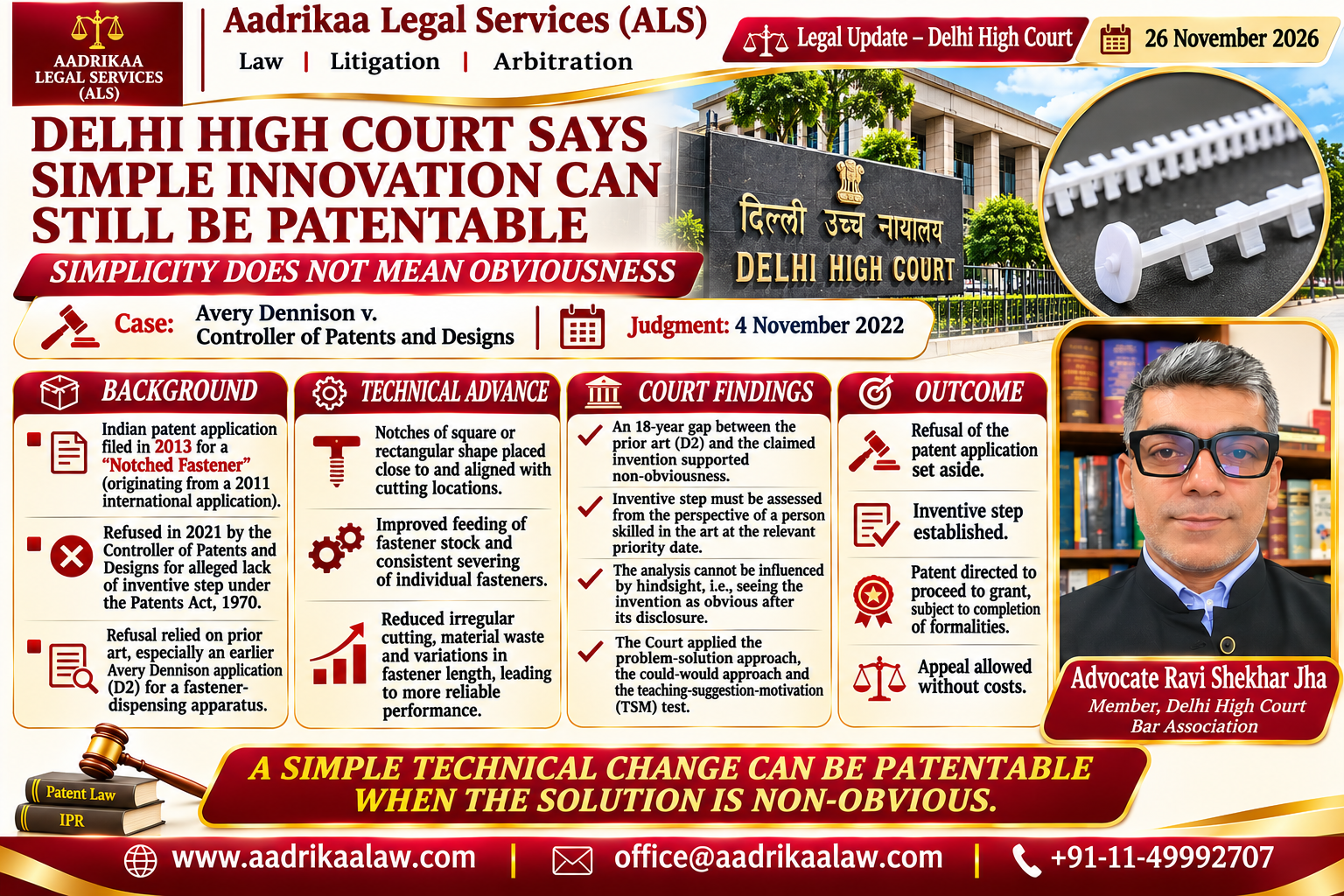
Delhi High Court Says Simple Innovation Can Still Be Patentable
This Short Article has been prepared & written by Advocate Ravi Shekhar Jha-Delhi High Court, New Delhi. The views expressed are based on his interpretation of the law. He can be reached at his email id intelconsul@gmail.com .

The Delhi High Court set aside the refusal of Avery Dennison’s patent application for a “Notched Fastener,” holding that the claimed design showed a non-obvious technical advance over prior art and should proceed to grant.
The ruling is a notable explanation of how Indian patent authorities and courts should assess inventive step, particularly where an invention appears simple but solves a longstanding technical problem.
The dispute: a patent refusal based on alleged obviousness
Avery Dennison Corporation appealed a 2021 decision of the Controller General of Patents and Designs that had refused its Indian patent application for a “Notched Fastener.” The application, filed in India in 2013 and originating from a 2011 international patent application, concerned continuously connected plastic fastener stock used in dispensing systems.
The Controller had concluded that the claimed fastener lacked an inventive step under the Patents Act, 1970. The refusal relied principally on earlier patent publications, especially a prior Avery Dennison patent application known as D2, concerning an apparatus for dispensing individual plastic fasteners from continuously connected ladder stock.
On 4 November 2022, Justice Prathiba M. Singh allowed Avery Dennison’s appeal. The Court found that the relevant differences in notch design and operation were not merely superficial changes, but formed a technical advancement that would not have been obvious to a person skilled in the art.
What the patented fastener was designed to solve
The invention addressed a practical reliability problem in conventional fastener-dispensing systems. In older systems, a feed wheel or similar rotary mechanism engaged flexible filaments in the fastener stock to move it forward. Because those filaments could stretch by differing amounts during feeding, the location at which each fastener was cut could vary.
That inconsistency could produce fasteners with uneven or reduced side-member lengths and, in turn, compromise their ability to retain securely when used. Rotary feed mechanisms could also be bulky, complex, and costly.
Avery Dennison’s application sought to improve this process through the design and placement of notches in the fastener stock. Its claimed approach focused on three connected features:
- Notch position: The notches were placed close to, and aligned with, actual or intended cut locations to promote consistent severing.
- Notch shape: Rectangular or square notches were intended to support forward linear movement of the fastener stock.
- Notch direction: The orientation of the notches relative to cross-pieces was designed to work with the feeding mechanism.
Together, these features aimed to enable more uniform dispensing, reduce material waste, preserve equal spacing of cross-pieces, and produce consistently shaped fasteners.
Why the prior art did not defeat the application
The central prior-art reference, D2, also disclosed continuously connected fastener stock with notches. However, its operating arrangement differed materially from Avery Dennison’s later application.
In D2, the stock moved forward through engagement of a pawl with a triangular notch. The Court distinguished that system from the proposed invention, where the configuration, placement, and interaction of the notch with the feeding system were different. It also noted that the later design addressed irregular cutting and variation caused by the earlier approach.
The Court accepted that the comparison had to go beyond asking whether both inventions used “notches.” Instead, the correct inquiry was whether the specific changes in shape, position, engagement, and detachment would have been obvious to a skilled person at the relevant priority date.
The answer was no. The Court emphasized that the later application identified concrete deficiencies in the existing design and provided a technically meaningful solution. In particular, it found that the later fastener stock achieved improved alignment between the notch and the point of detachment, reducing the risk of irregular cutting.
A key finding: simplicity does not mean obviousness
A major theme of the judgment is that a simple innovation can still be patentable. The Court cautioned against assuming that an apparently straightforward modification requires no inventive effort simply because it seems easy to understand after the invention has been disclosed.
This principle matters in mechanical and industrial inventions, where a modest structural change may create significant operational benefits. The Court observed that the differences described by the Controller as “superficial” had a real effect on the fastener product and its performance.
The ruling also stressed the prohibition on hindsight analysis. A decision-maker must not start with knowledge of the claimed invention and work backward through prior art to reconstruct a route to it. The proper question is whether, before the invention was known, the prior art would have motivated a skilled person to make the claimed modification.
The 18-year gap supported non-obviousness
The Court gave significant weight to the time between the earlier D2 filing and Avery Dennison’s later application. D2 dated back to the early 1990s, while the later application was filed almost 18 years afterward.
During that period, no cited prior art had addressed the same shortcomings or suggested a solution close to the claimed notch configuration. For the Court, that gap weakened the assertion that the claimed change was an obvious workshop modification. If the modification had truly been obvious, particularly in a field involving widely used bulk industrial products, the Court reasoned that others might reasonably have made it earlier.
This analysis reflects the concept of a “long-felt want”: a solution may be non-obvious where an existing problem was recognized, relevant prior art had long been available, yet no one arrived at the claimed improvement.
The legal framework for assessing inventive step
The judgment provides a useful consolidation of approaches used to test inventive step and obviousness. These include:
- The problem-solution approach: Identify the closest prior art, define the objective technical problem, and ask whether the claimed solution would have been obvious to the skilled person.
- The could-would approach: Distinguish between what a skilled person could have done and what the prior art would have prompted that person to do.
- The teaching-suggestion-motivation approach: Consider whether prior art provides a genuine reason to modify or combine known teachings to reach the claimed invention.
- The Windsurfing/Pozzoli framework: Identify the skilled person and common general knowledge, determine the inventive concept, identify differences from the prior art, and decide whether those differences would have been obvious without hindsight.
The Court made clear that these are not rigid formulas. The appropriate analysis depends on the technology, the prior art, and the facts of the particular case. But the basic task remains constant: compare the prior art with the claimed invention through the eyes of a skilled person at the relevant date.
What patent examiners must explain when refusing an application
The decision reinforces an important procedural requirement for inventive-step objections. A bare conclusion that an application lacks inventive step is not enough.
When refusing an application for obviousness, the Controller must address three elements:
- What the prior art discloses
- What the application under examination discloses
- How and why a skilled person would move from the prior art to the claimed invention
Without that reasoning, a refusal may fail to satisfy the statutory standard for inventive step. Under Indian law, inventive step includes a feature involving technical advance over existing knowledge, economic significance, or both, provided it is not obvious to a person skilled in the art.
Outcome and broader implications
The Delhi High Court held that Avery Dennison’s notched-fastener application involved an inventive step and directed that the patent proceed to grant, subject to completion of any required formalities. The appeal was allowed without an order on costs.
The Court also noted that corresponding patent applications had already been granted in the United States, Japan, South Korea, and China. While those grants were not the legal basis of the Indian ruling, they formed part of the factual context considered by the Court.
For patent applicants, the decision underscores the value of clearly documenting the technical problem, the shortcomings of existing solutions, and the operational advantages created by each claimed feature.
For patent offices and challengers, it confirms that an obviousness case must show more than structural similarity or the theoretical possibility of modification: it must demonstrate a real, non-hindsight reason why a skilled person would have made the claimed change.
In short, Avery Dennison v. Controller of Patents and Designs confirms that even a seemingly small mechanical design change can qualify for patent protection when it solves a recognized technical problem in a way that prior art did not make obvious.
Connected Matter
Aadrikaa Legal Services is a trusted legal and regulatory support partner providing end-to-end legal solutions to law firms, corporate organizations, and businesses across India. We specialize in paralegal services, litigation support, tax and regulatory matters, delivering reliable, efficient, and result-oriented legal assistance.
Our services include comprehensive paralegal support, drafting and documentation, legal research, case management, litigation handling, and representation support across various judicial and quasi-judicial forums. We also assist in direct and indirect tax matters, customs, GST, corporate regulatory compliance, and legal advisory.
Source: Delhi High Court
Handy Download:
Write to us at office@aadrikaalaw.com
Tel: +91-11-4999 2707
Ravi Shekhar Jha – Advocate, Bar Council of Delhi