Tag: #DPIIT

  • Compilation of Judicial Decisions on Indian Intellectual Property Rights

    Compilation of Judicial Decisions on Indian Intellectual Property Rights

    Date: 29.08.2026

    India’s intellectual property (IP) regime continues to evolve rapidly, with courts issuing pivotal judgments that clarify, reinforce, and sometimes reshape the legal landscape. This article presents a detailed review of the most significant judicial decisions from July 2026, as compiled by the Office of the Controller General of Patents, Designs & Trade Marks. The focus spans patents, copyrights, designs, and trademarks, offering insights for practitioners, businesses, and scholars alike.

    Patents: Defining Inventive Step, Product Claims, and Exclusions

    1. Pharmaceutical Combinations and Section 3(d) Bar

    • Case: ARRAY BIOPHARMA INC v. Deputy Controller of Patents and Designs
    • Key Takeaway: The Delhi High Court clarified that a product claim for a combination of distinct active drugs is not barred by Section 3(d) of the Patents Act. The court emphasized that such combinations, when supported by clinical data showing technical advancement, are patentable even if the specification includes administration schedules. The decision also reinforced that product claims should not be rejected as β€œmethods of treatment” merely due to functional descriptors in the claims.

    2. Inventive Step and Reasoned Orders

    • Case: DEEPAK NITRITE LIMITED v. Assistant Controller General of Patents and Designs
    • Key Takeaway: The Bombay High Court set aside a patent rejection for lack of a reasoned order. The court held that patent office decisions must be based on clear, substantiated reasoning, especially when relying on β€œcommon general knowledge.” The inventive step must be assessed holistically, considering the integrated process and technical advancement.

    3. Therapeutic Efficacy in Pharmaceutical Patents

    • Case: INTRA-CELLULAR THERAPIES, INC. v. Controller of Patents
    • Key Takeaway: The court reaffirmed that increased bioavailability or improved physicochemical properties alone do not satisfy Section 3(d) unless there is evidence of enhanced therapeutic efficacy. The applicant must demonstrate a corresponding improvement in medical outcomes.

    4. Obviousness and Prior Art

    • Case: SULZER MIXPAC AG v. Assistant Controller of Patents and Designs
    • Key Takeaway: Minor modifications of known techniques, even if they improve performance, are not patentable unless they represent a non-obvious technical advance. The court clarified that the substance of the inventive step inquiry is more important than strict adherence to judicial formulas.

    5. Mental Acts and Patent Exclusions

    • Case: T-MOBILE INTERNATIONAL AG AND CO. KG. v. Controller General of Patents, Designs and Trademarks
    • Key Takeaway: The Delhi High Court issued guidelines for assessing exclusions under Section 3(m), clarifying that claims must be evaluated as a whole. Exclusions target purely abstract or mental acts, not technical implementations involving tangible outputs.

    Copyright: Fair Dealing, Moral Rights, and Digital Challenges

    1. AI Training and Fair Dealing

    • Case: ANI MEDIA Pvt. Ltd. vs. OPEN AI OPCO LLC
    • Key Takeaway: The Delhi High Court held that using copyrighted works for AI training can qualify as fair dealing under Section 52(1)(a), provided the use is internal, non-commercial, and does not result in substantial reproduction. The court recognized the evolving nature of β€œresearch” in the digital age.

    2. Artistic Work and Trade Dress

    • Case: OPELLA HEALTHCARE GROUP v. PURECA LABORATORIES PVT LTD
    • Key Takeaway: The court granted summary judgment against a defendant whose label was a colourable imitation of the plaintiff’s well-known packaging, reinforcing the protection of trade dress as artistic work.

    3. Moral Rights and AI Deepfakes

    • Case: PREITY G. ZINTA v. GOOGLE LLC & ORS.
    • Key Takeaway: Unauthorized creation and dissemination of AI-generated deepfakes and morphed content violate a performer’s moral rights under Section 38-B, justifying urgent injunctive relief.

    4. Ownership of Musical Works

    • Case: SAREGAMA INDIA LTD. V. BLACK MADRAS FILMS & ORS.
    • Key Takeaway: Copyright in musical compositions is distinct from sound recordings and cinematograph films; composers retain rights in their works even when incorporated into films.

    Designs: Novelty and Litigation Costs

    1. Design Infringement and Prior Publication

    • Case: CROCS INC USA V. M/S BATA INDIA LTD AND ORS.
    • Key Takeaway: Lack of novelty and prior publication can invalidate a registered design. Successful defendants are entitled to recover actual litigation costs, emphasizing the need for parties to assess the strength of their case before pursuing litigation.

    Trademarks: Well-Known Marks, Passing Off, and Procedural Safeguards

    1. Well-Known Marks and Cross-Class Protection

    • Case: COLUMBIA PICTURES INDUSTRIES, INC v. REGISTRAR OF TRADE MARKS & ANR
    • Key Takeaway: A mark need not be formally declared “well-known” to claim cross-class protection; evidence of reputation and recognition is sufficient. The Registrar must consider well-known status claims before focusing on goods’ dissimilarity.

    2. Priority of Application vs. Actual Use

    • Case: Parle Products Pvt. Ltd. v. The Registrar of Trade Marks & Anr.
    • Key Takeaway: In registration disputes, the date of application determines priority, not the date of first use, unless the dispute involves passing off. Administrative delays by the Registry cannot penalize diligent applicants.

    3. Deceptive Similarity in Pharmaceuticals

    • Case: SUN PHARMA LABORATORIES LTD. v. FINECURE PHARMACEUTICALS LTD. & ORS
    • Key Takeaway: Even minor differences in pharmaceutical trademarks can cause confusion; public interest justifies a stricter approach to similarity. Delay in seeking relief does not defeat an injunction in such cases.

    4. Restoration and Procedural Compliance

    • Cases: ARUN KUMAR GUPTA V. REGISTRAR OF TRADE MARKS and AMRIT SINGH MEHTA TRADING AS MEHTA COSMETICS V. CONTROLLER GENERAL OF PATENTS, DESIGNS AND TRADE MARKS
    • Key Takeaway: Removal of a trademark for non-renewal is invalid without issuing the mandatory renewal notice; procedural safeguards protect proprietors’ rights.

    Conclusion

    The July 2026 judicial decisions underscore the Indian judiciary’s nuanced approach to balancing innovation, public interest, and procedural fairness in IP law. Stakeholders should closely monitor these developments to ensure compliance and to leverage evolving legal standards in protecting their intellectual property.

    Aadrikaa Legal Services is a trusted legal and regulatory support partner providing end-to-end legal solutions to law firms, corporate organizations, and businesses across India. We specialize in paralegal services, litigation support, tax and regulatory matters, delivering reliable, efficient, and result-oriented legal assistance.

    Our services include comprehensive paralegal support, drafting and documentation, legal research, case management, litigation handling, and representation support across various judicial and quasi-judicial forums. We also assist in direct and indirect tax matters, customs, GST, corporate regulatory compliance, and legal advisory.

    Handy Download:

    Ravi Shekhar Jha – Advocate, Bar Council of Delhi

  • Temporary Exemption for Import of Specified Copper Products for Designated End-Uses under the Copper Products QCO-2024

    Temporary Exemption for Import of Specified Copper Products for Designated End-Uses under the Copper Products QCO-2024

    Date: 13.08.2026

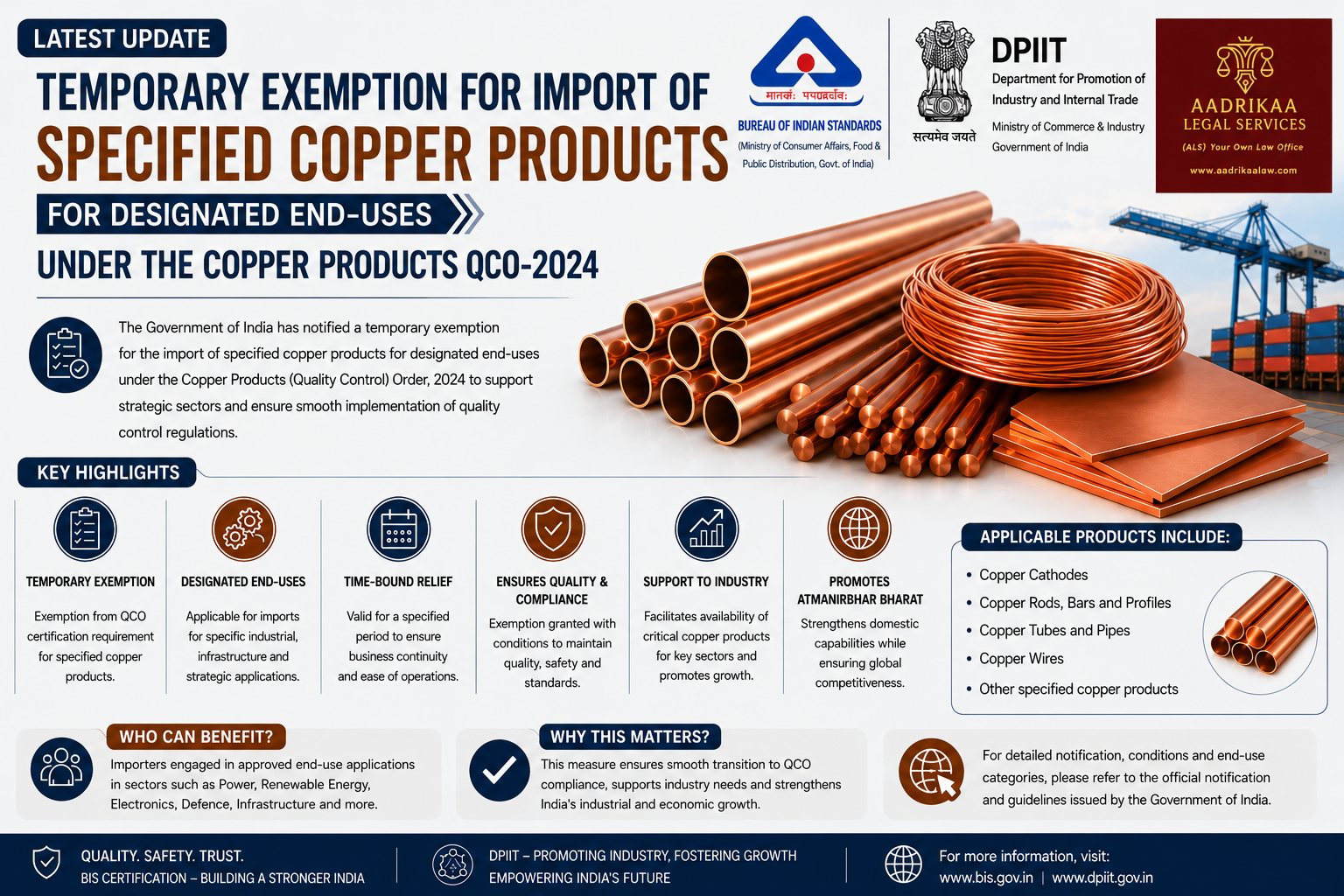
    The Government of India has issued a significant order granting temporary exemptions for the import of specific copper products, addressing the needs of various industrial sectors. This move aims to bridge the gap between domestic supply and specialized requirements not currently met by Indian manufacturers or covered under the Copper Products (Quality Control) Order, 2024.

    Background and Rationale

    Industry stakeholders and associations highlighted challenges in sourcing certain high-purity and specialized copper products domestically, either due to lack of standards coverage or insufficient quality and quantity. Responding to these concerns, the Department for Promotion of Industry and Internal Trade (DPIIT), in consultation with the Bureau of Indian Standards (BIS), has provided a one-year exemption for select copper products, strictly for designated end-uses.

    List of Exempted Copper Products and Their End-Uses

    The exemption covers a range of copper products, each tied to a specific industrial application. Here’s a summary of the key products and their permitted uses:

    1. Oxygen Free Copper rods, bars, strips, and sheets (min. purity 99.995%, max. oxygen 5 PPM)
      • End-use: Vacuum interrupters
    2. Silver bearing Oxygen Free Copper, Zirconium Copper, High Conductivity Phosphorous-Deoxidised Copper rods, bars, and strips
      • End-use: Generator rotor coils, generators, electrical shunts
    3. Beryllium Alloy Copper Bar (End Wadge/Rotor Center Wedge-material grade)
      • End-use: Generators
    4. Oxygen Free Copper strips (min. purity 99.995%, max. oxygen 5 PPM)
      • End-use: Automotive bus bars for battery packs
    5. OFC Grade Copper Tape (0.18 mm x 81 mm and 0.095 mm x 85 mm)
      • End-use: RF feeder cables
    6. Billet & Section of Copper Alloy Grades (CuCr 90:10, CuZr 50:50, CuSi 90:10, CuP 85:15, CuTe 50:50)
      • End-use: Electrical contacts, short circuit rings, rotor bars for industrial and traction motors
    7. Copper Alloys C15000 (Zirconium Copper) and C18150 (Chromium Zirconium Copper) billets
      • End-use: Short circuit rings and rotor bars for traction and industrial motors
    8. Copper Alloy Strips (TRKFC 4, C151, DK Alloy, DSC-3N 1/2H, DK-3)
      • End-use: Bus bars for automobiles
    9. ETP Copper Plate in Coils (Grade C11000, Cu-ETP)
      • End-use: Electrical applications
    10. Hard Drawn Grooved Copper Tin alloy (150 sqmm and above, GT-SN)
      • End-use: Overhead electrical conductors
    11. Hard-Drawn Copper Wire (Dia 2.6mm, 99.9%+ purity)
      • End-use: Wiring harnesses for the automobile industry
    12. Enameled Copper Wire/Magnet Wire (0.01 to 0.16 mm, various grades)
      • End-use: Electrical wound components
    13. Copper Finned Tubes (externally and internally finned, various grades)
      • End-use: Chillers
    14. High Strength Copper Alloy Tubes (multiple grades)
      • End-use: Air-conditioning systems and electrical applications

    Conditions for Availing the Exemption

    To ensure traceability and promote future indigenization, importers must comply with the following conditions:

    1. Notification to BIS: Inform the Bureau of Indian Standards within 7 days of consignment clearance, using company letterhead and authorized signatory, via email.
    2. Quarterly Reporting: Maintain and submit quarterly records of imported goods to Central Government authorities, again on company letterhead and signed, via email.
    3. Indigenization Plan: Submit a plan for local manufacturing (indigenization) of the imported goods to the Central Government.

    Scope and Limitations

    • The exemption is valid for one year from the date of the order’s publication.
    • It applies strictly to the products and end-uses listed, and only to actual users (not traders or resellers).
    • The government reserves the right to review and amend the list of products and end-uses as needed.

    Implications for Industry

    This exemption provides immediate relief to sectors reliant on specialized copper products, such as electrical, automotive, and industrial equipment manufacturers. It also encourages importers to plan for future domestic production, aligning with the government’s broader Make in India initiative.

    For further details or compliance queries, stakeholders should contact the relevant government departments as specified in the official order.

    This proactive measure is expected to support critical industries while paving the way for enhanced domestic capabilities in the copper sector.

    Aadrikaa Legal Services is a trusted legal and regulatory support partner providing end-to-end legal solutions to law firms, corporate organizations, and businesses across India. We specialize in paralegal services, litigation support, tax and regulatory matters, delivering reliable, efficient, and result-oriented legal assistance.

    Our services include comprehensive paralegal support, drafting and documentation, legal research, case management, litigation handling, and representation support across various judicial and quasi-judicial forums. We also assist in direct and indirect tax matters, customs, GST, corporate regulatory compliance, and legal advisory.

    Handy Download:

  • β€œCAAR New Delhi Clarifies Classification of Smartphone Window Glass as β€˜Parts’ under CTH 8529”

    β€œCAAR New Delhi Clarifies Classification of Smartphone Window Glass as β€˜Parts’ under CTH 8529”

    Logo of Aadrikaa Law Offices featuring a gold design with scales of justice on a maroon background, including the text 'Your Own Law Office' and the website URL.

    Date: 30.01.2026

    Adv Ravi Shekhar Jha
    Adv Ravi Shekhar Jha

    ​​ ​​  β€‹  β€‹ ​​ ​

    The ruling concerns an application filed by M/s. Samsung Display Noida Private Limited before the Customs Authority for Advance Rulings (CAAR), New Delhi, seeking clarity on the tariff classification of imported β€œWindow Glass” used in the manufacture of display assemblies for mobile phones and tablets.

    The applicant argued that the product is not merely safety glass but an integral and indispensable component of the display assembly, providing protection, structural stability, optical clarity, and user interaction interface.

    Two competing tariff headings were examined:

    • CTH 7007 – Safety glass (toughened or laminated)
    • CTH 8529 – Parts suitable for use solely or principally with apparatus of headings 8525–8528

    After analysing the product’s function, industry usage, and HSN explanatory notes, the Authority concluded that the Window Glass functions as a part of the display assembly rather than standalone safety glass and therefore merits classification under CTH 8529 90 90 (β€œOther”).

    Legal / Statutory Provisions Referred

    1. Section 28E(c), Customs Act, 1962 β€” Defines β€œapplicant” eligible to seek an advance ruling.
    2. Section 28H β€” Governs the procedure for filing advance ruling applications.
    3. Section 28-I(2) β€” Bars admission where the issue is pending before any customs authority or court.
    4. Section 12, Customs Act, 1962 β€” Charging provision for levy of customs duty.
    5. General Rules for Interpretation (GIR) β€” Classification must follow headings, section notes, and chapter notes; Rule 3(c) applies when goods are equally classifiable.
    6. Section XVI Note 2(b) β€” Parts suitable for use solely or principally with a specific machine are classified with that machine.
    7. HSN Explanatory Notes to Heading 7007 and 8529 β€” Provide interpretative guidance on β€œsafety glass” versus β€œparts of apparatus.”

    Judicial Citations Referred:

    1. Saurashtra Chemicals v. Collector of Customs, 1997 (95) ELT 455 (SC)

    Held that section and chapter notes override headings, establishing hierarchy in tariff interpretation.

    2. O.K. Play (India) Ltd. v. CCE, Delhi III, 2005 (180) ELT 300 (SC)

    Recognised the HSN as a dependable guide for resolving classification disputes.

    3. I.M.L. Ltd. v. Commissioner of Customs, 2010 (258) ELT 321 (SC)

    Confirmed that HSN explanatory notes carry persuasive value in tariff interpretation.

    4. CC v. Gajra Beveling Electronics Ltd., 2005 (188) ELT 352 (SC)

    Reaffirmed reliance on HSN where domestic tariff mirrors international nomenclature.

    5. CCE v. Phil Corporation Ltd., 2008 (223) ELT 9 (SC)

    Held that classification must consider functional characteristics of goods.

    6. CAAR Mumbai Ruling β€” M/s Online Instruments India Pvt. Ltd. (01.05.2025)

    Display cover glass designed solely for Interactive Flat Panel Displays classified under CTH 8529, not 7007.

    Key Legal Principles Emerging from the Ruling

    • Functional test prevails over material composition in classification.
    • Goods forming an inseparable part of a larger apparatus should be classified as parts.
    • HSN explanatory notes remain a critical interpretative tool.
    • When dual classification is possible, GIR and section notes guide the final outcome.
    • Industry and commercial understanding can influence classification.

    Order Issued

    The CAAR held that the imported Window Glass is an integral component of the display assembly used in mobile phones and is therefore classifiable under CTH 8529 90 90 rather than CTH 7007.

    This ruling is strategically important for the electronics manufacturing ecosystem, particularly for companies operating under India’s PLI-driven mobile manufacturing supply chains.

    Why the ruling matters:

    • It reinforces the β€œsole or principal use” doctrine for parts classification.
    • Prevents revenue authorities from adopting a narrow, material-based approach.
    • Provides certainty for importers of high-value electronic components.
    • Aligns Indian classification with global HSN interpretation β€” reducing litigation risk.

    Possible Future Impact:

    The decision may influence classification disputes involving touch panels, cover glass, OLED layers, and display modules, where authorities often attempt classification under generic glass headings.

    Caution:

    Since advance rulings are binding only on the applicant and jurisdictional officers, broader applicability will depend on departmental acceptance or appellate affirmation.

    Tel: +91-11-4999 2707 I +91-9999005379