

Aadrikaa Legal Services (ALS)- Law I Litigation I Arbitration
Date: 28.11.2026
Delhi High Court: Cosmetic Design Changes Cannot Eliminate Trademark Confusion
This Short Article has been prepared & written by Advocate Ravi Shekhar Jha-Delhi High Court, New Delhi. The views expressed are based on his interpretation of the law. He can be reached at his email id intelconsul@gmail.com .

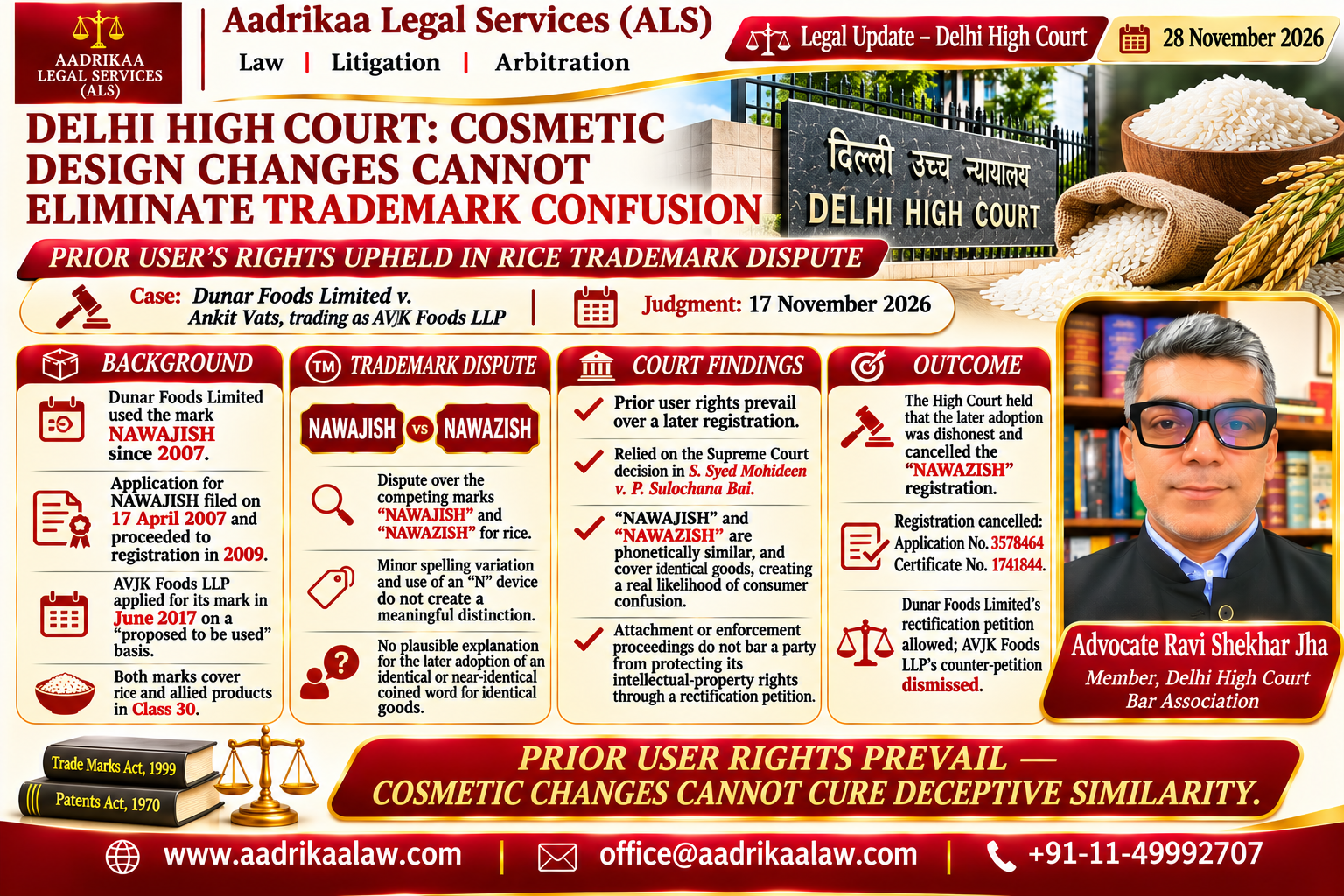
The Delhi High Court has cancelled AVJK Foods LLP’s registration for the “NAWAZISH” mark for rice, holding that Dunar Foods Limited was the prior user and that the later adoption was dishonest and likely to confuse consumers.
Court resolves competing claims over basmati-rice branding
In a trademark rectification dispute between Dunar Foods Limited and Ankit Vats, trading as AVJK Foods LLP, the Delhi High Court considered two competing registrations connected with the names NAWAJISH/NAWAZISH for rice and allied products in Class 30.
Dunar Foods sought cancellation of AVJK Foods’ registration, arguing that it had used and registered the distinctive mark years earlier. AVJK Foods filed a counter-petition challenging Dunar Foods’ mark. The Court allowed Dunar Foods’ petition and dismissed AVJK Foods’ counter-petition.
Justice pronounced the judgment on 17 November 2026.
Dunar Foods established earlier adoption and registration
Dunar Foods relied on a long commercial history in the basmati-rice business and evidence of use of the NAWAJISH mark from 2007. Its registration application for NAWAJISH was filed on 17 April 2007 and proceeded to registration in 2009.
The company also relied on a later application for a stylised/device version of the mark. In that filing, the word was initially recorded as “NAWAGISH” because of a clerical spelling error, later rectified to “NAWAJISH.” The Court treated the evidence as establishing Dunar Foods’ long-standing market presence and prior commercial adoption.
By comparison, AVJK Foods applied for its mark in June 2017 on a “proposed to be used” basis. The Court found no plausible explanation in the record for its adoption of an identical or near-identical coined word for identical goods.
Similar names and packaging created a real risk of confusion
The Court compared the competing marks and trade dress and concluded that they were visually and phonetically identical in the context of rice products. Both parties’ marks covered identical goods in Class 30.
AVJK Foods’ use of an “N” device element did not, in the Court’s view, create a meaningful distinction. The judgment emphasised that consumers generally do not make a detailed side-by-side comparison when purchasing products in the marketplace. A minor design feature was therefore insufficient to eliminate confusion.
The difference between the spellings “NAWAJISH” and “NAWAZISH” also did not assist AVJK Foods. The Court found that the two expressions are phonetically similar and considered the altered spelling a calculated attempt to pass off goods by exploiting Dunar Foods’ earlier goodwill.
Prior user rights prevail over later registration
A central principle in the judgment is that a prior user’s rights are stronger than a later registrant’s rights. Referring to the Supreme Court’s decision in S. Syed Mohideen v. P. Sulochana Bai, the Court reaffirmed that trademark registration cannot displace the rights of an earlier user.
The Court held that Dunar Foods’ prior use and goodwill meant that AVJK Foods’ use of the same or deceptively similar mark for identical goods was likely to deceive consumers about the source of the rice products. This brought the later registration into conflict with the statutory grounds that prevent registration where a mark is deceptive, confusing, or likely to result in passing off.
Objection based on enforcement proceedings did not bar the case
AVJK Foods argued that Dunar Foods lacked standing to bring the rectification proceedings because of proceedings connected with the Maharashtra Protection of Interest of Depositors Act and enforcement actions. The Court rejected that objection.
It held that protecting intellectual-property rights through legal proceedings did not amount to creating third-party rights in the intellectual property. An attachment or restriction on dealing with property did not erase Dunar Foods’ rights or prevent it from seeking protection of those rights through a trademark rectification petition.
Registration cancelled; counter-petition dismissed
The Court found AVJK Foods’ adoption of the impugned mark dishonest and contrary to the Trade Marks Act, 1999. It therefore cancelled the registration for “NAWAZISH”, Application No. 3578464 in Class 30, together with Registration Certificate No. 1741844.
AVJK Foods’ petition challenging Dunar Foods’ trademark was dismissed. All pending applications in both matters were disposed of, and the hearing date previously set before the Joint Registrar was cancelled.
Why the decision matters for brand owners
The ruling reinforces several important trademark principles for businesses:
- Earlier commercial use can outweigh a later registration. Registration is valuable, but it does not defeat the superior rights of a genuine prior user.
- Small spelling or design changes may not avoid infringement or cancellation. Where names sound alike and the products are the same, courts will assess the practical likelihood of consumer confusion.
- A distinctive coined mark receives stronger protection. The Court noted that “NAWAJISH” was not a common dictionary word, making an unexplained identical adoption particularly difficult to justify.
- The reason for adoption matters. A party adopting a similar mark for identical goods should be able to demonstrate an honest, independent, and bona fide explanation.
For brand owners, the case underscores the value of maintaining evidence of first use, registrations, packaging history, sales, and market goodwill. Those records can be decisive when defending a brand against a later adopter in the same product category.
The decision ultimately confirms that trademark law protects marketplace clarity: a later trader cannot rely on a minor spelling variation or device element to appropriate the established reputation of an earlier brand owner.
Aadrikaa Legal Services is a trusted legal and regulatory support partner providing end-to-end legal solutions to law firms, corporate organizations, and businesses across India. We specialize in paralegal services, litigation support, tax and regulatory matters, delivering reliable, efficient, and result-oriented legal assistance.
Our services include comprehensive paralegal support, drafting and documentation, legal research, case management, litigation handling, and representation support across various judicial and quasi-judicial forums. We also assist in direct and indirect tax matters, customs, GST, corporate regulatory compliance, and legal advisory.
Source: Delhi High Court
Handy Download:
Write to us at office@aadrikaalaw.com
Tel: +91-11-4999 2707
Ravi Shekhar Jha – Advocate, Bar Council of Delhi