Aadrikaa Legal Services (ALS)- Law I Litigation I Arbitration
Date: 31.08.2026
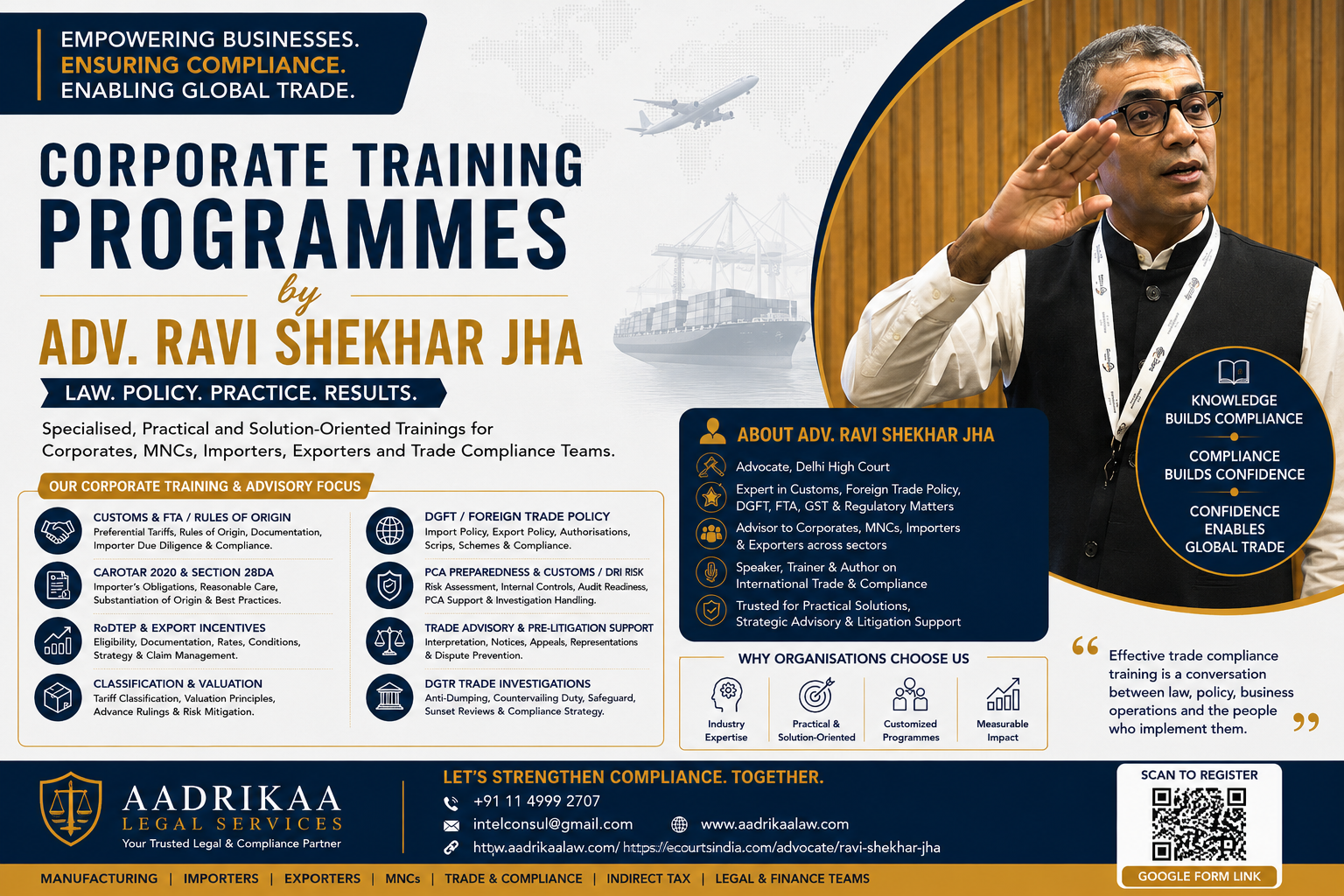
Advocate Ravi Shekhar Jha conducts a corporate Masterclass for Syngenta India on FTAs, CAROTAR 2020, Customs compliance, Rules of Origin, RoDTEP, export incentives and Foreign Trade Policy
This Short Article has been prepared & written by Advocate Ravi Shekhar Jha-Delhi High Court, New Delhi. The views expressed are based on his interpretation of the law. He can be reached at his email id intelconsul@gmail.com .
From Trade Benefits to Trade Readiness — Compliance Must Come First
It was a privilege to conduct an intensive Masterclass on Free Trade Agreements (FTAs), Customs Compliance, RoDTEP and Export Incentives for the Syngenta India team at its Pune headquarters, with professionals participating across functions and geographies.
The programme focused on an increasingly important reality of international trade: trade benefits can be effectively realised only when they are supported by strong regulatory compliance, documentation and internal controls.
The session brought together professionals from Trade Compliance & Customs, R&D, Logistics, GST, Trade Finance and Procurement, resulting in highly engaging discussions around the practical application of Customs law, Foreign Trade Policy and FTA requirements.
From FTA Benefits to Compliance Readiness
A major focus of the programme was the effective utilisation of preferential tariff benefits under India’s Free Trade Agreements.
FTA benefits are not simply about claiming a lower rate of Customs duty. Businesses must consider the complete compliance framework surrounding the transaction, including:
correct tariff classification;
applicable Rules of Origin and Product Specific Rules (PSR);
origin documentation and supporting records;
importer due diligence;
valuation and Customs compliance; and
preparedness for subsequent verification by Customs authorities.
The discussions also examined Section 28DA of the Customs Act, 1962 and CAROTAR 2020, including the importer’s responsibility to exercise reasonable care and maintain sufficient information to substantiate the origin criteria applicable to preferential imports.
The underlying message was clear: a proof/certificate of origin should form part of a wider origin-compliance framework rather than being treated as the sole basis for an FTA claim.
Classification, Valuation and Origin: Connected Compliance Controls
Another important theme was the relationship between tariff classification, Customs valuation and origin. Although these are legally distinct concepts, they frequently interact in determining the ultimate Customs duty exposure, availability of preferential tariff treatment and overall transaction risk.
Businesses therefore need to examine these issues before imports are undertaken, rather than addressing them only when a query is raised during Customs assessment or a subsequent audit or investigation.
RoDTEP & Export Incentives
The programme also covered RoDTEP and India’s export remission and incentive framework, with emphasis on evaluating benefits strategically. Exporters should assess eligibility, notified rates, documentation requirements, product classification and applicable conditions before structuring their claims.
The objective should not merely be to identify available benefits, but to establish processes capable of supporting those benefits during subsequent regulatory scrutiny.
Compliance Should Begin Before the Transaction
Perhaps the most important takeaway from the Masterclass was simple:
Compliance should begin before the transaction — not after Customs raises a query.
Effective trade compliance requires coordination between law, policy and actual business operations. Procurement, logistics, finance, taxation, R&D and trade-compliance teams therefore need to work together rather than treating Customs and FTA compliance as isolated functions.
The quality of participation, practical questions and cross-functional discussions from the Syngenta India team made the programme particularly rewarding. My sincere appreciation to the entire participating team for investing in continuous capability development and for the thoughtful and highly engaging discussions throughout the programme.
Customised Corporate Trade Compliance Programmes
Through Aadrikaa Legal Services, customised executive workshops, corporate training and advisory programmes can be structured for MNCs, manufacturers, importers, exporters and trade-compliance teams covering
a. FTA , CAROTAR 2020 & Section 28DA
b. RoDTEP & export incentives,
c. Classification & General Rules of Interpretation (GRI)
d. Valuation
e. DGFT/Foreign Trade Policy- EPCG/Advance License
f. Customs Special Programmes- SVB, AEO, MOOWR, EMI
g. PCA preparedness and Customs/DRI risk
h. trade advisory and pre-litigation support
i. DGTR trade investigations
j. Customs & allied regulatory laws (PGAs)
Secure your operations. Strengthen compliance. Reduce cross-border friction.
Knowledge builds compliance. Compliance builds confidence. Confidence enables global trade.
Aadrikaa Legal Services is a trusted legal and regulatory support partner providing end-to-end legal solutions to law firms, corporate organizations, and businesses across India. We specialize in paralegal services, litigation support, tax and regulatory matters, delivering reliable, efficient, and result-oriented legal assistance.
Our services include comprehensive paralegal support, drafting and documentation, legal research, case management, litigation handling, and representation support across various judicial and quasi-judicial forums. We also assist in direct and indirect tax matters, customs, GST, corporate regulatory compliance, and legal advisory.
Aadrikaa Legal Services (ALS)- Law I Litigation I Arbitration
Date: 06.08.2026
Locked at the Port: Inside India’s ₹1.52 Trillion Customs Litigation Crisis
This Insightful Article has been prepared & written by Advocate Ravi Shekhar Jha-Delhi High Court, New Delhi. The views expressed are based on his interpretation of the law. He can be reached at his email id intelconsul@gmail.com.
As of recent legal and official reports, there are approximately 38,000 to 40,000 cases pending specifically in customs matters across all major judicial and quasi-judicial forums in India. This represents a massive backlog, with a staggering litigation amount of ₹1.52 lakh crore locked up in these disputes.
The structure of customs litigation in India flows from specialized tribunals up to the apex court. The volume of pending cases is split across three primary tiers:
CESTAT (Customs, Excise and Service Tax Appellate Tribunal): This quasi-judicial tribunal holds the largest chunk of customs-specific backlogs. Out of its total estimated backlog of roughly 72,000 to 80,000 indirect tax cases, customs matters constitute a significant portion.
High Courts: Thousands of customs appeals and writ petitions challenge CESTAT orders or provisional assessments under Section 130 of the Customs Act.
Supreme Court of India: The top court handles high-stakes customs classification and valuation matters. The Central Board of Indirect Taxes and Customs (CBIC) maintains dedicated quarterly tracking of admitted and pending revenue matters awaiting final judgment here.
Core Drivers of Customs Litigation
The persistent accumulation of customs disputes is primarily driven by specific legal and structural bottlenecks:
Classification Disputes (HS Codes): Importers and customs authorities frequently clash over product definitions, especially regarding composite goods and technological items.
Valuation and Transfer Pricing: Intense scrutiny by field formations and Special Valuation Branches (SVBs) over royalties, licence fees, and related-party transaction values routinely feeds new appeals.
Absence of Dispute Settlement Mechanisms: Since the Customs Settlement Commission became unavailable, there is a lack of structured exit paths for legacy cases, prompting trade bodies to heavily advocate for a dedicated Customs Amnesty Scheme.
While the Central Board of Indirect Taxes and Customs (CBIC) does not publish a live, automated dashboard isolating a single static percentage, continuous legal audits, tribunal studies, and trade grievance reports indicate that classification disputes constitute roughly 40% to 50% of all pending customs litigation in India.
When analyzing the volume of disputes and structural bottlenecks, the share of pendency unfolds through specific data points:
The Dominance of Classification in Litigation Volume
The ~45% Structural Share: In overall revenue litigation volumes (spanning CESTAT to the Supreme Court), classification disputes—specifically disagreements over the 8-digit Harmonised System (HS) codes—consistently rank as the single largest category of active court disputes.
Contrasting with Valuation: While technical trade facilitation reports (like those published by NACIN or industry commerce groups) point out that day-to-day clearance friction at port entry levels is heavily dominated by Valuation / Special Valuation Branch (SVB) issues (~19%), Classification issues dominate long-term court backlogs. Valuation disputes are often resolved via financial bonds or provisional clearance, whereas a rigid dispute over an HS code (such as whether an item is a structural component or an electronics accessory) routinely drives deep multi-tier appeals lasting years.
Why Classification Accounts for Nearly Half of the Backlog
The outsized percentage of classification pendency is locked into the system by three factors:
Vast Exemption Dependencies: In Indian customs, a minor change in the assigned HS code can swing an importer’s duty liability from 0% (under free-trade exemptions) to the maximum standard rate. High-stakes corporate demands—such as the landmark $1.4 billion auto-component classification case—clog up appellate backlogs because neither the revenue department nor the corporate entity is willing to yield.
Rapid Technological Evolution: Traditional tariff entries struggle to accommodate modern composite tech imports. High Courts and CESTAT are continually gridlocked trying to determine the “most akin” function of multi-use items (e.g., smart wearable bands vs. watches, or networking module components vs. generic electronic equipment).
The “Extended Period” Trigger: Customs authorities frequently issue Show Cause Notices alleging “willful mis-declaration” under Section 28(4) simply because an importer used a different tariff heading. This escalates minor interpretative differences into high-penalty litigation, compounding the multi-year backlog.
The Over-50% Tariff Trap: Why Pre-PO HSN Vetting is the Ultimate Customs Shield
With customs litigation in India locked in a massive multi-trillion rupee backlog across tribunals and High Courts, a staggering fact stands out to trade compliance officers: classification and related tariff matters account for over 50% of all litigations within the Customs Department.
For businesses relying on global supply chains, entering this judicial gridlock is costly, disruptive, and entirely avoidable.
Moving from ‘Damage Control’ to ‘Preventive Compliance’
The traditional approach to customs disputes in India has long been reactive. Importers frequently discover classification misalignments only after goods land at the port, or when a Show Cause Notice (SCN) is slapped against them alleging mis-declaration under Section 28 of the Customs Act. At this stage, companies are forced into “damage control” mode—submitting provisional bonds, paying differential duties under protest, and entering years of appellate battles.
To safeguard corporate balance sheets, the industry must pivot sharply toward a “preventive” compliance mode.
The absolute best practice to insulate your supply chain is to thoroughly vet the Harmonised System of Nomenclature (HSN), tariff descriptions, and exemption notification conditions even before a Purchase Order (PO) is issued to overseas suppliers.
The Silent Threat: CAROTAR Rules, 2020 and FTA Disallowances
The stakes of incorrect classification have exponentially magnified following the enforcement of the Customs (Administration of Rules of Origin under Trade Agreements) Rules, 2020 (CAROTAR).
Under these rigid regulations, an incorrect HSN or an inaccurate material description on a bill of entry does not just trigger a local classification dispute. It frequently leads to the absolute disallowance of Free Trade Agreement (FTA) or Preferential Trade Agreement (PTA) claims. When an FTA claim is dismantled due to a classification error, the importer is suddenly hit with standard, non-concessional duty rates alongside significant statutory penalties.
Empowering Corporate Teams: The Need for Legal & Classification Training
Technology is a formidable shield, but it is only as powerful as the hands that wield it. To truly institutionalize a preventive mindset, corporate procurement, tax, and logistics teams must be systematically trained on the legal aspects of customs classification.
Understanding the General Rules for the Interpretation (GIR) of the customs tariff, navigating Section and Chapter Notes, and recognizing the strict legal triggers of CAROTAR are no longer skills exclusive to lawyers—they are essential core competencies for modern corporate teams to prevent catastrophic compliance errors at the port.
A Strategic Synergy: Technology Meets Legal Expertise
Recognizing this critical gap where technology must meet seasoned legal interpretation, Treximerce Technology and Consulting LLP and Advocate Ravi Shekhar Jha have teamed up. This unique collaboration bridges the best of both worlds: cutting-edge legal tech and deep courtroom litigation experience.
While Treximerce’s flagship platform, Trade Companion, enables compliance teams to run a precise 10-second verification check to validate HSN accuracy before a contract is signed, our joint advisory framework ensures that corporate teams are deeply trained to understand why those classifications matter legally. This combination short-circuits future complexities and customs litigation before an item ever boards a cargo vessel.
The Verdict
In customs law, a stitch in time doesn’t just save nine—it saves millions in locked-up revenue, bank guarantees, and legal expenses. By integrating automated pre-PO vetting with well-trained corporate teams, your business can confidently navigate India’s customs corridors, ensuring that preferential tariffs are fully protected and port clearances remain completely seamless.
Over 50% of Indian Customs litigation stems from a single vulnerability: HSN Classification.
Is your supply chain operating in a “preventive” mode, or are you constantly stuck in “damage control” after goods hit the port?
Waiting for a Show Cause Notice to verify your tariff headings is a high-risk strategy. An incorrect classification can instantly dismantle your FTA/PTA benefits under the strict CAROTAR Rules, 2020.
The Strategy:
1. Vet your HSN and tariff descriptions before the Purchase Order (PO) is issued. 2. Upskill your corporate procurement and tax teams on the legal nuances of customs classification.
To solve this exact bottleneck, Treximerce Technology and Consulting LLP and I have joined forces. By pairing their advanced Trade Companion platform—which allows a precise, 10-second HSN check—with specialized legal training and advisory, we are helping corporate teams kill litigation before it even starts.
How Advocate Ravi Shekhar Jha and Treximerce Train Corporate Teams to Kill Customs Litigation before placing the PO
Through a powerful blend of courtroom litigation experience and cutting-edge trade intelligence, Advocate Ravi Shekhar Jha and Treximerce are fundamentally rewriting how businesses approach border compliance. Their joint masterclasses dismantle traditional, reactive “damage control” by training corporate procurement, tax, and logistics teams to master the technical intricacies of the General Rules of Interpretation (GIR), Chapter Notes, and strict CAROTAR 2020 legal triggers. By transforming raw legal principles into actionable operational workflows, this collaborative training empowers your workforce to spot high-risk tariff anomalies and execute precise HSN vetting before a Purchase Order is ever issued—effectively killing multi-year customs disputes and catastrophic FTA disallowances at the absolute root of the supply chain. To ensure a seamless transition from theory to real-world application, every trainee receives complimentary, unrestricted access to the powerful Trade Companion product for 7 calendar days (1 week) absolutely FREE.
Aadrikaa Legal Services is a trusted legal and regulatory support partner providing end-to-end legal solutions to law firms, corporate organizations, and businesses across India. We specialize in paralegal services, litigation support, tax and regulatory matters, delivering reliable, efficient, and result-oriented legal assistance.
Our services include comprehensive paralegal support, drafting and documentation, legal research, case management, litigation handling, and representation support across various judicial and quasi-judicial forums. We also assist in direct and indirect tax matters, customs, GST, corporate regulatory compliance, and legal advisory.
Source: The Original News Piece was published on the website of Times of India
Aadrikaa Legal Services (ALS) – IDT Tax I Arbitration I Litigation
Date: 15.07.2026
CESTAT Delhi Upholds Validity of Country of Origin Certificates Under India-Thailand FTA
This Short Article has been prepared & written by Advocate Ravi Shekhar Jha-Delhi High Court, New Delhi. The views expressed are based on his interpretation of the law. He can be reached at his email id intelconsul@gmail.com .
The Customs, Excise & Service Tax Appellate Tribunal (CESTAT), New Delhi, recently delivered a significant judgment in favor of M/s. P.C. Jeweller Limited and its key officials. The case revolved around the import of diamond-studded gold jewellery from Thailand and the validity of Country of Origin (COO) certificates under the India-Thailand Free Trade Agreement (FTA). This article provides a detailed overview of the case, the legal issues involved, and the implications of the Tribunal’s decision.
Background of the Case
Between 2010-11 and 2011-12, P.C. Jeweller Limited imported diamond-studded gold jewellery from Thailand, filing 24 Bills of Entry and claiming preferential customs duty benefits under Notification No. 85/2004-Customs and Notification No. 101/2004-Customs (NT). Each import was accompanied by a COO certificate from Thai authorities, as required under the FTA.
At the time of import, customs authorities cleared the goods without raising any objections regarding the description, quantity, value, or the COO certificates. However, in December 2012, the Directorate of Revenue Intelligence (DRI) initiated an investigation, alleging that the COO certificates reflected inflated local value addition in Thailand, thereby wrongly availing FTA benefits.
Key Allegations and Proceedings
DRI’s Allegations:
The COO certificates did not meet the mandatory regional value content of at least 80% as required for FTA benefits.
Value addition was uniformly declared as 22%, regardless of the jewellery’s specifics, suggesting misrepresentation.
The investigation relied on statements from third parties and other jewellers, not on direct verification with Thai authorities.
Show Cause Notice and Adjudication:
Based on the DRI’s findings, a show cause notice was issued, demanding duty and proposing penalties against P.C. Jeweller and its officials.
The adjudicating authority confirmed the demand and imposed penalties.
Legal Arguments by the Appellants
The appellants argued that:
All required documents, including COO certificates, were submitted at the time of import and verified by customs.
The DRI’s allegations were based on indirect evidence and not on verification with the issuing authority in Thailand.
As per the ‘Interim Rules of Origin’ and related procedures, any doubt about a COO certificate’s authenticity must be resolved by retroactive verification with the issuing authority, which was not done in this case.
The Tribunal’s earlier decision in the case of Hazoorilal & Sons Jewellers supported their position.
Tribunal’s Findings and Decision
The CESTAT bench, comprising Hon’ble Mr. Ashok Jindal (Judicial) and Mr. K. Anpazhakan (Technical), made the following key observations:
Procedural Lapse by DRI:
The DRI did not follow the prescribed mechanism under Rule 14 and Rule 15 of the ‘Interim Rules of Origin’ for verifying COO certificates.
Instead of seeking retroactive verification from Thai authorities, the DRI relied on statements from unrelated parties.
Importance of Proper Verification:
The Tribunal emphasized that doubts about COO certificates must be addressed through official channels, as outlined in the FTA’s operational procedures.
Failure to follow these procedures invalidates the basis for denying FTA benefits.
Setting Aside the Demand and Penalties:
The Tribunal set aside the impugned order, dropped the demand for duty, and nullified all penalties against the appellants.
The appeals were allowed with consequential relief.
Implications of the Judgment
This ruling reinforces the importance of adhering to prescribed verification procedures in trade agreement cases. It protects importers from arbitrary denial of benefits based on unverified allegations and upholds the sanctity of international certification processes.
Key Takeaways for Importers
Maintain Complete Documentation: Always ensure all required certificates and documents are filed at the time of import.
Know Your Rights: If COO certificates are challenged, insist on proper verification with the issuing authority as per the relevant rules.
Legal Precedent: This judgment can be cited in similar disputes involving FTAs and COO certificates.
Conclusion
The CESTAT Delhi’s decision in favor of P.C. Jeweller Limited is a landmark in the interpretation of trade agreement procedures and the protection of importers’ rights. It underscores the necessity for authorities to follow due process and provides clarity on the handling of COO certificate disputes under FTAs.
ALO Law Office- IDT Tax I Arbitration I Litigation
Date: 09.06.2025
CESTAT Mumbai Quashes Customs Duty Demand on Gold Jewellery Imports Under India–Thailand FTA
The Customs, Excise & Service Tax Appellate Tribunal (CESTAT), Mumbai has set aside the denial of concessional customs duty benefits to importers of gold jewellery from Thailand under the India–Thailand Free Trade Agreement (FTA). The Tribunal held that customs authorities cannot unilaterally reject the Certificate of Origin (CoO) issued by the exporting country without following the designated verification mechanism under the FTA framework.
This landmark decision comes as a relief to several importers who were denied preferential duty benefits despite submitting valid CoOs issued by the Thai authorities.
Background of the Dispute
Multiple importers imported gold jewellery from Thailand, availing concessional duty benefits under the India–Thailand Early Harvest Scheme of the FTA.
The Customs Department rejected the declared origin, citing improper documentation and alleged non-fulfilment of origin criteria, and demanded differential duty along with interest and penalties.
The Department proceeded without referring the matter to the Designated Authority in Thailand as per the dispute resolution procedure of the FTA.
This Article has been written by Shri Ravi Shekhar Jha, Advocate Delhi High Court based on his interpretation of the law. He can be reached at his email id intelconsul@gmail.com or on his Mobile +91-9999005379.