Tag: #IndirectTaxMatters

  • Analysis of Country of Origin Misdeclaration, Procedural Safeguards, and Extended Limitation under Customs Law

    Analysis of Country of Origin Misdeclaration, Procedural Safeguards, and Extended Limitation under Customs Law

    Date: 01.09.2026

    The Customs, Excise & Service Tax Appellate Tribunal (CESTAT) at Ahmedabad recently delivered a significant order in the case of Imperial Fibres Pvt. Ltd., addressing allegations of misdeclaration of the country of origin for imported polyester knitted fabrics. This case highlights the complexities of customs law, the importance of procedural compliance, and the evidentiary standards required to establish fraud in international trade.

    Background of the Case

    Imperial Fibres Pvt. Ltd., based in New Delhi, is engaged in the import and trading of polyester knitted fabrics. The company imported goods under preferential tariff benefits available for imports from ASEAN countries, specifically Malaysia, under Notification No. 46/2011-Cus. However, the Directorate of Revenue Intelligence (DRI) alleged that the company misdeclared the country of origin as Malaysia, while the goods were actually from China, to wrongfully avail duty concessions.

    Key Allegations and Investigations

    • Misdeclaration of Origin: DRI claimed that Imperial Fibres used fabricated Certificates of Origin (COO) to show Malaysia as the origin, while the goods were Chinese.
    • Verification Process: Out of 29 COO certificates, only 15 were verified by Malaysian authorities, who reported them as not authentic and belonging to another company.
    • Procedural Delays: The verification process was delayed beyond the prescribed period, and test results on samples drawn from consignments were not provided.
    • Statements and Evidence: The director, Mr. Varun Goyal, maintained that he relied on documents provided by suppliers and had no reason to doubt their authenticity. The department, however, cited a later statement as an admission of awareness about the fabricated certificates.

    Legal Arguments

    Appellant’s Grounds

    1. Partial Verification: Only 15 out of 29 COO certificates were verified. The appellant argued that demands could only be confirmed for those verified, not all.
    2. Limitation Period: The show cause notice was issued well beyond the normal period. The appellant contended that the extended period for raising demands requires proof of fraud or collusion, which was not established.
    3. Procedural Lapses: The department failed to follow mandatory procedures under the Rules of Origin, including timely verification and detailed clarification from the issuing authority.
    4. Lack of Evidence: No test reports or expert analysis were provided to conclusively prove the goods were of Chinese origin or that the importer was complicit in any fraud.

    Department’s Position

    • The department argued that the pattern of invoices, signature mismatches, and the director’s statements established a modus operandi of fraud.
    • They maintained that the extended period for demand and penalties was justified due to willful misstatement and suppression of facts.
    • The department relied on Rule 23 of the Origin Rules, which deals with fraudulent acts, to justify bypassing certain procedural requirements.

    Tribunal’s Analysis and Findings

    Procedural Compliance

    The Tribunal emphasized that procedural safeguards under Rules 7(c) and 7(d) of the Origin Rules are mandatory, even in cases of suspected fraud. The department’s reliance on Rule 23 to override these procedures was rejected.

    Evidence and Burden of Proof

    • The Tribunal found that the evidence provided by the department was insufficient to conclusively establish fraud or conscious involvement by the importer.
    • The lack of timely verification, absence of test reports, and failure to authenticate documents as per legal standards weakened the department’s case.
    • The Tribunal cited several precedents, highlighting that extended limitation periods and penalties require clear proof of willful misstatement or collusion by the importer.

    Limitation and Demand

    • The show cause notice was issued beyond the normal limitation period without adequate evidence of fraud.
    • Demands could only be confirmed for the certificates that were actually verified and found to be non-authentic.
    • The Tribunal held that the extended period under Section 28(4) of the Customs Act could not be invoked in the absence of proven malafide intent.

    Key Takeaways for Importers and Trade Professionals

    1. Strict Adherence to Procedures: Customs authorities must follow all procedural requirements for verification and denial of preferential tariff treatment.
    2. Burden of Proof: The onus is on the department to prove fraud or willful misstatement; mere suspicion or incomplete verification is insufficient.
    3. Timely Action: Delays in verification or issuing show cause notices can render demands unsustainable.
    4. Document Authentication: Evidence from foreign authorities must be properly authenticated and corroborated.
    5. Rights of Importers: Importers are entitled to detailed clarifications and the opportunity to respond to allegations before adverse actions are taken.

    Conclusion

    The Imperial Fibres Pvt. Ltd. case underscores the importance of due process and evidentiary rigor in customs investigations. While combating fraud is essential, authorities must ensure that procedural safeguards are respected and that demands are based on solid, timely, and authenticated evidence. This decision serves as a valuable reference for both importers and customs officials navigating the complexities of international trade compliance.

    Aadrikaa Legal Services is a trusted legal and regulatory support partner providing end-to-end legal solutions to law firms, corporate organizations, and businesses across India. We specialize in paralegal services, litigation support, tax and regulatory matters, delivering reliable, efficient, and result-oriented legal assistance.

    Our services include comprehensive paralegal support, drafting and documentation, legal research, case management, litigation handling, and representation support across various judicial and quasi-judicial forums. We also assist in direct and indirect tax matters, customs, GST, corporate regulatory compliance, and legal advisory.

    Handy Download:

    Ravi Shekhar Jha – Advocate, Bar Council of Delhi

  • Balancing Stringent Bail Provisions and the Right to Speedy Trial: Supreme Court on Prolonged Undertrial Detention under the NDPS Act

    Balancing Stringent Bail Provisions and the Right to Speedy Trial: Supreme Court on Prolonged Undertrial Detention under the NDPS Act

    Date: 01.09.2026

    The Supreme Court of India’s decision in the case of Mohd Muslim @ Hussain v. State (NCT of Delhi) is a landmark judgment that reaffirms the constitutional right to a speedy trial and examines the balance between individual liberty and public interest in the context of stringent bail provisions under special laws like the Narcotic Drugs and Psychotropic Substances Act, 1985 (NDPS Act).

    Background of the Case

    • Case Overview: The appellant, Mohd Muslim, was accused under Sections 20, 25, and 29 of the NDPS Act for alleged involvement in a drug trafficking network. He was arrested in October 2015 and remained in custody for over seven years, with the trial progressing slowly and only about half the witnesses examined.
    • Key Facts:
      • The appellant was not found in possession of narcotics at the time of arrest.
      • The prosecution relied on call records and bank transactions to implicate him.
      • Two co-accused, similarly situated, had already been granted bail.

    Legal Issues and Arguments

    1. Right to Speedy Trial under Article 21

    • The Supreme Court reiterated that the right to a speedy trial is an essential part of the right to life and liberty under Article 21 of the Constitution.
    • Prolonged incarceration without conclusion of trial amounts to a violation of this fundamental right.

    2. Stringent Bail Provisions under NDPS Act (Section 37)

    • Section 37 imposes strict conditions for granting bail, requiring the court to be satisfied that the accused is not guilty and is unlikely to commit any offence while on bail.
    • The Court noted that such provisions are justified only if trials are conducted expeditiously.

    3. Balancing Liberty and Public Interest

    • The judgment emphasized the need to balance the presumption of innocence and individual liberty with societal interest in preventing serious crimes.
    • However, when trials are unduly delayed, continued detention becomes punitive and unjust.

    Supreme Court’s Analysis

    1. Precedents Cited:
      • The Court referred to earlier judgments (e.g., Hussainara Khatoon, Abdul Rehman Antulay, Supreme Court Legal Aid Committee) that established the right to speedy trial and the need for fairness in criminal proceedings.
    2. Application of Section 436A CrPC:
      • The Court clarified that Section 436A, which mandates release on bail if an undertrial has spent half the maximum possible sentence in custody, applies even to special laws like the NDPS Act.
    3. Impact of Prolonged Incarceration:
      • The judgment highlighted the negative effects of long-term imprisonment, especially for undertrials from weaker economic backgrounds, including loss of livelihood, family disruption, and risk of further criminalization.
    4. Judicial Discretion:
      • Courts must interpret bail restrictions reasonably and ensure that denial of bail does not result in preventive detention without trial.

    Key Takeaways from the Judgment

    1. Speedy Trial is Non-Negotiable:
      • The right to a speedy trial is integral to justice and cannot be sacrificed, even under special statutes with stringent bail conditions.
    2. Bail Cannot Be Denied Indefinitely:
      • If the trial is unduly delayed and the accused has spent a significant period in custody, bail should be considered, subject to reasonable conditions.
    3. Need for Judicial Sensitivity:
      • Courts must be sensitive to the socio-economic impact of prolonged incarceration and ensure that justice is not denied by delay.
    4. Systemic Reforms Needed:
      • The judgment calls for efficient investigation, adequate judicial infrastructure, and strict compliance with procedural safeguards to prevent miscarriage of justice.

    Conclusion

    The Supreme Court’s decision in Mohd Muslim @ Hussain serves as a crucial reminder that the justice system must uphold the fundamental rights of the accused, even while addressing serious crimes. Stringent bail provisions must be balanced with the constitutional mandate for a fair and speedy trial. The judgment not only granted bail to the appellant but also set a precedent for future cases involving prolonged undertrial detention under special laws.

    Aadrikaa Legal Services is a trusted legal and regulatory support partner providing end-to-end legal solutions to law firms, corporate organizations, and businesses across India. We specialize in paralegal services, litigation support, tax and regulatory matters, delivering reliable, efficient, and result-oriented legal assistance.

    Our services include comprehensive paralegal support, drafting and documentation, legal research, case management, litigation handling, and representation support across various judicial and quasi-judicial forums. We also assist in direct and indirect tax matters, customs, GST, corporate regulatory compliance, and legal advisory.

    Handy Download:

    Ravi Shekhar Jha – Advocate, Bar Council of Delhi

  • Bombay High Court Sets Aside Patent Refusal for Safety Syringe

    Bombay High Court Sets Aside Patent Refusal for Safety Syringe

    Date: 01.09.2026

    A recent judgment by the Bombay High Court has brought significant attention to the standards of reasoning required in patent application decisions. The case, Medipack Global Ventures Private Limited vs. Assistant Controller of Patents, centered on the rejection of a patent application for a novel safety syringe. This article provides a detailed overview of the dispute, the legal arguments, and the implications of the Court’s decision for patent applicants and the Indian patent system.

    Background: The Patent Application

    Medipack Global Ventures filed a patent application for a single-use safety syringe designed to prevent reuse and reduce infection risks. The invention featured:

    1. A barrel with inner tear-off notches
    2. A plunger with a breakable section and locking grooves
    3. A removable spacer to prevent premature plunger entry

    The design ensured that after use, the plunger would lock and break, rendering the syringe unusable and thus enhancing patient safety.

    The Dispute: Grounds for Rejection

    The Assistant Controller of Patents rejected the application on two grounds:

    • Lack of novelty
    • Lack of inventive step

    Medipack challenged this decision, arguing that:

    • The hearing notice only raised the issue of inventive step, not novelty.
    • The rejection order lacked independent reasoning and merely reproduced prior art and the applicant’s claims without substantive analysis.

    Key Legal Arguments

    Petitioner (Medipack Global Ventures)

    • Violation of Natural Justice: The Controller introduced a novelty objection in the final order without prior notice, denying the applicant a chance to respond.
    • Non-Speaking Order: The order failed to provide independent reasoning or analysis, simply copying claims and prior art without mapping or explaining how the invention was anticipated or obvious.
    • Failure to Follow Patent Office Manual: The Controller did not conduct a holistic assessment of the invention as required by the Patent Office Manual, nor did it provide structured reasoning for combining prior art.
    • Reliance on Precedents: The petitioner cited Delhi High Court cases criticizing the endemic problem of non-speaking, copy-paste orders in patent refusals.

    Respondent (Assistant Controller of Patents)

    • Order Should Be Read as a Whole: The respondent argued that the order, when read in its entirety, showed due consideration of the claims and prior art.
    • Implicit Reasoning: The respondent maintained that the Controller’s reasoning was implicit in the order, even if not explicitly detailed.

    The Court’s Analysis and Decision

    Justice Arif S. Doctor found in favor of Medipack Global Ventures, highlighting several critical points:

    1. Natural Justice Breach: The Controller rejected the application on novelty grounds without prior notice, violating the applicant’s right to respond.
    2. Lack of Reasoned Order: The order was unreasoned, merely reproducing claims and prior art without explaining how the invention was anticipated or obvious.
    3. Requirement for Speaking Orders: The Court reiterated that patent refusal orders must be reasoned and address each objection systematically, as established in prior Delhi High Court rulings.
    4. Failure to Follow Procedure: The Controller ignored the Patent Office Manual’s requirement for a holistic and structured inventive step analysis.

    Final Order

    • The impugned order was set aside.
    • The matter was remanded for fresh consideration by a different Controller.
    • The Court clarified that no aspersion was cast on the previous Controller.

    Implications for Patent Applicants and the Patent Office

    This judgment reinforces the necessity for:

    • Transparent and Reasoned Decisions: Patent authorities must provide clear, detailed reasoning for refusals, addressing each objection and applicant submission.
    • Adherence to Natural Justice: Applicants must be given notice of all grounds for refusal and an opportunity to respond.
    • Structured Analysis: Decisions must follow the guidelines in the Patent Office Manual, especially regarding inventive step and novelty.

    Conclusion

    The Bombay High Court’s decision in the Medipack case is a significant step toward improving the quality and transparency of patent examination in India. It serves as a reminder to both applicants and patent authorities of the importance of reasoned, fair, and procedurally sound decision-making in the patent process.

    Aadrikaa Legal Services is a trusted legal and regulatory support partner providing end-to-end legal solutions to law firms, corporate organizations, and businesses across India. We specialize in paralegal services, litigation support, tax and regulatory matters, delivering reliable, efficient, and result-oriented legal assistance.

    Our services include comprehensive paralegal support, drafting and documentation, legal research, case management, litigation handling, and representation support across various judicial and quasi-judicial forums. We also assist in direct and indirect tax matters, customs, GST, corporate regulatory compliance, and legal advisory.

    Handy Download:

    Ravi Shekhar Jha – Advocate, Bar Council of Delhi

  • Advocate Ravi Shekhar Jha conducts a corporate Masterclass for Syngenta India on FTAs, CAROTAR 2020, Customs compliance, Rules of Origin, RoDTEP, export incentives and Foreign Trade Policy

    Advocate Ravi Shekhar Jha conducts a corporate Masterclass for Syngenta India on FTAs, CAROTAR 2020, Customs compliance, Rules of Origin, RoDTEP, export incentives and Foreign Trade Policy

    Date: 31.08.2026

    From Trade Benefits to Trade Readiness β€” Compliance Must Come First

    It was a privilege to conduct an intensive Masterclass on Free Trade Agreements (FTAs), Customs Compliance, RoDTEP and Export Incentives for the Syngenta India team at its Pune headquarters, with professionals participating across functions and geographies.

    The programme focused on an increasingly important reality of international trade: trade benefits can be effectively realised only when they are supported by strong regulatory compliance, documentation and internal controls.

    The session brought together professionals from Trade Compliance & Customs, R&D, Logistics, GST, Trade Finance and Procurement, resulting in highly engaging discussions around the practical application of Customs law, Foreign Trade Policy and FTA requirements.

    From FTA Benefits to Compliance Readiness

    A major focus of the programme was the effective utilisation of preferential tariff benefits under India’s Free Trade Agreements.

    FTA benefits are not simply about claiming a lower rate of Customs duty. Businesses must consider the complete compliance framework surrounding the transaction, including:

    • correct tariff classification;
    • applicable Rules of Origin and Product Specific Rules (PSR);
    • origin documentation and supporting records;
    • importer due diligence;
    • valuation and Customs compliance; and
    • preparedness for subsequent verification by Customs authorities.

    The discussions also examined Section 28DA of the Customs Act, 1962 and CAROTAR 2020, including the importer’s responsibility to exercise reasonable care and maintain sufficient information to substantiate the origin criteria applicable to preferential imports.

    The underlying message was clear: a proof/certificate of origin should form part of a wider origin-compliance framework rather than being treated as the sole basis for an FTA claim.

    Classification, Valuation and Origin: Connected Compliance Controls

    Another important theme was the relationship between tariff classification, Customs valuation and origin. Although these are legally distinct concepts, they frequently interact in determining the ultimate Customs duty exposure, availability of preferential tariff treatment and overall transaction risk.

    Businesses therefore need to examine these issues before imports are undertaken, rather than addressing them only when a query is raised during Customs assessment or a subsequent audit or investigation.

    RoDTEP & Export Incentives

    The programme also covered RoDTEP and India’s export remission and incentive framework, with emphasis on evaluating benefits strategically. Exporters should assess eligibility, notified rates, documentation requirements, product classification and applicable conditions before structuring their claims.

    The objective should not merely be to identify available benefits, but to establish processes capable of supporting those benefits during subsequent regulatory scrutiny.

    Compliance Should Begin Before the Transaction

    Perhaps the most important takeaway from the Masterclass was simple:

    Compliance should begin before the transaction β€” not after Customs raises a query.

    Effective trade compliance requires coordination between law, policy and actual business operations. Procurement, logistics, finance, taxation, R&D and trade-compliance teams therefore need to work together rather than treating Customs and FTA compliance as isolated functions.

    The quality of participation, practical questions and cross-functional discussions from the Syngenta India team made the programme particularly rewarding. My sincere appreciation to the entire participating team for investing in continuous capability development and for the thoughtful and highly engaging discussions throughout the programme.

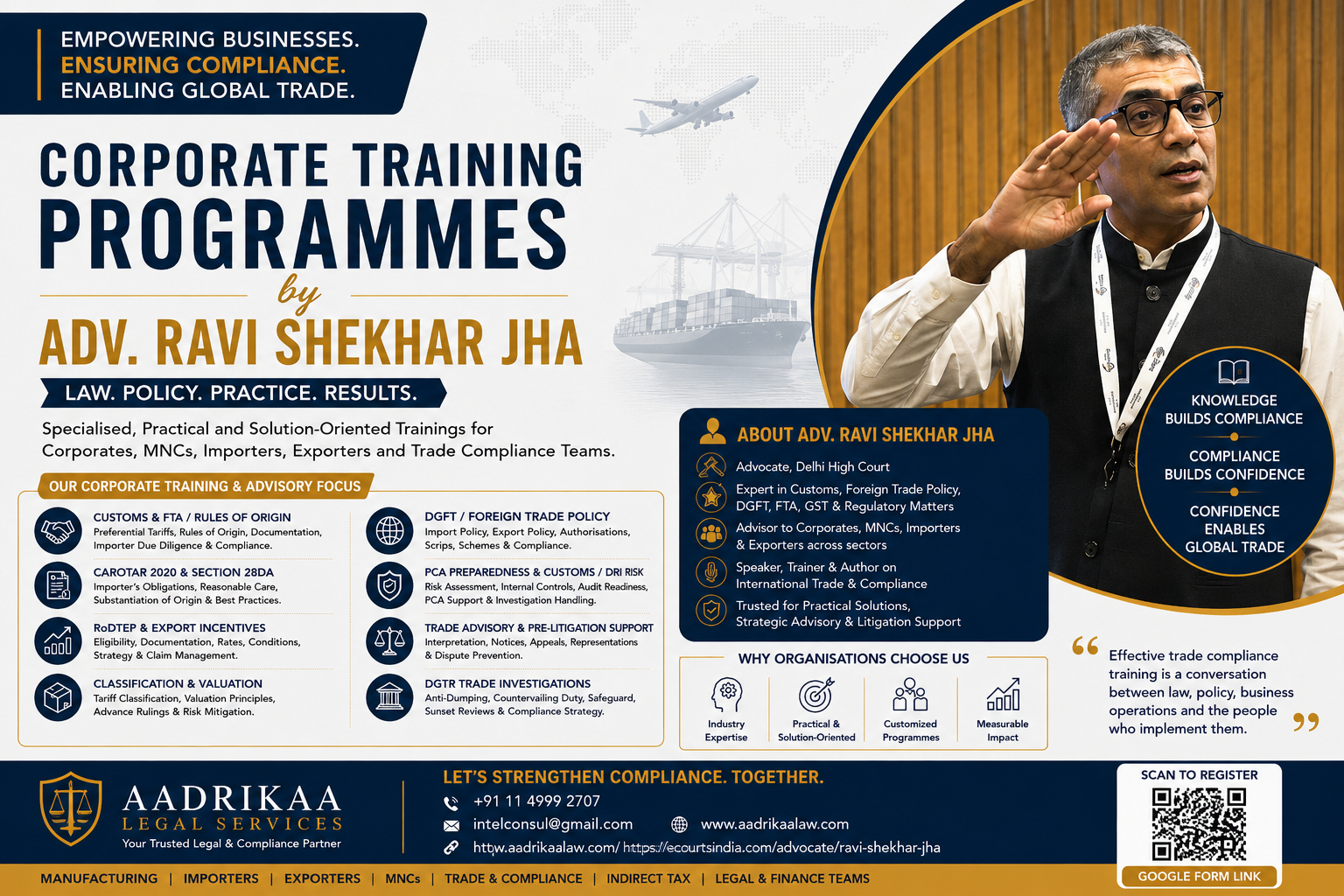
    Customised Corporate Trade Compliance Programmes

    Through Aadrikaa Legal Services, customised executive workshops, corporate training and advisory programmes can be structured for MNCs, manufacturers, importers, exporters and trade-compliance teams covering

    a. FTA , CAROTAR 2020 & Section 28DA

    b. RoDTEP & export incentives,

    c. Classification & General Rules of Interpretation  (GRI)

    d. Valuation

    e. DGFT/Foreign Trade Policy- EPCG/Advance License

    f. Customs Special Programmes- SVB, AEO, MOOWR, EMI

    g. PCA preparedness and Customs/DRI risk

    h. trade advisory and pre-litigation support

    i. DGTR trade investigations

    j. Customs & allied regulatory laws (PGAs)

    Secure your operations. Strengthen compliance. Reduce cross-border friction.

    Advocate Ravi Shekhar Jha
    Customs | Foreign Trade Policy | FTA | Trade & Regulatory Advisory

    Google Form Link

    🌐 Aadrikaa Legal Services
    πŸ“§ intelconsul@gmail.com
    βš–οΈ Professional Profile – Advocate Ravi Shekhar Jha

    Knowledge builds compliance. Compliance builds confidence. Confidence enables global trade.

    Aadrikaa Legal Services is a trusted legal and regulatory support partner providing end-to-end legal solutions to law firms, corporate organizations, and businesses across India. We specialize in paralegal services, litigation support, tax and regulatory matters, delivering reliable, efficient, and result-oriented legal assistance.

    Our services include comprehensive paralegal support, drafting and documentation, legal research, case management, litigation handling, and representation support across various judicial and quasi-judicial forums. We also assist in direct and indirect tax matters, customs, GST, corporate regulatory compliance, and legal advisory.

  • Karnataka High Court Grants Bail to Nigerian National in Major NDPS Drug Trafficking After Four Years in Custody

    Karnataka High Court Grants Bail to Nigerian National in Major NDPS Drug Trafficking After Four Years in Custody

    Date: 31.08.2026

    A recent order by the High Court of Karnataka has brought significant attention to the legal processes surrounding bail for foreign nationals accused under the Narcotic Drugs and Psychotropic Substances (NDPS) Act. The case involves Mr. Samuel Chinweike Anoh, a Nigerian national, who was granted bail after spending over four years in custody, despite serious allegations of drug trafficking. This article provides a detailed overview of the case, the court’s reasoning, and the broader legal context.

    Background of the Case

    • Case Details:
      • Petitioner: Mr. Samuel Chinweike Anoh (Accused No. 3)
      • Respondent: Union of India, represented by the Customs Intelligence Unit (CIU), Bengaluru
      • Offences: Sections 8(c), 21(c), 22, 23, 28, and 29 of the NDPS Act
      • Allegations: Involvement in the shipment and attempted collection of consignments containing MDMA (4.581 kg) and heroin (1.002 kg) disguised as machine parts and personal items.
    • Chronology:
      • Shipments intercepted at FedEx, Bengaluru, based on credible information.
      • Accused Nos. 1 and 2 arrested while collecting the shipments; contraband seized from their possession.
      • Petitioner (Accused No. 3) arrested based on their confession statements.
      • Petitioner remained in custody for over four years; trial delayed at the stage of witness examination.

    Legal Arguments and Court Observations

    Arguments by the Petitioner

    • No contraband was seized from the petitioner directly.
    • Arrest and charges based solely on co-accused confessions.
    • Co-accused (Accused Nos. 1 and 2) had already been granted bail due to prolonged incarceration and trial delays.
    • Petitioner has been in custody for an extended period with little progress in the trial.

    Arguments by the Respondent

    • Petitioner allegedly played an active role and has similar criminal antecedents.
    • As a foreign national without valid documents, the petitioner poses a flight risk and must be detained even if granted bail, as per Supreme Court and High Court precedents.

    Court’s Analysis

    • Delay in Trial: The court noted that out of eight charge sheet witnesses, not even one had been fully examined after four years, echoing Supreme Court judgments that prolonged incarceration without trial progress justifies bail.
    • No Direct Seizure: The petitioner was not found in possession of contraband; his arrest was based on confessions of others.
    • Precedents Cited:
      • Chitta Biswas v. State of West Bengal: Bail granted due to long custody and slow trial.
      • Nitish Adhikary v. State of West Bengal: Bail granted when only one witness examined after long custody.
      • Mohd. Muslim v. State (NCT of Delhi): Courts should consider bail if guilt is not prima facie established and trial is unduly delayed.
      • Javed Gulam Nabi Shaikh v. State of Maharashtra: Right to speedy trial under Article 21 applies regardless of crime seriousness.

    Guidelines for Foreign Nationals

    The court reiterated and applied guidelines from previous judgments regarding foreign nationals:

    • Immediate initiation of deportation proceedings if a foreign national is found without valid documents.
    • If bail is granted, the individual must be detained in a detention center until trial concludes or deportation is arranged.
    • Courts and authorities must prioritize speedy disposal of such cases and ensure humane treatment in detention centers.

    Bail Order and Conditions

    The High Court allowed the bail petition with the following conditions:

    1. Execution of a personal bond of Rs. 1,00,000 with two sureties.
    2. Detention in a designated center in Bangalore until the trial concludes.
    3. Regular appearance before the trial court.
    4. No tampering with evidence or witnesses.
    5. No involvement in similar offences in the future.

    Broader Legal Implications

    • Right to Speedy Trial: The order reinforces the constitutional right to a speedy trial, especially in cases involving severe charges under the NDPS Act.
    • Treatment of Foreign Nationals: The judgment clarifies the process for handling foreign nationals accused of serious crimes, balancing legal procedures with human rights and national security.
    • Judicial Precedents: The court’s reliance on Supreme Court decisions ensures consistency and fairness in bail jurisprudence, even in high-stakes narcotics cases.

    Conclusion

    This case highlights the importance of upholding fundamental rights, even in serious criminal matters. The High Court’s decision underscores the judiciary’s commitment to fair trial standards, due process, and humane treatment of all accused, including foreign nationals, while ensuring that legal safeguards and national interests are maintained.

    Aadrikaa Legal Services is a trusted legal and regulatory support partner providing end-to-end legal solutions to law firms, corporate organizations, and businesses across India. We specialize in paralegal services, litigation support, tax and regulatory matters, delivering reliable, efficient, and result-oriented legal assistance.

    Our services include comprehensive paralegal support, drafting and documentation, legal research, case management, litigation handling, and representation support across various judicial and quasi-judicial forums. We also assist in direct and indirect tax matters, customs, GST, corporate regulatory compliance, and legal advisory.

    Handy Download:

    Ravi Shekhar Jha – Advocate, Bar Council of Delhi

  • Customs Classification of Imported Polyester Knitted Fabrics

    Customs Classification of Imported Polyester Knitted Fabrics

    Date: 31.08.2026

    The Customs, Excise and Service Tax Appellate Tribunal (CESTAT), Kolkata, recently delivered a significant judgment in the case of M/s. Elvance Overseas LLP regarding the customs classification and duty assessment of imported polyester knitted fabrics. This article provides a detailed overview of the dispute, the legal arguments, and the Tribunal’s final decision, offering valuable insights for importers, customs professionals, and legal practitioners.

    Background of the Case

    Elvance Overseas LLP, a Delhi-based importer, brought in consignments described as “Mixed Lot of Polyester Knitted Fabrics” from Chinese suppliers. The company filed six Bills of Entry, classifying the goods under Customs Tariff Item (CTI) 6006 9000 and claimed a concessional Basic Customs Duty (BCD) rate of 10% under Notification No. 82/2017-Customs. The total assessable value of the imports was over Rs. 2.17 crore, and the declared customs duty paid was Rs. 36 lakh.

    Table: Summary of Bills of Entry

    Sl. No.Bill of Entry No.DateSupplierDescriptionAssessable Value (Rs.)
    1822992827.09.2018Dauer International Ltd., U.K.Mixed lot of Polyester Knitted Fabric28,42,278.51
    2805626115.09.2018Dauer International Ltd., U.K.Mixed lot of Polyester Knitted Fabric49,21,368.00
    3844511413.10.2018LCL Group Co. Ltd., H.K.Mixed lot of Polyester Knitted Fabric (non printed)28,21,408.00
    4844493713.10.2018LCL Group Co. Ltd., H.K.Mixed lot of Polyester Knitted Fabric (non printed)28,51,792.00
    5793936606.09.2018Dauer International Ltd., U.K.Mixed lot of Polyester Knitted Fabric54,67,566.00
    6833828505.10.2018Dauer International Ltd., U.K.Mixed lot of Polyester Knitted Fabric (non printed)28,53,163.00
    Total2,17,57,575.51

    The Department’s Stand

    The Customs Department challenged the classification, arguing that the imported goods should be classified under CTI 6006 3200 (knitted fabrics of synthetic fibres), attracting a higher BCD of 20%. The Department alleged that Elvance Overseas LLP misclassified the goods to avail a lower duty rate, and issued a Show Cause Notice demanding differential duty of Rs. 25.13 lakh, along with interest and penalty under Section 114A of the Customs Act, 1962.

    Legal Arguments

    Appellant’s Contentions

    1. Burden of Proof: The importer argued that the burden to prove misclassification lies with the Revenue, which must provide technical or scientific evidence.
    2. Need for Laboratory Testing: Classification depends on fiber composition and other technical parameters, which require laboratory analysis. No such testing was conducted by the Department.
    3. Interpretation of Chapter 60: The chapter requires careful analysis, and mixed lots cannot be presumed to be 100% synthetic without scientific proof.
    4. Contemporaneous Assessment: Other customs ports had accepted similar goods under the same classification, and any deviation must be justified.
    5. Finality of Assessment: The original assessment was completed and accepted by the proper officer; changing it without new evidence is not permissible.
    6. Lack of Evidence: The Department failed to provide any laboratory reports, technical literature, or expert opinions to support reclassification.

    Department’s Arguments

    • The Department maintained that the goods were polyester knitted fabrics, which are synthetic by definition, and thus should be classified under CTI 6006 3200.
    • They argued that the importer’s own description supported this classification and that the lower duty rate was wrongly claimed.

    Tribunal’s Analysis and Findings

    The Tribunal examined the facts and legal submissions in detail:

    1. Original Assessment Holds Weight: The goods were assessed and cleared under the declared classification, and the Department did not challenge this at the time.
    2. No Laboratory Evidence: The Department did not conduct any laboratory testing to establish the actual composition of the imported fabrics.
    3. Mixed Lot Description: The term β€œMixed Lot” indicates a variety of fabrics, not necessarily homogeneous synthetic fibre content. Without testing, the Department could not conclusively prove the goods were synthetic.
    4. Contemporaneous Practice: Other importers had similar goods classified under CTI 6006 9000, and the Department had accepted this practice elsewhere.
    5. No Evidence of Suppression or Malafide: There was no proof of deliberate misstatement or intent to evade duty by the importer.

    Final Order and Impact

    The CESTAT Kolkata ruled in favor of Elvance Overseas LLP, holding:

    • The goods are correctly classifiable under CTI 6006 9000.
    • The demand for differential duty and penalty is set aside.
    • The appeal is allowed with consequential relief.

    Key Takeaways for Importers

    1. Importance of Evidence: Customs authorities must provide concrete evidence, such as laboratory reports, to challenge an importer’s declared classification.
    2. Finality of Assessment: Once an assessment is completed and accepted, it cannot be changed without new, substantive evidence.
    3. Consistency in Classification: Uniformity in classification across ports is crucial; arbitrary changes can be challenged.
    4. Interpretational Disputes: Penalties should not be imposed in cases involving genuine interpretational differences without evidence of malafide intent.

    Conclusion

    This ruling reinforces the principle that customs classification disputes must be resolved based on evidence and established legal standards, not assumptions or administrative convenience. Importers should ensure accurate documentation and be prepared to defend their classification with technical data, while authorities must adhere to due process and evidentiary requirements.

    Aadrikaa Legal Services is a trusted legal and regulatory support partner providing end-to-end legal solutions to law firms, corporate organizations, and businesses across India. We specialize in paralegal services, litigation support, tax and regulatory matters, delivering reliable, efficient, and result-oriented legal assistance.

    Our services include comprehensive paralegal support, drafting and documentation, legal research, case management, litigation handling, and representation support across various judicial and quasi-judicial forums. We also assist in direct and indirect tax matters, customs, GST, corporate regulatory compliance, and legal advisory.

    Handy Download:

    Ravi Shekhar Jha – Advocate, Bar Council of Delhi

  • Bombay High Court Sets Aside Patent Refusal for Lack of Reasoned Order and Remands for Fresh Consideration under Section 117A of the Patents Act, 1970

    Bombay High Court Sets Aside Patent Refusal for Lack of Reasoned Order and Remands for Fresh Consideration under Section 117A of the Patents Act, 1970

    Date: 31.08.2026

    The Bombay High Court recently delivered a significant judgment in the case of Deepak Nitrite Limited vs. The Assistant Controller of Patents & Designs. This case revolved around the refusal of a patent application for a novel food-grade sodium nitrite and its production method. The judgment not only impacts the parties involved but also sets important precedents for patent examination standards in India.

    Background of the Case

    Deepak Nitrite Limited filed a patent application (No. 202021019409) for “A Free-Flowing Food Grade Sodium Nitrite and Production Method Thereof.” The Assistant Controller of Patents & Designs, Mumbai, refused the application under Section 15 of the Patents Act, 1970, citing lack of inventive step as per Section 2(1)(ja) of the Act. The refusal was based on the assertion that the claimed reduction in impurities was common general knowledge and that the process steps were routine laboratory procedures.

    Key Arguments Presented

    Petitioner’s Submissions

    1. Product Claims (Claims 1-3):
      • The claimed product was distinguished from prior art by its unique impurity profile, crucial for achieving food-grade quality.
      • The Controller’s order failed to cite any authoritative source for the alleged “common general knowledge” and did not analyze whether the specific impurity profile was disclosed or suggested in prior art.
    2. Process Claims (Claims 4-8):
      • The process involved a synergistic combination and specific sequencing of steps, not merely routine filtration.
      • The Controller isolated a single step (filtration) and ignored the inventive contribution of the integrated process.
    3. Legal Precedents:
      • The petitioner cited several judgments emphasizing the need for a reasoned analysis, identification of inventive concepts, and proper assessment of common general knowledge.

    Respondent’s Submissions

    • The Respondent defended the refusal, arguing that the order was passed after due examination.
    • Upon judicial questioning, the Respondent conceded that the order lacked independent analysis of the process claims and that it would have been more appropriate to consider the invention as a whole.

    Court’s Analysis and Findings

    1. On Common General Knowledge:
      • The Court held that invoking “common general knowledge” without citing identifiable sources is impermissible and arbitrary.
      • The Controller must substantiate such assertions with published sources predating the patent application.
    2. On Reasoned Orders:
      • The Court criticized the recurring pattern of non-speaking, inadequately reasoned orders from the Patent Office.
      • It emphasized the mandatory obligation of Controllers to provide well-reasoned, speaking orders that demonstrate independent application of mind and address all objections and responses.
    3. On Remand and Future Conduct:
      • The Court set aside the impugned order and remanded the matter for fresh consideration by a different Controller.
      • It directed that the application be decided within twelve weeks, ensuring compliance with the standards outlined in the judgment.

    Broader Implications

    This judgment highlights systemic issues in patent examination, such as:

    • Failure to provide applicants a fair opportunity to address objections.
    • Lack of independent reasoning and mechanical reproduction of prior art or objections.
    • The need for transparency and accountability in quasi-judicial decisions.

    The Court’s directions reinforce the importance of reasoned decision-making and adherence to natural justice principles in the patent grant process. The judgment is expected to influence future conduct of the Patent Office and improve the quality of patent examination in India.

    Conclusion

    The Bombay High Court’s decision in Deepak Nitrite Limited vs. Assistant Controller of Patents & Designs is a landmark ruling that strengthens procedural safeguards for patent applicants. It underscores the judiciary’s commitment to upholding fairness, transparency, and reasoned analysis in intellectual property adjudication.

    Aadrikaa Legal Services is a trusted legal and regulatory support partner providing end-to-end legal solutions to law firms, corporate organizations, and businesses across India. We specialize in paralegal services, litigation support, tax and regulatory matters, delivering reliable, efficient, and result-oriented legal assistance.

    Our services include comprehensive paralegal support, drafting and documentation, legal research, case management, litigation handling, and representation support across various judicial and quasi-judicial forums. We also assist in direct and indirect tax matters, customs, GST, corporate regulatory compliance, and legal advisory.

    Handy Download:

    Ravi Shekhar Jha – Advocate, Bar Council of Delhi

  • Madras High Court Quashes Customs Duty and Penalty on Shipping Agent

    Madras High Court Quashes Customs Duty and Penalty on Shipping Agent

    Date: 29.08.2026

    A recent judgment by the Madras High Court in the case of C.Solomon Selvaraj vs. Principal Commissioner of Customs has significant implications for customs law, particularly regarding the liability of agents and facilitators in import transactions involving alleged smuggling. This article provides a detailed overview of the case, the legal arguments, the court’s reasoning, and its broader impact.

    Background of the Case

    The dispute centers on an import consignment declared as gas stoves and spare parts, but upon inspection, authorities discovered a large quantity of undeclared sewing machine needles and steel measuring tapes. The consignment was imported under the name of M/s. R.M. Enterprises, whose ownership and address were found to be fictitious. The Directorate of Revenue Intelligence (DRI) initiated an investigation, leading to the involvement of Mr. C. Solomon Selvaraj, proprietor of M/s. The Sea Shipping Forwarders.

    Allegations and Department’s Stand

    The Customs Department alleged that:

    1. Mr. Selvaraj received import documents from an individual named Vishal and handed them to the Customs Broker.
    2. He instructed the Customs Broker to file the Bill of Entry in the name of M/s. R.M. Enterprises.
    3. He paid customs duty from his firm’s bank account and arranged for the clearance of the consignment.
    4. The Department relied on Mr. Selvaraj’s statement under Section 108 of the Customs Act, where he admitted to handling the clearance on behalf of Vishal and to previous similar transactions.

    Based on these findings, the Department imposed a differential customs duty of Rs. 4,56,00,374 and equivalent penalties on Mr. Selvaraj, treating him as jointly and severally liable with other parties.

    Legal Proceedings and Arguments

    Mr. Selvaraj challenged the order, arguing that:

    • He was neither the owner nor the beneficial owner of the goods.
    • The Department failed to prove he had knowledge of the undeclared goods or knowingly participated in smuggling.
    • Previous penalties imposed on him in similar cases had been set aside by the Customs, Excise and Service Tax Appellate Tribunal (CESTAT).

    The High Court had earlier remitted the matter for fresh consideration, directing the Department to specifically determine whether Mr. Selvaraj had knowledge of the attempted smuggling and to assess his liability based on his actual role.

    Court’s Analysis and Findings

    The High Court made several key observations:

    1. Involvement in Clearance Not Sufficient: Merely facilitating customs clearance does not make a person the owner or beneficial owner of goods, nor does it establish knowledge of smuggling.
    2. Agency Under Customs Act: Section 147(3) of the Customs Act requires clear evidence that a person was expressly or impliedly authorized by the actual owner/importer to act as an agent. This was not established in Mr. Selvaraj’s case.
    3. No Evidence of Knowledge or Intent: The court found no specific or reasoned finding that Mr. Selvaraj had prior knowledge of the concealed goods or knowingly facilitated their smuggling.
    4. Reliance on Previous Proceedings Unjustified: The Department’s reliance on earlier proceedings was misplaced, as those penalties had been set aside by the CESTAT.
    5. Penalty Provisions Not Attracted: For penalties under Sections 114A and 114AA of the Customs Act, the law requires proof of knowledge, intent, or collusion, which was absent in this case.

    Judgment and Impact

    The High Court set aside the order imposing duty and penalties on Mr. Selvaraj, holding that:

    • The Department failed to establish the necessary findings regarding his knowledge or intent.
    • Liability for customs duty and penalties cannot be fastened merely on the basis of involvement in the clearance process or unproven allegations of abetment.
    • The order is confined to Mr. Selvaraj and does not affect proceedings against other parties.

    Key Takeaways

    1. Due Process in Customs Investigations: Authorities must establish clear evidence of knowledge or intent before imposing liability on agents or facilitators.
    2. Limits of Agency Liability: The mere act of facilitating customs clearance does not automatically make one liable as an importer or beneficial owner.
    3. Importance of Specific Findings: Penalties under customs law require specific and reasoned findings, not just circumstantial involvement.

    Conclusion

    This judgment reinforces the principle that liability under customs law must be based on concrete evidence of knowledge and intent, not mere association or procedural involvement. It serves as a crucial precedent for importers, customs brokers, and logistics professionals, emphasizing the need for thorough investigations and adherence to due process.

    Aadrikaa Legal Services is a trusted legal and regulatory support partner providing end-to-end legal solutions to law firms, corporate organizations, and businesses across India. We specialize in paralegal services, litigation support, tax and regulatory matters, delivering reliable, efficient, and result-oriented legal assistance.

    Our services include comprehensive paralegal support, drafting and documentation, legal research, case management, litigation handling, and representation support across various judicial and quasi-judicial forums. We also assist in direct and indirect tax matters, customs, GST, corporate regulatory compliance, and legal advisory.

    Handy Download:

    Ravi Shekhar Jha – Advocate, Bar Council of Delhi

  • Train for your CBLR Exams 2027 under the most with Prolific Trainer in India: Enrollment Now Open

    Train for your CBLR Exams 2027 under the most with Prolific Trainer in India: Enrollment Now Open

    Date: 29.08.2026

    The National Academy of Customs, Indirect Taxes and Narcotics (NACIN) has officially set the stage for the Customs Brokers Licensing Regulations (CBLR) Examination 2027. This lifetime-valid Regulation 6 license is the golden ticket to top-tier career opportunities in global logistics, customs clearance, and international trade compliance.

    This critical public announcement has been picked up and advanced by India’s most prolific and versatile customs law trainer: Advocate Ravi Shekhar Jha. Practicing at the Delhi High Court and an esteemed DHCBA Member, he is launching the highly anticipated CBLR 2027 Preparation Batch-2. This intensive program bridges complex legal statutory frameworks with practical port compliance rules.

    πŸš€ Key Highlights of the CBLR 2027 Exam

    • Massive Weightage: Written paper consists of 150 Multiple Choice Questions (MCQs).
    • Negative Marking: Features a strict +3 for correct and -1 for incorrect marking scheme.
    • Passing Benchmark: Requires a mandatory score of 60% (270 out of 450 marks) to pass.
    • Strict Attempt Cap: Candidates are permitted a maximum of 6 lifetime attempts.
    • Dual-Stage Clearance: Written exam clearance is mandatory to sit for the subsequent Oral Viva Voce.

    πŸ‘¨β€πŸ« Meet Your Trainer: Advocate Ravi Shekhar Jha

    • Legal Authority: Practicing Advocate at the Delhi High Court (DHCBA Member).
    • Proven Track Record: Acclaimed expert and prolific trainer in Customs Law & EXIM Policy.
    • Practical Legal Approach: Simplifies complex judicial principles and Section 149/Section 14 amendments.
    • Direct Communication: Accessible directly for candidate queries via email at intelconsul@gmail.com.

    πŸ“… 3-Month Accelerated Program Schedule

    • Total Program Length: Exactly 3 Months.
    • Weekly Frequency: Twice a week on Wednesdays and Fridays.
    • Batch Timings: Evening sessions from 7:00 PM to 9:00 PM (2 Hours each).
    • Digital Backup: Full Recorded Sessions support to revise complicated case laws at your convenience.

    πŸ“š Broad Course Structure

    Month 1: Customs Core & Valuation Systems

    • The Customs Act, 1962: In-depth entry, assessment, and port clearance protocols.
    • Customs Tariff Act: Rules of interpretation and cargo classification principles.
    • Valuation Rules: Breakdown of transaction value, related party rules, and transfer pricing.

    Month 2: Allied Acts & Trade Documentation

    • Foreign Trade Policy (FTP): Decoding DGFT handbooks, SEZ, and export incentive schemes.
    • Allied Laws: Compliance integration with FSSAI, AQCS, PQCS, and Drug Controller regulations.
    • Documentation Architecture: Mastering electronic Bill of Entry and Shipping Bill layouts.

    Month 3: Simulated Drills & Viva Prep

    • High-Yield MCQ Drill: Speed and accuracy practice under simulated negative marking pressures.
    • Digital Trade Training: Navigation over ICEGATE and CBLMS portal updates.

    πŸ› οΈ The Strategic Edge: Treximerce Trade Companion

    Theoretical knowledge isn’t enough to pass this technical exam. Candidates in this batch get exclusive access to the Treximerce Trade Companion tool, providing an elite competitive advantage:

    • Instant Tariff Lookup: Speeds up learning of complex HS Codes, duty rates, and notifications.
    • Live Circular Mapping: Links raw legal sections directly to current CBIC circulars and anti-dumping acts.
    • Visual Memory Retention: Translates dry statutory text into clear, operational digital trade compliance flows.

    πŸ’° All-Inclusive & Catchy Fee Structure

    Invest in your professional future with a transparent, high-value fee design that leaves no hidden costs behind:

    • Complete 3-Month Tuition: Fee to be discussed
    • Premium PDF Notes Included: Exhaustive, chapter-wise digital summaries, ready for offline reading.
    • Dedicated Doubt Resolution: Zero unanswered queries with 24/7 forum support and live Q&A intervals.

    πŸ“ Secure Your Spot Immediately!

    Seats for Batch-2 are strictly capped to ensure personalized attention and optimal doubt resolution for every student. Don’t risk exhausting your limited attempts.

    πŸ‘‰ Click Here to Access the Official Google Registration Form and Enroll Now: CBLR Batch Enrollment Form

    How Advocate Ravi Shekhar Jha & Treximerce Train Candidates to Master the CBLR 2027 Exam Framework

    Through a powerful blend of courtroom litigation experience and cutting-edge trade intelligence, Advocate Ravi Shekhar Jha and Treximerce are fundamentally rewriting how candidates prepare for and ace the CBLR 2027 Examination.

    This unique preparation ecosystem divides your study strategy into two highly effective pillars: the mastery of law and the simplifying of trade execution. While Advocate Ravi Shekhar Jha will personally train candidates on the core letter of the law, unpacking complex legal statutes, judicial precedents, and litigation pitfalls, the Trade Companion tool by Treximerce will help them understand the complexities of trade in the most simplified way ever built for the trade.

    Their combined methodology dismantles overwhelming study blocks by training aspiring Customs Brokers to master the technical intricacies of the General Rules of Interpretation (GIR), Chapter Notes, and strict CAROTAR 2020 legal triggersβ€”all of which form the highest-yielding segments of the official NACIN written syllabus.

    By transforming raw legal principles into actionable operational workflows, this training empowers candidates to spot high-risk tariff anomalies and execute precise HSN vetting seamlessly. This strategy is specifically designed to eliminate the risk of critical errors, effectively killing negative marking risks in the MCQ paper and building bulletproof confidence for the practical board interview.

    To bridge the gap between classroom theory and real-world exam application, every candidate receives complimentary, unrestricted access to the powerful Treximerce Trade Companion product for a period of 3 weeks only, giving them the ultimate operational edge needed to clear both the CBLR written exam and the final Viva Voce.

    Aadrikaa Legal Services is a trusted legal and regulatory support partner providing end-to-end legal solutions to law firms, corporate organizations, and businesses across India. We specialize in paralegal services, litigation support, tax and regulatory matters, delivering reliable, efficient, and result-oriented legal assistance.

    Our services include comprehensive paralegal support, drafting and documentation, legal research, case management, litigation handling, and representation support across various judicial and quasi-judicial forums. We also assist in direct and indirect tax matters, customs, GST, corporate regulatory compliance, and legal advisory.

    Download the Advertisement Notice for Customs Brokers Examination, 2027

    Sister Concern: www.sjexim.services/

    Tech Partners: www.treximerce.com

    Ravi Shekhar Jha – Advocate, Bar Council of Delhi

  • Compilation of Judicial Decisions on Indian Intellectual Property Rights

    Compilation of Judicial Decisions on Indian Intellectual Property Rights

    Date: 29.08.2026

    India’s intellectual property (IP) regime continues to evolve rapidly, with courts issuing pivotal judgments that clarify, reinforce, and sometimes reshape the legal landscape. This article presents a detailed review of the most significant judicial decisions from July 2026, as compiled by the Office of the Controller General of Patents, Designs & Trade Marks. The focus spans patents, copyrights, designs, and trademarks, offering insights for practitioners, businesses, and scholars alike.

    Patents: Defining Inventive Step, Product Claims, and Exclusions

    1. Pharmaceutical Combinations and Section 3(d) Bar

    • Case: ARRAY BIOPHARMA INC v. Deputy Controller of Patents and Designs
    • Key Takeaway: The Delhi High Court clarified that a product claim for a combination of distinct active drugs is not barred by Section 3(d) of the Patents Act. The court emphasized that such combinations, when supported by clinical data showing technical advancement, are patentable even if the specification includes administration schedules. The decision also reinforced that product claims should not be rejected as β€œmethods of treatment” merely due to functional descriptors in the claims.

    2. Inventive Step and Reasoned Orders

    • Case: DEEPAK NITRITE LIMITED v. Assistant Controller General of Patents and Designs
    • Key Takeaway: The Bombay High Court set aside a patent rejection for lack of a reasoned order. The court held that patent office decisions must be based on clear, substantiated reasoning, especially when relying on β€œcommon general knowledge.” The inventive step must be assessed holistically, considering the integrated process and technical advancement.

    3. Therapeutic Efficacy in Pharmaceutical Patents

    • Case: INTRA-CELLULAR THERAPIES, INC. v. Controller of Patents
    • Key Takeaway: The court reaffirmed that increased bioavailability or improved physicochemical properties alone do not satisfy Section 3(d) unless there is evidence of enhanced therapeutic efficacy. The applicant must demonstrate a corresponding improvement in medical outcomes.

    4. Obviousness and Prior Art

    • Case: SULZER MIXPAC AG v. Assistant Controller of Patents and Designs
    • Key Takeaway: Minor modifications of known techniques, even if they improve performance, are not patentable unless they represent a non-obvious technical advance. The court clarified that the substance of the inventive step inquiry is more important than strict adherence to judicial formulas.

    5. Mental Acts and Patent Exclusions

    • Case: T-MOBILE INTERNATIONAL AG AND CO. KG. v. Controller General of Patents, Designs and Trademarks
    • Key Takeaway: The Delhi High Court issued guidelines for assessing exclusions under Section 3(m), clarifying that claims must be evaluated as a whole. Exclusions target purely abstract or mental acts, not technical implementations involving tangible outputs.

    Copyright: Fair Dealing, Moral Rights, and Digital Challenges

    1. AI Training and Fair Dealing

    • Case: ANI MEDIA Pvt. Ltd. vs. OPEN AI OPCO LLC
    • Key Takeaway: The Delhi High Court held that using copyrighted works for AI training can qualify as fair dealing under Section 52(1)(a), provided the use is internal, non-commercial, and does not result in substantial reproduction. The court recognized the evolving nature of β€œresearch” in the digital age.

    2. Artistic Work and Trade Dress

    • Case: OPELLA HEALTHCARE GROUP v. PURECA LABORATORIES PVT LTD
    • Key Takeaway: The court granted summary judgment against a defendant whose label was a colourable imitation of the plaintiff’s well-known packaging, reinforcing the protection of trade dress as artistic work.

    3. Moral Rights and AI Deepfakes

    • Case: PREITY G. ZINTA v. GOOGLE LLC & ORS.
    • Key Takeaway: Unauthorized creation and dissemination of AI-generated deepfakes and morphed content violate a performer’s moral rights under Section 38-B, justifying urgent injunctive relief.

    4. Ownership of Musical Works

    • Case: SAREGAMA INDIA LTD. V. BLACK MADRAS FILMS & ORS.
    • Key Takeaway: Copyright in musical compositions is distinct from sound recordings and cinematograph films; composers retain rights in their works even when incorporated into films.

    Designs: Novelty and Litigation Costs

    1. Design Infringement and Prior Publication

    • Case: CROCS INC USA V. M/S BATA INDIA LTD AND ORS.
    • Key Takeaway: Lack of novelty and prior publication can invalidate a registered design. Successful defendants are entitled to recover actual litigation costs, emphasizing the need for parties to assess the strength of their case before pursuing litigation.

    Trademarks: Well-Known Marks, Passing Off, and Procedural Safeguards

    1. Well-Known Marks and Cross-Class Protection

    • Case: COLUMBIA PICTURES INDUSTRIES, INC v. REGISTRAR OF TRADE MARKS & ANR
    • Key Takeaway: A mark need not be formally declared “well-known” to claim cross-class protection; evidence of reputation and recognition is sufficient. The Registrar must consider well-known status claims before focusing on goods’ dissimilarity.

    2. Priority of Application vs. Actual Use

    • Case: Parle Products Pvt. Ltd. v. The Registrar of Trade Marks & Anr.
    • Key Takeaway: In registration disputes, the date of application determines priority, not the date of first use, unless the dispute involves passing off. Administrative delays by the Registry cannot penalize diligent applicants.

    3. Deceptive Similarity in Pharmaceuticals

    • Case: SUN PHARMA LABORATORIES LTD. v. FINECURE PHARMACEUTICALS LTD. & ORS
    • Key Takeaway: Even minor differences in pharmaceutical trademarks can cause confusion; public interest justifies a stricter approach to similarity. Delay in seeking relief does not defeat an injunction in such cases.

    4. Restoration and Procedural Compliance

    • Cases: ARUN KUMAR GUPTA V. REGISTRAR OF TRADE MARKS and AMRIT SINGH MEHTA TRADING AS MEHTA COSMETICS V. CONTROLLER GENERAL OF PATENTS, DESIGNS AND TRADE MARKS
    • Key Takeaway: Removal of a trademark for non-renewal is invalid without issuing the mandatory renewal notice; procedural safeguards protect proprietors’ rights.

    Conclusion

    The July 2026 judicial decisions underscore the Indian judiciary’s nuanced approach to balancing innovation, public interest, and procedural fairness in IP law. Stakeholders should closely monitor these developments to ensure compliance and to leverage evolving legal standards in protecting their intellectual property.

    Aadrikaa Legal Services is a trusted legal and regulatory support partner providing end-to-end legal solutions to law firms, corporate organizations, and businesses across India. We specialize in paralegal services, litigation support, tax and regulatory matters, delivering reliable, efficient, and result-oriented legal assistance.

    Our services include comprehensive paralegal support, drafting and documentation, legal research, case management, litigation handling, and representation support across various judicial and quasi-judicial forums. We also assist in direct and indirect tax matters, customs, GST, corporate regulatory compliance, and legal advisory.

    Handy Download:

    Ravi Shekhar Jha – Advocate, Bar Council of Delhi