Tag: #ParaLegalServices

  • Analysis of Country of Origin Misdeclaration, Procedural Safeguards, and Extended Limitation under Customs Law

    Analysis of Country of Origin Misdeclaration, Procedural Safeguards, and Extended Limitation under Customs Law

    Date: 01.09.2026

    The Customs, Excise & Service Tax Appellate Tribunal (CESTAT) at Ahmedabad recently delivered a significant order in the case of Imperial Fibres Pvt. Ltd., addressing allegations of misdeclaration of the country of origin for imported polyester knitted fabrics. This case highlights the complexities of customs law, the importance of procedural compliance, and the evidentiary standards required to establish fraud in international trade.

    Background of the Case

    Imperial Fibres Pvt. Ltd., based in New Delhi, is engaged in the import and trading of polyester knitted fabrics. The company imported goods under preferential tariff benefits available for imports from ASEAN countries, specifically Malaysia, under Notification No. 46/2011-Cus. However, the Directorate of Revenue Intelligence (DRI) alleged that the company misdeclared the country of origin as Malaysia, while the goods were actually from China, to wrongfully avail duty concessions.

    Key Allegations and Investigations

    • Misdeclaration of Origin: DRI claimed that Imperial Fibres used fabricated Certificates of Origin (COO) to show Malaysia as the origin, while the goods were Chinese.
    • Verification Process: Out of 29 COO certificates, only 15 were verified by Malaysian authorities, who reported them as not authentic and belonging to another company.
    • Procedural Delays: The verification process was delayed beyond the prescribed period, and test results on samples drawn from consignments were not provided.
    • Statements and Evidence: The director, Mr. Varun Goyal, maintained that he relied on documents provided by suppliers and had no reason to doubt their authenticity. The department, however, cited a later statement as an admission of awareness about the fabricated certificates.

    Legal Arguments

    Appellant’s Grounds

    1. Partial Verification: Only 15 out of 29 COO certificates were verified. The appellant argued that demands could only be confirmed for those verified, not all.
    2. Limitation Period: The show cause notice was issued well beyond the normal period. The appellant contended that the extended period for raising demands requires proof of fraud or collusion, which was not established.
    3. Procedural Lapses: The department failed to follow mandatory procedures under the Rules of Origin, including timely verification and detailed clarification from the issuing authority.
    4. Lack of Evidence: No test reports or expert analysis were provided to conclusively prove the goods were of Chinese origin or that the importer was complicit in any fraud.

    Department’s Position

    • The department argued that the pattern of invoices, signature mismatches, and the director’s statements established a modus operandi of fraud.
    • They maintained that the extended period for demand and penalties was justified due to willful misstatement and suppression of facts.
    • The department relied on Rule 23 of the Origin Rules, which deals with fraudulent acts, to justify bypassing certain procedural requirements.

    Tribunal’s Analysis and Findings

    Procedural Compliance

    The Tribunal emphasized that procedural safeguards under Rules 7(c) and 7(d) of the Origin Rules are mandatory, even in cases of suspected fraud. The department’s reliance on Rule 23 to override these procedures was rejected.

    Evidence and Burden of Proof

    • The Tribunal found that the evidence provided by the department was insufficient to conclusively establish fraud or conscious involvement by the importer.
    • The lack of timely verification, absence of test reports, and failure to authenticate documents as per legal standards weakened the department’s case.
    • The Tribunal cited several precedents, highlighting that extended limitation periods and penalties require clear proof of willful misstatement or collusion by the importer.

    Limitation and Demand

    • The show cause notice was issued beyond the normal limitation period without adequate evidence of fraud.
    • Demands could only be confirmed for the certificates that were actually verified and found to be non-authentic.
    • The Tribunal held that the extended period under Section 28(4) of the Customs Act could not be invoked in the absence of proven malafide intent.

    Key Takeaways for Importers and Trade Professionals

    1. Strict Adherence to Procedures: Customs authorities must follow all procedural requirements for verification and denial of preferential tariff treatment.
    2. Burden of Proof: The onus is on the department to prove fraud or willful misstatement; mere suspicion or incomplete verification is insufficient.
    3. Timely Action: Delays in verification or issuing show cause notices can render demands unsustainable.
    4. Document Authentication: Evidence from foreign authorities must be properly authenticated and corroborated.
    5. Rights of Importers: Importers are entitled to detailed clarifications and the opportunity to respond to allegations before adverse actions are taken.

    Conclusion

    The Imperial Fibres Pvt. Ltd. case underscores the importance of due process and evidentiary rigor in customs investigations. While combating fraud is essential, authorities must ensure that procedural safeguards are respected and that demands are based on solid, timely, and authenticated evidence. This decision serves as a valuable reference for both importers and customs officials navigating the complexities of international trade compliance.

    Aadrikaa Legal Services is a trusted legal and regulatory support partner providing end-to-end legal solutions to law firms, corporate organizations, and businesses across India. We specialize in paralegal services, litigation support, tax and regulatory matters, delivering reliable, efficient, and result-oriented legal assistance.

    Our services include comprehensive paralegal support, drafting and documentation, legal research, case management, litigation handling, and representation support across various judicial and quasi-judicial forums. We also assist in direct and indirect tax matters, customs, GST, corporate regulatory compliance, and legal advisory.

    Handy Download:

    Ravi Shekhar Jha – Advocate, Bar Council of Delhi

  • High Court of Karnataka Clarifies Scope of Section 482 CrPC in Property Disputes Involving Civil and Criminal Remedies

    High Court of Karnataka Clarifies Scope of Section 482 CrPC in Property Disputes Involving Civil and Criminal Remedies

    Date: 01.09.2026

    A recent judgment by the High Court of Karnataka at Bengaluru has provided significant clarity on the interplay between civil and criminal proceedings in property disputes, particularly those involving allegations of forgery and fraud. This article explores the background, legal arguments, judicial reasoning, and implications of the case, making it a valuable resource for legal professionals, property owners, and the general public.

    Background of the Case

    The case involved a dispute over a property in Abbigere, Bengaluru. The complainant, H.S. Ashok Kumar, alleged that he had purchased the property from his father-in-law (accused no.2) via a registered sale deed in 2001 and had been residing there ever since. He claimed that a forged General Power of Attorney (GPA) was later created in his name, which was then used to illegally sell the property to another party (accused no.1). When the complainant’s possession was interfered with, he filed a civil suit and obtained a temporary injunction. However, upon discovering the alleged forgery, he filed a criminal complaint for offences under Sections 420, 465, 467, 468, and 471 read with Section 34 of the Indian Penal Code (IPC).

    Legal Arguments Presented

    Petitioners’ Stand

    1. Civil Nature of Dispute: The petitioners argued that the dispute was purely civil, as the complainant had already sought civil remedies.
    2. Abuse of Criminal Process: They contended that the criminal complaint was filed to harass the accused and that the allegations did not constitute criminal offences.
    3. Defence of Nominal Sale: The accused claimed the sale deed was executed only for loan purposes and that the loan was repaid by the accused, not the complainant.
    4. Reliance on Supreme Court Precedents: The petitioners cited several Supreme Court judgments emphasizing that criminal proceedings should not be used to settle civil disputes.

    Respondents’ Stand

    1. Allegation of Forgery: The complainant maintained that the GPA was forged, making the matter criminal in nature.
    2. Concealment of Evidence: The accused’s refusal to produce the original GPA was highlighted as deliberate concealment.
    3. Need for Investigation: The respondents argued that the allegations warranted a thorough police investigation and could not be quashed at the inception stage.

    Judicial Reasoning and Key Findings

    Justice Ravi V Hosmani, presiding over the case, delivered a detailed oral order addressing the following points:

    1. Scope of Section 482 CrPC: The court reiterated that its inherent powers to quash proceedings are to be exercised sparingly and only in cases where the allegations do not disclose any offence or are manifestly attended with mala fide.
    2. Civil vs. Criminal Nature: While acknowledging that civil disputes should not be given a criminal color, the court emphasized that if the allegations prima facie disclose criminal offences (such as forgery), criminal proceedings should not be quashed merely because a civil remedy is also available.
    3. Prima Facie Case for Forgery: The court found that the complaint’s allegations regarding the forged GPA and subsequent illegal sale deed satisfied the essential ingredients of forgery under Sections 463 and 464 of the IPC.
    4. No Mini-Trial at Quashing Stage: The court clarified that it cannot weigh evidence or conduct a mini-trial at the stage of considering a petition for quashing; it must only see if the complaint discloses an offence.
    5. Reference to Supreme Court Precedents: The judgment cited several Supreme Court decisions, including Bhajan Lal, Mohd. Ibrahim v. State of Bihar, and others, to support its reasoning.

    Outcome of the Petition

    The High Court dismissed the petition to quash the FIR and criminal proceedings, holding that:

    • The allegations of forgery and fabrication of the GPA warranted a full police investigation.
    • The existence of a civil dispute did not preclude criminal liability where forgery was alleged.
    • None of the grounds urged by the petitioners were meritorious at this stage.

    Implications and Takeaways

    1. Dual Proceedings Permitted: The judgment reinforces that civil and criminal proceedings can run concurrently if the facts support both.
    2. High Threshold for Quashing: Courts will not quash criminal proceedings at the inception stage unless the complaint fails to disclose any offence.
    3. Forgery Allegations Taken Seriously: Allegations of document forgery, especially in property matters, will be thoroughly investigated and not dismissed as mere civil disputes.
    4. Importance of Evidence: The refusal to produce original documents can be viewed as concealment and may strengthen the case for investigation.

    Conclusion

    This ruling serves as a crucial precedent for property disputes involving allegations of forgery. It underscores the judiciary’s commitment to ensuring that criminal liability is not evaded under the guise of civil litigation and that genuine grievances are investigated thoroughly. Property owners and legal practitioners should be mindful of the dual nature of remedies and the high bar for quashing criminal proceedings at the preliminary stage.

    Aadrikaa Legal Services is a trusted legal and regulatory support partner providing end-to-end legal solutions to law firms, corporate organizations, and businesses across India. We specialize in paralegal services, litigation support, tax and regulatory matters, delivering reliable, efficient, and result-oriented legal assistance.

    Our services include comprehensive paralegal support, drafting and documentation, legal research, case management, litigation handling, and representation support across various judicial and quasi-judicial forums. We also assist in direct and indirect tax matters, customs, GST, corporate regulatory compliance, and legal advisory.

    Handy Download:

  • Balancing Stringent Bail Provisions and the Right to Speedy Trial: Supreme Court on Prolonged Undertrial Detention under the NDPS Act

    Balancing Stringent Bail Provisions and the Right to Speedy Trial: Supreme Court on Prolonged Undertrial Detention under the NDPS Act

    Date: 01.09.2026

    The Supreme Court of India’s decision in the case of Mohd Muslim @ Hussain v. State (NCT of Delhi) is a landmark judgment that reaffirms the constitutional right to a speedy trial and examines the balance between individual liberty and public interest in the context of stringent bail provisions under special laws like the Narcotic Drugs and Psychotropic Substances Act, 1985 (NDPS Act).

    Background of the Case

    • Case Overview: The appellant, Mohd Muslim, was accused under Sections 20, 25, and 29 of the NDPS Act for alleged involvement in a drug trafficking network. He was arrested in October 2015 and remained in custody for over seven years, with the trial progressing slowly and only about half the witnesses examined.
    • Key Facts:
      • The appellant was not found in possession of narcotics at the time of arrest.
      • The prosecution relied on call records and bank transactions to implicate him.
      • Two co-accused, similarly situated, had already been granted bail.

    Legal Issues and Arguments

    1. Right to Speedy Trial under Article 21

    • The Supreme Court reiterated that the right to a speedy trial is an essential part of the right to life and liberty under Article 21 of the Constitution.
    • Prolonged incarceration without conclusion of trial amounts to a violation of this fundamental right.

    2. Stringent Bail Provisions under NDPS Act (Section 37)

    • Section 37 imposes strict conditions for granting bail, requiring the court to be satisfied that the accused is not guilty and is unlikely to commit any offence while on bail.
    • The Court noted that such provisions are justified only if trials are conducted expeditiously.

    3. Balancing Liberty and Public Interest

    • The judgment emphasized the need to balance the presumption of innocence and individual liberty with societal interest in preventing serious crimes.
    • However, when trials are unduly delayed, continued detention becomes punitive and unjust.

    Supreme Court’s Analysis

    1. Precedents Cited:
      • The Court referred to earlier judgments (e.g., Hussainara Khatoon, Abdul Rehman Antulay, Supreme Court Legal Aid Committee) that established the right to speedy trial and the need for fairness in criminal proceedings.
    2. Application of Section 436A CrPC:
      • The Court clarified that Section 436A, which mandates release on bail if an undertrial has spent half the maximum possible sentence in custody, applies even to special laws like the NDPS Act.
    3. Impact of Prolonged Incarceration:
      • The judgment highlighted the negative effects of long-term imprisonment, especially for undertrials from weaker economic backgrounds, including loss of livelihood, family disruption, and risk of further criminalization.
    4. Judicial Discretion:
      • Courts must interpret bail restrictions reasonably and ensure that denial of bail does not result in preventive detention without trial.

    Key Takeaways from the Judgment

    1. Speedy Trial is Non-Negotiable:
      • The right to a speedy trial is integral to justice and cannot be sacrificed, even under special statutes with stringent bail conditions.
    2. Bail Cannot Be Denied Indefinitely:
      • If the trial is unduly delayed and the accused has spent a significant period in custody, bail should be considered, subject to reasonable conditions.
    3. Need for Judicial Sensitivity:
      • Courts must be sensitive to the socio-economic impact of prolonged incarceration and ensure that justice is not denied by delay.
    4. Systemic Reforms Needed:
      • The judgment calls for efficient investigation, adequate judicial infrastructure, and strict compliance with procedural safeguards to prevent miscarriage of justice.

    Conclusion

    The Supreme Court’s decision in Mohd Muslim @ Hussain serves as a crucial reminder that the justice system must uphold the fundamental rights of the accused, even while addressing serious crimes. Stringent bail provisions must be balanced with the constitutional mandate for a fair and speedy trial. The judgment not only granted bail to the appellant but also set a precedent for future cases involving prolonged undertrial detention under special laws.

    Aadrikaa Legal Services is a trusted legal and regulatory support partner providing end-to-end legal solutions to law firms, corporate organizations, and businesses across India. We specialize in paralegal services, litigation support, tax and regulatory matters, delivering reliable, efficient, and result-oriented legal assistance.

    Our services include comprehensive paralegal support, drafting and documentation, legal research, case management, litigation handling, and representation support across various judicial and quasi-judicial forums. We also assist in direct and indirect tax matters, customs, GST, corporate regulatory compliance, and legal advisory.

    Handy Download:

    Ravi Shekhar Jha – Advocate, Bar Council of Delhi

  • Bombay High Court Sets Aside Patent Refusal for Safety Syringe

    Bombay High Court Sets Aside Patent Refusal for Safety Syringe

    Date: 01.09.2026

    A recent judgment by the Bombay High Court has brought significant attention to the standards of reasoning required in patent application decisions. The case, Medipack Global Ventures Private Limited vs. Assistant Controller of Patents, centered on the rejection of a patent application for a novel safety syringe. This article provides a detailed overview of the dispute, the legal arguments, and the implications of the Court’s decision for patent applicants and the Indian patent system.

    Background: The Patent Application

    Medipack Global Ventures filed a patent application for a single-use safety syringe designed to prevent reuse and reduce infection risks. The invention featured:

    1. A barrel with inner tear-off notches
    2. A plunger with a breakable section and locking grooves
    3. A removable spacer to prevent premature plunger entry

    The design ensured that after use, the plunger would lock and break, rendering the syringe unusable and thus enhancing patient safety.

    The Dispute: Grounds for Rejection

    The Assistant Controller of Patents rejected the application on two grounds:

    • Lack of novelty
    • Lack of inventive step

    Medipack challenged this decision, arguing that:

    • The hearing notice only raised the issue of inventive step, not novelty.
    • The rejection order lacked independent reasoning and merely reproduced prior art and the applicant’s claims without substantive analysis.

    Key Legal Arguments

    Petitioner (Medipack Global Ventures)

    • Violation of Natural Justice: The Controller introduced a novelty objection in the final order without prior notice, denying the applicant a chance to respond.
    • Non-Speaking Order: The order failed to provide independent reasoning or analysis, simply copying claims and prior art without mapping or explaining how the invention was anticipated or obvious.
    • Failure to Follow Patent Office Manual: The Controller did not conduct a holistic assessment of the invention as required by the Patent Office Manual, nor did it provide structured reasoning for combining prior art.
    • Reliance on Precedents: The petitioner cited Delhi High Court cases criticizing the endemic problem of non-speaking, copy-paste orders in patent refusals.

    Respondent (Assistant Controller of Patents)

    • Order Should Be Read as a Whole: The respondent argued that the order, when read in its entirety, showed due consideration of the claims and prior art.
    • Implicit Reasoning: The respondent maintained that the Controller’s reasoning was implicit in the order, even if not explicitly detailed.

    The Court’s Analysis and Decision

    Justice Arif S. Doctor found in favor of Medipack Global Ventures, highlighting several critical points:

    1. Natural Justice Breach: The Controller rejected the application on novelty grounds without prior notice, violating the applicant’s right to respond.
    2. Lack of Reasoned Order: The order was unreasoned, merely reproducing claims and prior art without explaining how the invention was anticipated or obvious.
    3. Requirement for Speaking Orders: The Court reiterated that patent refusal orders must be reasoned and address each objection systematically, as established in prior Delhi High Court rulings.
    4. Failure to Follow Procedure: The Controller ignored the Patent Office Manual’s requirement for a holistic and structured inventive step analysis.

    Final Order

    • The impugned order was set aside.
    • The matter was remanded for fresh consideration by a different Controller.
    • The Court clarified that no aspersion was cast on the previous Controller.

    Implications for Patent Applicants and the Patent Office

    This judgment reinforces the necessity for:

    • Transparent and Reasoned Decisions: Patent authorities must provide clear, detailed reasoning for refusals, addressing each objection and applicant submission.
    • Adherence to Natural Justice: Applicants must be given notice of all grounds for refusal and an opportunity to respond.
    • Structured Analysis: Decisions must follow the guidelines in the Patent Office Manual, especially regarding inventive step and novelty.

    Conclusion

    The Bombay High Court’s decision in the Medipack case is a significant step toward improving the quality and transparency of patent examination in India. It serves as a reminder to both applicants and patent authorities of the importance of reasoned, fair, and procedurally sound decision-making in the patent process.

    Aadrikaa Legal Services is a trusted legal and regulatory support partner providing end-to-end legal solutions to law firms, corporate organizations, and businesses across India. We specialize in paralegal services, litigation support, tax and regulatory matters, delivering reliable, efficient, and result-oriented legal assistance.

    Our services include comprehensive paralegal support, drafting and documentation, legal research, case management, litigation handling, and representation support across various judicial and quasi-judicial forums. We also assist in direct and indirect tax matters, customs, GST, corporate regulatory compliance, and legal advisory.

    Handy Download:

    Ravi Shekhar Jha – Advocate, Bar Council of Delhi

  • Advocate Ravi Shekhar Jha conducts a corporate Masterclass for Syngenta India on FTAs, CAROTAR 2020, Customs compliance, Rules of Origin, RoDTEP, export incentives and Foreign Trade Policy

    Advocate Ravi Shekhar Jha conducts a corporate Masterclass for Syngenta India on FTAs, CAROTAR 2020, Customs compliance, Rules of Origin, RoDTEP, export incentives and Foreign Trade Policy

    Date: 31.08.2026

    From Trade Benefits to Trade Readiness β€” Compliance Must Come First

    It was a privilege to conduct an intensive Masterclass on Free Trade Agreements (FTAs), Customs Compliance, RoDTEP and Export Incentives for the Syngenta India team at its Pune headquarters, with professionals participating across functions and geographies.

    The programme focused on an increasingly important reality of international trade: trade benefits can be effectively realised only when they are supported by strong regulatory compliance, documentation and internal controls.

    The session brought together professionals from Trade Compliance & Customs, R&D, Logistics, GST, Trade Finance and Procurement, resulting in highly engaging discussions around the practical application of Customs law, Foreign Trade Policy and FTA requirements.

    From FTA Benefits to Compliance Readiness

    A major focus of the programme was the effective utilisation of preferential tariff benefits under India’s Free Trade Agreements.

    FTA benefits are not simply about claiming a lower rate of Customs duty. Businesses must consider the complete compliance framework surrounding the transaction, including:

    • correct tariff classification;
    • applicable Rules of Origin and Product Specific Rules (PSR);
    • origin documentation and supporting records;
    • importer due diligence;
    • valuation and Customs compliance; and
    • preparedness for subsequent verification by Customs authorities.

    The discussions also examined Section 28DA of the Customs Act, 1962 and CAROTAR 2020, including the importer’s responsibility to exercise reasonable care and maintain sufficient information to substantiate the origin criteria applicable to preferential imports.

    The underlying message was clear: a proof/certificate of origin should form part of a wider origin-compliance framework rather than being treated as the sole basis for an FTA claim.

    Classification, Valuation and Origin: Connected Compliance Controls

    Another important theme was the relationship between tariff classification, Customs valuation and origin. Although these are legally distinct concepts, they frequently interact in determining the ultimate Customs duty exposure, availability of preferential tariff treatment and overall transaction risk.

    Businesses therefore need to examine these issues before imports are undertaken, rather than addressing them only when a query is raised during Customs assessment or a subsequent audit or investigation.

    RoDTEP & Export Incentives

    The programme also covered RoDTEP and India’s export remission and incentive framework, with emphasis on evaluating benefits strategically. Exporters should assess eligibility, notified rates, documentation requirements, product classification and applicable conditions before structuring their claims.

    The objective should not merely be to identify available benefits, but to establish processes capable of supporting those benefits during subsequent regulatory scrutiny.

    Compliance Should Begin Before the Transaction

    Perhaps the most important takeaway from the Masterclass was simple:

    Compliance should begin before the transaction β€” not after Customs raises a query.

    Effective trade compliance requires coordination between law, policy and actual business operations. Procurement, logistics, finance, taxation, R&D and trade-compliance teams therefore need to work together rather than treating Customs and FTA compliance as isolated functions.

    The quality of participation, practical questions and cross-functional discussions from the Syngenta India team made the programme particularly rewarding. My sincere appreciation to the entire participating team for investing in continuous capability development and for the thoughtful and highly engaging discussions throughout the programme.

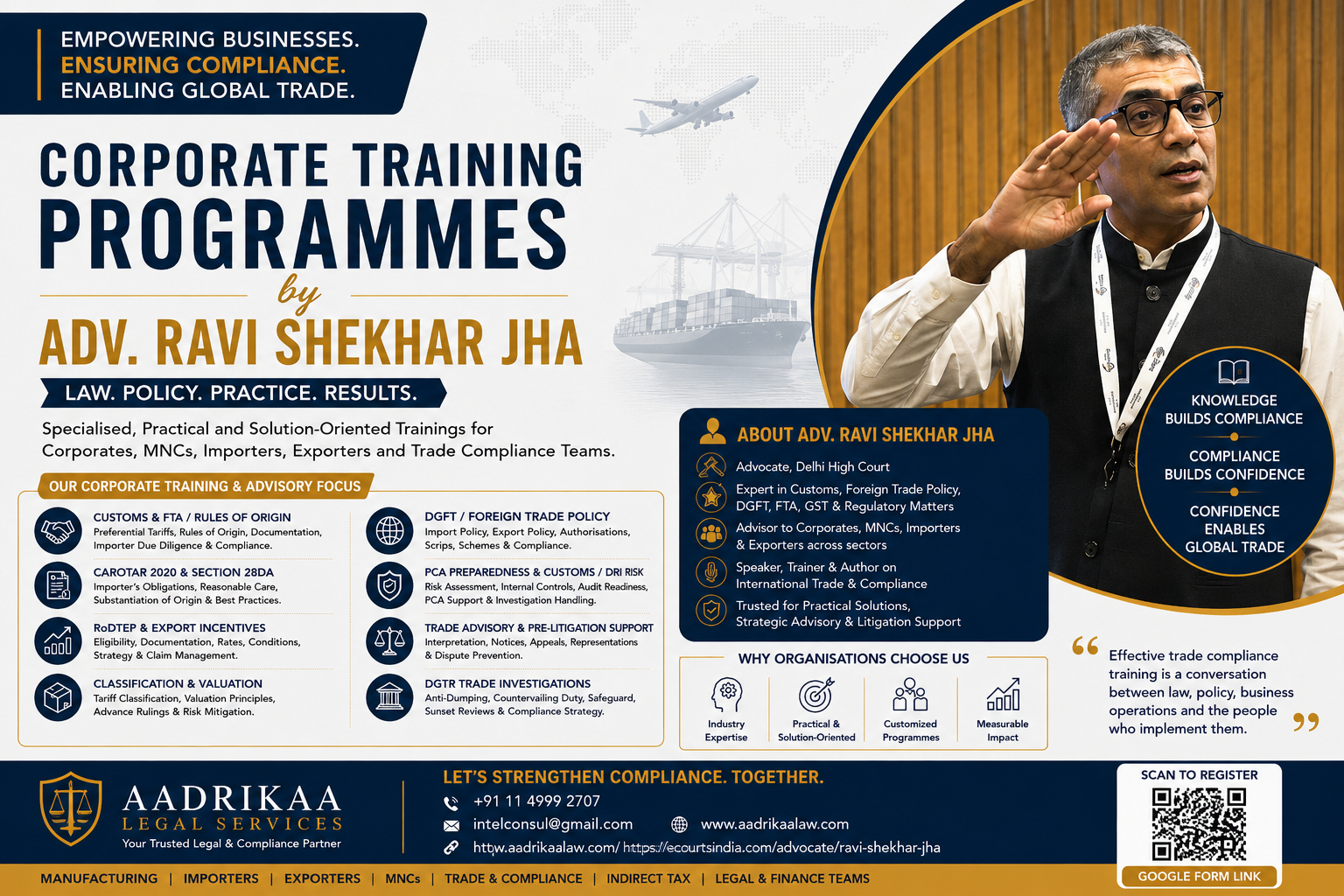
    Customised Corporate Trade Compliance Programmes

    Through Aadrikaa Legal Services, customised executive workshops, corporate training and advisory programmes can be structured for MNCs, manufacturers, importers, exporters and trade-compliance teams covering

    a. FTA , CAROTAR 2020 & Section 28DA

    b. RoDTEP & export incentives,

    c. Classification & General Rules of Interpretation  (GRI)

    d. Valuation

    e. DGFT/Foreign Trade Policy- EPCG/Advance License

    f. Customs Special Programmes- SVB, AEO, MOOWR, EMI

    g. PCA preparedness and Customs/DRI risk

    h. trade advisory and pre-litigation support

    i. DGTR trade investigations

    j. Customs & allied regulatory laws (PGAs)

    Secure your operations. Strengthen compliance. Reduce cross-border friction.

    Advocate Ravi Shekhar Jha
    Customs | Foreign Trade Policy | FTA | Trade & Regulatory Advisory

    Google Form Link

    🌐 Aadrikaa Legal Services
    πŸ“§ intelconsul@gmail.com
    βš–οΈ Professional Profile – Advocate Ravi Shekhar Jha

    Knowledge builds compliance. Compliance builds confidence. Confidence enables global trade.

    Aadrikaa Legal Services is a trusted legal and regulatory support partner providing end-to-end legal solutions to law firms, corporate organizations, and businesses across India. We specialize in paralegal services, litigation support, tax and regulatory matters, delivering reliable, efficient, and result-oriented legal assistance.

    Our services include comprehensive paralegal support, drafting and documentation, legal research, case management, litigation handling, and representation support across various judicial and quasi-judicial forums. We also assist in direct and indirect tax matters, customs, GST, corporate regulatory compliance, and legal advisory.

  • Scope of Agent’s Lien and Interim Relief in Multi-Contract Tank Container Disputes

    Scope of Agent’s Lien and Interim Relief in Multi-Contract Tank Container Disputes

    Date: 31.08.2026

    A recent judgment by the Bombay High Court in the case of Limited Liability Company β€œLTB” vs. Shri Vaibhavi Logistics and others has clarified important legal principles regarding the recovery and custody of tank containers in commercial disputes involving multiple contracts and parties. This article provides a detailed analysis of the case, the legal issues involved, and the implications for businesses engaged in logistics, agency, and container leasing agreements.

    Background of the Dispute

    • Parties Involved:
      • Petitioner: Limited Liability Company β€œLTB”, owner and operator of 138 tank containers.
      • Respondents: Shri Vaibhavi Logistics (Indian agent), E F C Logistics India Pvt Ltd, JMJ Container Solution, and Kashipur Infrastructure And Freight Terminal Pvt Ltd (depots holding the containers).
    • Agreements in Question:
      • Agency Agreement (4 March 2021): Appointed Respondent No.1 as LTB’s agent in India for 138 tanks.
      • Master Tank Container Lease Agreement (20 November 2023): Lease of containers.
      • Agency Agreement (8 December 2020): Appointed LTB as agent in Russia.
    • Nature of Dispute:
      • LTB sought interim relief under Section 9 of the Arbitration and Conciliation Act, 1996, for the unconditional release of its 138 tank containers from the depots.
      • Respondent No.1 claimed a lien over the containers for alleged dues under other agreements.

    Key Legal Issues Addressed

    1. Can a party exercise a lien over goods under one contract to secure claims from another contract?
    2. Is a composite petition maintainable when claims arise from multiple agreements with separate arbitration clauses?
    3. Can interim relief be granted against parties (depots) not signatory to the arbitration agreement?

    Court’s Analysis and Findings

    1. Lien and Cross-Contractual Claims

    • The Court held that unless expressly provided in the contract, a party cannot retain goods handed over under one contract to secure claims from another contract.
    • Section 221 of the Indian Contract Act, 1872, allows an agent to retain the principal’s property only for dues arising from services related to that property (particular lien), not for unrelated claims (general lien).
    • No clause in the 4 March 2021 agreement permitted Respondent No.1 to retain the tanks for dues under other agreements.

    2. Composite Petitions and Arbitration Clauses

    • The Supreme Court’s decision in Duro Felguera, S.A. v. Gangavaram Port Limited was cited: separate contracts with independent arbitration clauses cannot be combined into a single arbitral reference.
    • The Petitioner was allowed to restrict its claim to the 4 March 2021 agreement and pursue other claims separately.

    3. Relief Against Non-Signatory Depots

    • The Court clarified that interim relief under Section 9 can be granted against parties in possession of the subject matter (the tanks), even if they are not signatories to the arbitration agreement, provided the property is directly connected to the dispute.
    • Depots holding the tanks were ordered to release them to the Petitioner, subject to certain conditions (e.g., security for service charges claimed by one depot).

    Final Orders and Directions

    β€’ The Petition was partly allowed:

    1. Release of Containers: Depots (Respondents 2–4) must release the tanks to LTB, except for four tanks with Respondent No.4, which require security for service charges.
    2. No Cross-Contractual Lien: Respondent No.1 cannot retain the tanks for dues under other agreements.
    3. Disclosure of Missing Tanks: Respondent No.2 must disclose the whereabouts of two missing tanks.
    4. Commencement of Arbitration: LTB to initiate arbitration under the 4 March 2021 agreement.
    5. Other Claims: Monetary claims and other reliefs under different agreements to be pursued separately.

    Implications for Businesses

    • Contract Drafting: Ensure clear provisions regarding lien, retention, and cross-contractual rights in agency and logistics agreements.
    • Arbitration Strategy: Claims under separate agreements with distinct arbitration clauses should be pursued independently.
    • Interim Relief: Courts can grant interim protection for property central to the dispute, even against non-signatories in possession.

    Conclusion

    This judgment reinforces the importance of precise contractual drafting and clarifies the limits of lien and interim relief in multi-party, multi-contract commercial disputes. Businesses should review their agreements and dispute resolution strategies in light of these principles to safeguard their interests in similar situations.

    Aadrikaa Legal Services is a trusted legal and regulatory support partner providing end-to-end legal solutions to law firms, corporate organizations, and businesses across India. We specialize in paralegal services, litigation support, tax and regulatory matters, delivering reliable, efficient, and result-oriented legal assistance.

    Our services include comprehensive paralegal support, drafting and documentation, legal research, case management, litigation handling, and representation support across various judicial and quasi-judicial forums. We also assist in direct and indirect tax matters, customs, GST, corporate regulatory compliance, and legal advisory.

    Handy Download:

  • High Court of Karnataka Sets Aside Murder Conviction Under Section 302 IPC Due to Insufficient Circumstantial Evidence

    High Court of Karnataka Sets Aside Murder Conviction Under Section 302 IPC Due to Insufficient Circumstantial Evidence

    Date: 31.08.2026

    A recent judgment by the High Court of Karnataka at Bengaluru highlights the complexities of criminal trials based on circumstantial evidence. The case involved an appeal against a murder conviction, where the accused was ultimately acquitted due to insufficient and inconclusive evidence.

    Background of the Case

    • Parties Involved:
      • Appellant: Basappa Durgappa Masthmaradi (Basu)
      • Respondent: State of Karnataka
    • Incident:
      • The deceased, Sharanappa, along with the accused and another individual, was employed as a laborer at a power plant site. They were allotted a shared room (Shed No.C-6).
      • On 26 August 2013, Sharanappa was found dead in the room with multiple injuries, and a stone was found near his body.

    Prosecution’s Case

    • Motive:
      • Alleged disputes over a loan of Rs.500 between the accused and the deceased.
      • Quarrels over money and food preparation on the night of the incident.
    • Evidence Presented:
      • Testimonies from supervisors and co-laborers about the accused and deceased staying together.
      • Seizure of a blood-stained stone and clothes.
      • Post-mortem report confirming death due to blunt force trauma.
      • Recovery of the deceased’s mobile phone from the accused.

    Defense Arguments

    • Lack of Direct Evidence:
      • No eyewitnesses to the murder.
      • Motive not clearly established by any witness.
    • Weaknesses in Circumstantial Evidence:
      • The recovery of blood-stained clothes was linked to another accused who died during the trial.
      • The mobile phone’s ownership was not conclusively proven to belong to the deceased.
      • The accused’s absence after the incident was not sufficient to establish guilt.

    Court’s Analysis

    • Assessment of Circumstantial Evidence:
      • The court emphasized that conviction for murder cannot rest solely on the ‘last seen together’ theory without corroborative evidence.
      • The prosecution failed to prove beyond reasonable doubt that the accused committed the murder.
      • The court cited Supreme Court precedents, noting that absconding alone does not establish guilt.
    • Benefit of Doubt:
      • Given the inconclusive nature of the evidence, the court granted the benefit of doubt to the accused.

    Judgment and Outcome

    • The High Court set aside the conviction and life sentence imposed by the trial court.
    • The accused was acquitted and ordered to be released immediately, unless required in another case.

    Key Takeaways

    1. Importance of Conclusive Evidence:
      • Circumstantial evidence must form a complete chain pointing only to the guilt of the accused.
    2. Role of Motive and Corroboration:
      • Motive alone, without direct or strong circumstantial evidence, is insufficient for conviction.
    3. Judicial Precedents:
      • The judgment reinforces established legal principles regarding the standard of proof in criminal cases.

    Conclusion

    This case underscores the judiciary’s commitment to upholding the principle that an accused is presumed innocent until proven guilty beyond reasonable doubt. It serves as a reminder that convictions must be based on solid and conclusive evidence, especially in serious charges like murder.

    Aadrikaa Legal Services is a trusted legal and regulatory support partner providing end-to-end legal solutions to law firms, corporate organizations, and businesses across India. We specialize in paralegal services, litigation support, tax and regulatory matters, delivering reliable, efficient, and result-oriented legal assistance.

    Our services include comprehensive paralegal support, drafting and documentation, legal research, case management, litigation handling, and representation support across various judicial and quasi-judicial forums. We also assist in direct and indirect tax matters, customs, GST, corporate regulatory compliance, and legal advisory.

    Handy Download:

  • Delhi High Court Clarifies Law on Court-Auction Sales

    Delhi High Court Clarifies Law on Court-Auction Sales

    Date: 31.08.2026

    A recent judgment by the Delhi High Court in the case of Radhey Shyam Pahwa v. Universal Polychem (India) Pvt. Ltd. & Ors. has provided significant clarity on the legal procedures and principles governing court-conducted property auctions. This article offers a detailed analysis of the case, the legal arguments presented, and the implications for future auction sales under Indian law.

    Background of the Case

    The dispute arose from the auction of property No. J-60, First Floor, Lajpat Nagar-III, New Delhi, conducted to satisfy a court decree. The auction was held under the supervision of a Court Auctioneer, with a reserve price set at Rs. 1,70,00,000. Multiple bidders, including the appellant Radhey Shyam Pahwa and respondent Lokesh Mendiratta, participated.

    During the auction, a disagreement emerged regarding the increment (lot size) for bids. While the Court Auctioneer set the increment at Rs. 10,00,000, some bidders requested a reduction to Rs. 1,00,000 once the bidding reached Rs. 2,50,00,000. The Auctioneer declined, but noted all bids for transparency. Ultimately, Lokesh Mendiratta’s bid of Rs. 2,60,00,000 was recorded as the highest in accordance with the set lot size, though Pahwa offered Rs. 2,61,00,000, which was not accepted as it did not conform to the prescribed increment.

    Legal Issues and Arguments

    Appellant’s Contentions

    1. Irregularities and Fraud Alleged:
      • The appellant argued that the auction process was marred by irregularities, including the arbitrary fixation of the lot size and lack of transparency.
      • He claimed that as the highest bidder (Rs. 2,61,00,000), he should have been declared the purchaser.
    2. Mandatory Compliance with CPC:
      • Cited Order XXI Rules 84 and 85 of the Code of Civil Procedure (CPC), which require the highest bidder to deposit 25% of the bid immediately and the balance within 15 days.
      • Argued that these timelines should run from the date of the auction and identification of the highest bidder.
    3. Precedents Relied Upon:
      • Relied on Supreme Court and High Court judgments emphasizing strict compliance with auction rules and timelines, and the need for fairness and transparency in court auctions.

    Respondent’s Contentions

    1. No Declaration of Purchaser at Auction:
      • The respondent argued that the Court Auctioneer did not declare any bidder as the purchaser on the auction date due to disputes over the highest bid.
      • The matter was referred to the Executing Court for a final decision.
    2. Compliance with Court Orders:
      • Both the appellant and respondent deposited 25% of their respective bids, but the final declaration of the purchaser was made only by the court in its impugned order.
      • The respondent deposited the remaining 75% of the bid amount immediately after being declared the successful purchaser.
    3. Legal Principle:
      • Cited case law establishing that in court-supervised auctions, the sale is not complete until the court formally declares the purchaser and confirms the sale.

    Court’s Analysis and Decision

    The High Court meticulously analyzed the auction process, the relevant provisions of the CPC, and the arguments of both parties. Key findings include:

    1. Authority of the Court Auctioneer:
      • The Auctioneer was empowered by the Proclamation of Sale to set the bid increment. The lot size of Rs. 10,00,000 was validly fixed and announced.
    2. Declaration of Purchaser:
      • No purchaser was declared at the auction due to disputes. The Executing Court, after considering objections, declared Lokesh Mendiratta as the successful purchaser.
    3. Timelines for Deposit:
      • The mandatory timelines under Order XXI Rules 84 and 85 CPC for depositing the purchase money commence only after the court declares the purchaser, not merely upon the conclusion of the auction.
      • Since the declaration occurred on 05.05.2026, and the respondent deposited the balance amount on the same day, there was no violation of the CPC provisions.
    4. Objections and Non-Compliance:
      • The appellant’s objections regarding the lot size and the auction process were found to be without merit.
      • The court held that mere non-compliance with interim directions (such as deposit deadlines before the purchaser was declared) did not invalidate the sale, as the core issue of the successful purchaser was unresolved at that stage.
    5. Final Outcome:
      • The appeal was dismissed. The court upheld the Executing Court’s order declaring Lokesh Mendiratta as the successful purchaser and confirmed the auction sale.

    Key Legal Takeaways

    1. Court’s Role in Auction Sales:
      • In court-supervised auctions, the sale is not complete until the court formally declares the purchaser and confirms the sale, even if the highest bid is recorded at the auction.
    2. Strict Compliance with Auction Terms:
      • Bidders must adhere to the terms set out in the Proclamation of Sale, including bid increments. Deviations may result in bids being disregarded.
    3. Timelines for Payment:
      • The 25% and 75% payment requirements under Order XXI Rules 84 and 85 CPC are triggered only after the court’s declaration of the purchaser.
    4. Transparency and Fairness:
      • The court reaffirmed the need for transparency, fairness, and adherence to procedure in judicial auctions to protect the interests of all parties.

    Implications for Future Auctions

    This judgment provides a clear precedent for handling disputes in court-conducted auctions. It underscores the importance of following the auction terms and the central role of the court in finalizing the sale. Bidders and legal practitioners should ensure strict compliance with all procedural requirements and be aware that the court’s declaration is the definitive step in concluding a judicial auction.

    Aadrikaa Legal Services is a trusted legal and regulatory support partner providing end-to-end legal solutions to law firms, corporate organizations, and businesses across India. We specialize in paralegal services, litigation support, tax and regulatory matters, delivering reliable, efficient, and result-oriented legal assistance.

    Our services include comprehensive paralegal support, drafting and documentation, legal research, case management, litigation handling, and representation support across various judicial and quasi-judicial forums. We also assist in direct and indirect tax matters, customs, GST, corporate regulatory compliance, and legal advisory.

    Handy Download:

  • Karnataka High Court Grants Bail to Nigerian National in Major NDPS Drug Trafficking After Four Years in Custody

    Karnataka High Court Grants Bail to Nigerian National in Major NDPS Drug Trafficking After Four Years in Custody

    Date: 31.08.2026

    A recent order by the High Court of Karnataka has brought significant attention to the legal processes surrounding bail for foreign nationals accused under the Narcotic Drugs and Psychotropic Substances (NDPS) Act. The case involves Mr. Samuel Chinweike Anoh, a Nigerian national, who was granted bail after spending over four years in custody, despite serious allegations of drug trafficking. This article provides a detailed overview of the case, the court’s reasoning, and the broader legal context.

    Background of the Case

    • Case Details:
      • Petitioner: Mr. Samuel Chinweike Anoh (Accused No. 3)
      • Respondent: Union of India, represented by the Customs Intelligence Unit (CIU), Bengaluru
      • Offences: Sections 8(c), 21(c), 22, 23, 28, and 29 of the NDPS Act
      • Allegations: Involvement in the shipment and attempted collection of consignments containing MDMA (4.581 kg) and heroin (1.002 kg) disguised as machine parts and personal items.
    • Chronology:
      • Shipments intercepted at FedEx, Bengaluru, based on credible information.
      • Accused Nos. 1 and 2 arrested while collecting the shipments; contraband seized from their possession.
      • Petitioner (Accused No. 3) arrested based on their confession statements.
      • Petitioner remained in custody for over four years; trial delayed at the stage of witness examination.

    Legal Arguments and Court Observations

    Arguments by the Petitioner

    • No contraband was seized from the petitioner directly.
    • Arrest and charges based solely on co-accused confessions.
    • Co-accused (Accused Nos. 1 and 2) had already been granted bail due to prolonged incarceration and trial delays.
    • Petitioner has been in custody for an extended period with little progress in the trial.

    Arguments by the Respondent

    • Petitioner allegedly played an active role and has similar criminal antecedents.
    • As a foreign national without valid documents, the petitioner poses a flight risk and must be detained even if granted bail, as per Supreme Court and High Court precedents.

    Court’s Analysis

    • Delay in Trial: The court noted that out of eight charge sheet witnesses, not even one had been fully examined after four years, echoing Supreme Court judgments that prolonged incarceration without trial progress justifies bail.
    • No Direct Seizure: The petitioner was not found in possession of contraband; his arrest was based on confessions of others.
    • Precedents Cited:
      • Chitta Biswas v. State of West Bengal: Bail granted due to long custody and slow trial.
      • Nitish Adhikary v. State of West Bengal: Bail granted when only one witness examined after long custody.
      • Mohd. Muslim v. State (NCT of Delhi): Courts should consider bail if guilt is not prima facie established and trial is unduly delayed.
      • Javed Gulam Nabi Shaikh v. State of Maharashtra: Right to speedy trial under Article 21 applies regardless of crime seriousness.

    Guidelines for Foreign Nationals

    The court reiterated and applied guidelines from previous judgments regarding foreign nationals:

    • Immediate initiation of deportation proceedings if a foreign national is found without valid documents.
    • If bail is granted, the individual must be detained in a detention center until trial concludes or deportation is arranged.
    • Courts and authorities must prioritize speedy disposal of such cases and ensure humane treatment in detention centers.

    Bail Order and Conditions

    The High Court allowed the bail petition with the following conditions:

    1. Execution of a personal bond of Rs. 1,00,000 with two sureties.
    2. Detention in a designated center in Bangalore until the trial concludes.
    3. Regular appearance before the trial court.
    4. No tampering with evidence or witnesses.
    5. No involvement in similar offences in the future.

    Broader Legal Implications

    • Right to Speedy Trial: The order reinforces the constitutional right to a speedy trial, especially in cases involving severe charges under the NDPS Act.
    • Treatment of Foreign Nationals: The judgment clarifies the process for handling foreign nationals accused of serious crimes, balancing legal procedures with human rights and national security.
    • Judicial Precedents: The court’s reliance on Supreme Court decisions ensures consistency and fairness in bail jurisprudence, even in high-stakes narcotics cases.

    Conclusion

    This case highlights the importance of upholding fundamental rights, even in serious criminal matters. The High Court’s decision underscores the judiciary’s commitment to fair trial standards, due process, and humane treatment of all accused, including foreign nationals, while ensuring that legal safeguards and national interests are maintained.

    Aadrikaa Legal Services is a trusted legal and regulatory support partner providing end-to-end legal solutions to law firms, corporate organizations, and businesses across India. We specialize in paralegal services, litigation support, tax and regulatory matters, delivering reliable, efficient, and result-oriented legal assistance.

    Our services include comprehensive paralegal support, drafting and documentation, legal research, case management, litigation handling, and representation support across various judicial and quasi-judicial forums. We also assist in direct and indirect tax matters, customs, GST, corporate regulatory compliance, and legal advisory.

    Handy Download:

    Ravi Shekhar Jha – Advocate, Bar Council of Delhi

  • High Court of Karnataka Decree on Compromise Settlement in Project Dispute under Section 8 of the Real Estate (Regulation and Development) Act, 2016

    High Court of Karnataka Decree on Compromise Settlement in Project Dispute under Section 8 of the Real Estate (Regulation and Development) Act, 2016

    Date: 31.08.2026

    A significant legal dispute involving the Unishire Spacio real estate project in Bengaluru has reached a comprehensive settlement, bringing relief to developers, home buyers, and associated parties. This article provides a detailed overview of the case, the parties involved, the legal journey, and the terms of the final compromise.

    Background: The Dispute and the Parties

    The dispute centered around the Unishire Spacio project, developed on property in Arakere Village, Bengaluru South Taluk. The main parties included:

    1. M/s. Unishire Builtech LLP (Developer/Appellant)
    2. Karnataka Real Estate Regulatory Authority (RERA) (Regulatory Authority)
    3. Unishire Spacio Association (Apartment Owners’ Association/Home Buyers)
    4. Altico Capital India Pvt. Ltd. (Financial Institution)
    5. C. Krishna Reddy & Pushpa Krishna Reddy (Landowners)
    6. Keya Homes Pvt. Ltd. (New Developer)

    Legal Proceedings: From RERA to High Court

    • The dispute began with a complaint before RERA, which issued an order on 8 November 2021 under Section 8 of the Real Estate (Regulation and Development) Act, 2016.
    • The developer, Unishire Builtech LLP, appealed the order to the Karnataka Real Estate Appellate Tribunal, which dismissed the appeal.
    • The matter was then brought before the High Court of Karnataka as RERA Appeal No. 1 of 2023.

    The Settlement: Key Terms of the Compromise

    After negotiations, the parties reached an amicable settlement, recorded in a compromise petition under Order 23 Rule 3 of the Code of Civil Procedure, 1908. The main terms include:

    1. Developer’s Withdrawal
      • Unishire Builtech LLP agreed to abide by the original RERA order and withdraw all claims and appeals regarding the Unishire Spacio project.
      • All allegations and counter-allegations between the parties were withdrawn.
    2. Project Takeover and Development
      • The Apartment Owners’ Association (Respondent 2) was allowed to take over the project.
      • Keya Homes Pvt. Ltd. (Respondent 6) was authorized to complete the development and could engage in further construction, including additional apartments using Transferable Development Rights (TDR).
    3. Cancellation of Previous Agreements
      • The Joint Development Agreement and General Power of Attorney dated 27 May 2013 were cancelled and revoked.
      • Any civil suits related to the dispute were withdrawn as settled out of court.
    4. Financial Settlement
      • Keya Homes agreed to pay Unishire Builtech LLP a total of Rs. 5.25 crore as full and final settlement.
      • Of this, Rs. 2.5 crore had already been paid for the release of mortgaged property, and the balance was paid at the time of settlement.
      • A refundable deposit of Rs. 3.5 crore, previously paid by Unishire to the landowners, would be transferred to Keya Homes for project development.
    5. Asset and Apartment Allocation
      • Unishire relinquished all claims to construction materials and equipment at the site, except for a non-working crane, which was transferred to Keya Homes.
      • Of 138 apartments originally allocated to Unishire, 129 had been sold; the remaining 9 could be sold by Keya Homes.
    6. No Further Claims
      • All parties agreed not to pursue further claims against each other, except for enforcing the terms of the compromise.
      • Keya Homes was permitted to change the project name to β€œKeya Spring.”

    Court’s Decision

    The High Court reviewed the compromise, found it lawful and voluntary, and disposed of the appeal in accordance with the settlement. The court directed all parties to strictly adhere to the terms and avoid further litigation. Each party was to bear its own costs, and the registry was instructed to draw up the decree accordingly.

    Significance of the Settlement

    • For Home Buyers: The settlement ensures project completion and protects the interests of apartment owners.
    • For Developers: It provides a clear exit for the original developer and a fresh start for the new developer.
    • For the Real Estate Sector: The case highlights the effectiveness of RERA and judicial intervention in resolving complex real estate disputes through compromise and negotiation.

    This resolution marks a positive step for all stakeholders, setting a precedent for amicable settlements in real estate disputes.

    Aadrikaa Legal Services is a trusted legal and regulatory support partner providing end-to-end legal solutions to law firms, corporate organizations, and businesses across India. We specialize in paralegal services, litigation support, tax and regulatory matters, delivering reliable, efficient, and result-oriented legal assistance.

    Our services include comprehensive paralegal support, drafting and documentation, legal research, case management, litigation handling, and representation support across various judicial and quasi-judicial forums. We also assist in direct and indirect tax matters, customs, GST, corporate regulatory compliance, and legal advisory.

    Handy Download: