Tag: #ParaLegalServices

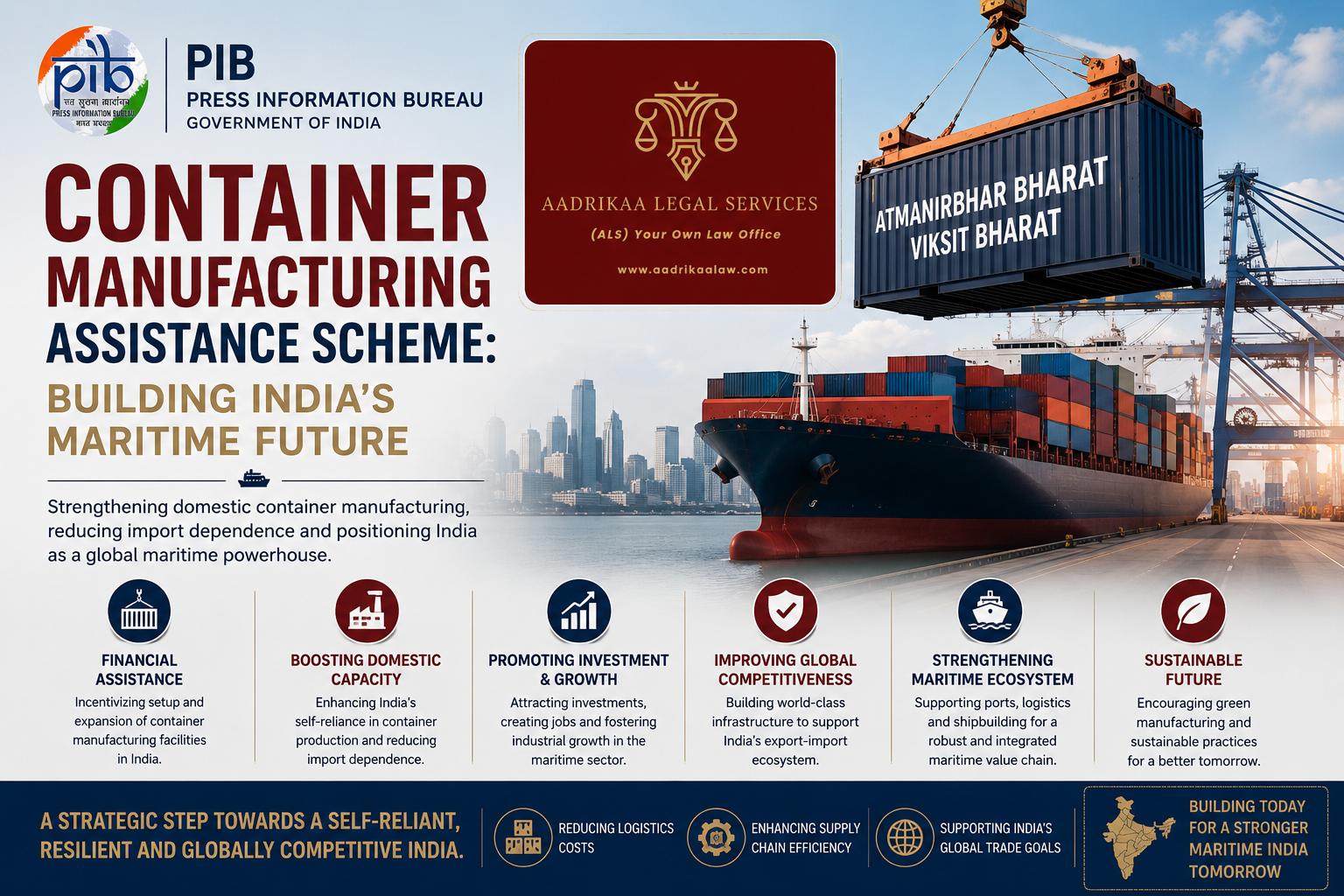
  • Container Manufacturing Assistance Scheme: Building India’s Maritime Future

    Container Manufacturing Assistance Scheme: Building India’s Maritime Future

    Date: 18.08.2026

    India is accelerating its maritime ambitions with the Container Manufacturing Assistance Scheme (CMAS), a transformative initiative designed to establish a robust domestic container manufacturing ecosystem. This article provides a comprehensive overview of CMAS, its strategic importance, recent milestones, and the broader reforms shaping India’s maritime sector, with direct links to official sources and references.

    The Need for Domestic Container Manufacturing

    Maritime transport is the backbone of global trade, with about 80% of merchandise trade by volume carried by sea (UNCTAD Review of Maritime Transport). Containerized cargo accounts for nearly two-thirds of the value of international trade, making efficient container logistics critical for supply chains. Recent disruptions and geopolitical tensions have exposed vulnerabilities in global shipping, prompting countries like India to focus on domestic manufacturing of critical logistics assets such as shipping containers.

    India currently imports nearly 2 million empty containers annually, making it susceptible to global market fluctuations and supply-chain disruptions. The CMAS aims to reduce this dependence, strengthen supply-chain resilience, and support India’s long-term trade ambitions. The scheme complements initiatives like Make in India, Maritime Amrit Kaal Vision 2047, and multimodal logistics development.

    What is the Container Manufacturing Assistance Scheme (CMAS)?

    Announced in the Union Budget 2026–27, CMAS is a targeted initiative with a β‚Ή10,000 crore outlay over five years. Its objectives include:

    • Establishing new Greenfield manufacturing facilities
    • Expanding existing Brownfield units
    • Providing operational support to enhance competitiveness
    • Supporting testing infrastructure, skilling, and capacity building

    The scheme targets an annual domestic manufacturing capacity of up to 7.5 lakh Twenty-foot Equivalent Units (TEUs)β€”about ten times the current capacity. This is expected to create a market opportunity of nearly β‚Ή80,000 lakh crore and position India as a reliable global supplier of shipping containers.

    For more details, see the Ministry of Ports, Shipping and Waterways official document.

    Building an Integrated Maritime Ecosystem

    CMAS is part of a broader strategy to create an integrated, domestically anchored container ecosystem. In February 2026, the Ministry of Ports, Shipping and Waterways signed an MoU to establish the Bharat Container Shipping Line (BCSL), bringing together major public sector stakeholders. The initiative includes investments of around β‚Ή99,149 crore in fleet development and domestic container procurement.

    This approach complements other government initiatives:

    • PM Gati Shakti: Enhancing connectivity between ports, railways, highways, and industrial centers
    • National Logistics Policy: Supporting operational efficiency
    • Sagarmala Programme: Promoting port-led development

    These efforts collectively support a resilient logistics network for India’s growing trade volumes.

    Employment and Industrial Growth

    CMAS is expected to generate around 3,000 direct jobs and over 50,000 indirect jobs in container manufacturing and allied industries. The scheme will also stimulate growth in ancillary sectors such as corner castings, wooden frames, and Corten steel production.

    Recent Progress and Industry Response

    A major milestone was achieved in July 2026 with the rollout of India’s first domestically manufactured EXIM shipping container for A.P. Moller–Maersk. Manufactured to international ISO and CSC standards, this container is suitable for global deployment. Maersk’s subsequent order for 1,000 additional Made-in-India containers with DCM Shriram Group signals growing confidence in India’s manufacturing capabilities. For more, see the DG Shipping address.

    Part of Wider Maritime Transformation

    CMAS is complemented by a series of legislative, institutional, and infrastructure reforms:

    • Merchant Shipping Act, 2025; Coastal Shipping Act, 2025; Indian Ports Act, 2025: Modernizing the legal framework for shipping and port governance
    • Digital Initiatives: One Nation One Port Process (ONOP), Maritime Single Window, and e-Samudra to streamline regulatory procedures (PIB Press Release)
    • Shipbuilding Financial Assistance Package: A β‚Ή70,000 crore package to boost domestic shipbuilding
    • Major Infrastructure Projects: Vadhavan Port, International Container Transshipment Port at Galathea Bay, Tuna Tekra Container Terminal, and Outer Harbour Container Terminal at V.O. Chidambaranar Port

    Way Forward

    The Container Manufacturing Assistance Scheme is a pivotal step in building a globally competitive maritime manufacturing ecosystem. By fostering domestic container production, reducing import dependence, and supporting broader maritime reforms, CMAS is set to enhance India’s supply-chain resilience, generate employment, and position the country as a leading maritime and logistics hub.

    References:

    Aadrikaa Legal Services is a trusted legal and regulatory support partner providing end-to-end legal solutions to law firms, corporate organizations, and businesses across India. We specialize in paralegal services, litigation support, tax and regulatory matters, delivering reliable, efficient, and result-oriented legal assistance.

    Our services include comprehensive paralegal support, drafting and documentation, legal research, case management, litigation handling, and representation support across various judicial and quasi-judicial forums. We also assist in direct and indirect tax matters, customs, GST, corporate regulatory compliance, and legal advisory.

    Handy Download:

  • Delhi High Court Upholds Arbitral Award: Scope of Judicial Review u/s 34 of the Arbitration and Conciliation Act, 1996

    Delhi High Court Upholds Arbitral Award: Scope of Judicial Review u/s 34 of the Arbitration and Conciliation Act, 1996

    Date: 18.08.2026

    A recent judgment by the Delhi High Court has brought clarity to the scope of judicial intervention in arbitral awards under Section 34 of the Arbitration and Conciliation Act, 1996. The case involved a contractual dispute between India Tourism Development Corporation (ITDC) and Bajaj Electricals Ltd. (BEL) regarding specialized illumination work at the Safdarjung Tomb Monument in New Delhi. This article provides a detailed analysis of the dispute, the arbitral award, the grounds for challenge, and the court’s findings.

    Background of the Dispute

    • Project Overview: ITDC awarded BEL a contract for the supply, installation, testing, and commissioning of state-of-the-art lighting at Safdarjung Tomb, following a competitive tender process.
    • Contractual Timeline:
      1. Tender submitted by BEL on 6 February 2007.
      2. Letter of Intent issued on 4 April 2007 for Rs. 2,08,90,095/-.
      3. Detailed work order and contract signed in May 2007, incorporating General Conditions of Contract (GCC).
    • Execution Issues:
    • During execution, media reports highlighted alleged damage to the monument, prompting the Archaeological Survey of India (ASI) to revise fixture layouts and require new approvals.
    • BEL completed the revised work, and ASI took over the installation in June 2009.
    • BEL submitted a final bill of Rs. 1,18,95,572/- but faced delays in payment, leading to disputes and eventual arbitration.

    The Arbitral Award

    • Award Details:
      • Principal amount of Rs. 46,92,298.22/- awarded to BEL.
      • Interest of Rs. 33,27,886/- (from July 2009 to April 2013) and Rs. 31,17,742.91/- as pendente lite interest (April 2013 to October 2018).
      • Future interest from the date of award until payment.
    • ITDC’s Challenge:
      • ITDC filed a petition under Section 34 to set aside the award, alleging errors in contract interpretation, non-consideration of deductions, and excessive interest.

    Key Contentions and Court’s Analysis

    1. Total Value of Work and Deductions

    • ITDC’s Argument: The arbitrator ignored legitimate deductions (Rs. 11,07,832/-) for non-execution or substitution of materials, as recorded in the Measurement Book.
    • Court’s Finding: The arbitrator based the award on evidence, including ITDC’s own admissions. Deductions recorded after 13 August 2008 (not signed by all parties) were rightly excluded. No patent illegality was found.

    2. Statutory Deductions (ESI/EPF, Service Tax, Labour Cess)

    • ITDC’s Argument: Amounts withheld for ESI/EPF, service tax, and labour cess were already deposited with authorities, and BEL failed to provide adequate proof.
    • Court’s Finding: BEL submitted required indemnity bonds and challans. The arbitrator’s acceptance of these documents was within his discretion and based on contract terms.

    3. Interest Rate

    • ITDC’s Argument: The 12% per annum interest awarded was excessive.
    • Court’s Finding: The arbitrator has wide discretion under Section 31(7) of the Act to award interest. The rate was not so unreasonable as to shock the court’s conscience.

    4. Post-Award Payments

    • ITDC’s Argument: A payment of Rs. 13,93,368/- made after the award should be adjusted against the principal for future interest calculation.
    • Court’s Finding: Such adjustments are to be addressed at the execution stage, not under Section 34 proceedings.

    Legal Principles Affirmed

    • Limited Scope of Section 34: The court reiterated that it does not sit in appeal over arbitral awards. Interference is limited to grounds such as patent illegality, violation of public policy, or fundamental procedural errors.
    • Respect for Arbitrator’s Findings: If the arbitrator’s view is plausible and based on evidence, courts will not substitute their own conclusions, even if another view is possible.
    • Interest Awards: Arbitrators have discretion to award reasonable interest unless expressly barred by contract.

    Conclusion

    The Delhi High Court dismissed ITDC’s petition, upholding the arbitral award in favor of Bajaj Electricals Ltd. This judgment reinforces the principle of minimal judicial interference in arbitral awards and underscores the importance of clear contractual compliance and documentation in public works contracts.

    This case serves as a significant reference for parties involved in government contracts and arbitration, highlighting the need for meticulous record-keeping and the finality of arbitral decisions within the statutory framework.

    Aadrikaa Legal Services is a trusted legal and regulatory support partner providing end-to-end legal solutions to law firms, corporate organizations, and businesses across India. We specialize in paralegal services, litigation support, tax and regulatory matters, delivering reliable, efficient, and result-oriented legal assistance.

    Our services include comprehensive paralegal support, drafting and documentation, legal research, case management, litigation handling, and representation support across various judicial and quasi-judicial forums. We also assist in direct and indirect tax matters, customs, GST, corporate regulatory compliance, and legal advisory.

    Handy Download:

  • Delhi High Court Clarifies Concurrent Remedies for Real Estate Disputes

    Delhi High Court Clarifies Concurrent Remedies for Real Estate Disputes

    Date: 18.08.2026

    The Delhi High Court’s decision in Priyanka Taksh Sood & Ors. v. Sunworld Residency Pvt. Ltd. & Anr. offers crucial insights into the interplay between arbitration clauses in real estate contracts and the jurisdiction of the Real Estate Regulatory Authority (RERA). This article breaks down the facts, legal issues, and the Court’s analysis for readers seeking clarity on dispute resolution in real estate matters.

    Background of the Dispute

    1. Parties Involved:
      • Petitioners: Priyanka Taksh Sood and her family, allottees of a flat in Sunworld Arista, Noida.
      • Respondents: Sunworld Residency Pvt. Ltd. (developer) and ICICI Bank (lender).
    2. Agreements Executed:
      • Flat Buyer Agreement (FBA)
      • Supplementary Agreement
      • Tripartite Housing Loan Agreement (with ICICI Bank)
    3. Nature of Dispute:
      • The allottees cancelled their flat booking after the lock-in period and sought a refund, alleging the developer failed to refund the amount and settle the loan account with ICICI Bank.
      • The developer argued that the flat was ready for possession and raised objections regarding the maintainability of the arbitration petition, citing RERA’s jurisdiction and alleged deficiency in stamp duty.

    Legal Issues Considered

    1. Existence of Dispute and Arbitration Clause

    • The Court confirmed the existence of disputes and a valid arbitration clause in the Flat Buyer Agreement.
    • Whether the allottees are entitled to a refund is a matter for arbitration, not for the Court at this stage.

    2. Deficiency of Stamp Duty

    • The developer’s objection regarding insufficient stamp duty was dismissed as vague and unsupported by evidence.
    • The Court relied on recent Supreme Court precedents to hold that such objections do not bar the appointment of an arbitrator at this stage.

    3. Jurisdiction: RERA vs. Arbitration

    • The developer argued that RERA, as a special statute, ousts the jurisdiction of arbitration for real estate disputes.
    • The Court analyzed:
      • Section 79 of RERA: Bars civil courts from entertaining matters within RERA’s purview.
      • Sections 88 & 89 of RERA: State that RERA remedies are in addition to, not in derogation of, other laws.
    • The Court held that:
      • The remedies under RERA and the Arbitration & Conciliation Act are concurrent.
      • Parties can elect their remedy, but once a forum is chosen (e.g., RERA or arbitration), the other cannot be pursued for the same dispute.
      • There is no express or implied bar on arbitration for such disputes under RERA.

    4. Doctrine of Election of Remedies

    • The Court emphasized that parties have the option to choose between available remedies (RERA, arbitration, consumer forums), but cannot pursue both for the same cause of action.

    5. Inclusion of ICICI Bank in Arbitration

    • Although the Tripartite Housing Loan Agreement with ICICI Bank did not contain an arbitration clause, the Court found ICICI Bank to be a necessary party due to the composite nature of the transaction.
    • ICICI Bank was referred to arbitration for issues arising from the interconnected agreements, but disputes solely under the loan agreement (e.g., enforcement actions by the bank) were excluded from arbitration.

    Key Takeaways for Homebuyers and Developers

    1. Arbitration Clauses Remain Enforceable:
      • Even after the enactment of RERA, arbitration clauses in real estate contracts are valid and can be enforced, provided the parties have not already chosen to proceed under RERA.
    2. Concurrent Remedies:
      • Homebuyers can choose between RERA, arbitration, or consumer forums, but must stick to one forum for the same dispute.
    3. No Automatic Bar Due to RERA:
      • RERA does not automatically oust the jurisdiction of arbitral tribunals unless a party has already elected to proceed under RERA.
    4. Composite Transactions:
      • Where multiple agreements are interlinked (e.g., sale agreement and loan agreement), all relevant parties may be referred to arbitration if necessary for complete adjudication.
    5. Practical Implications:
      • Developers cannot use technical objections (like stamp duty or RERA registration) to delay or avoid arbitration if a valid arbitration agreement exists.

    Conclusion

    The Delhi High Court’s judgment clarifies that RERA and arbitration are concurrent remedies for real estate disputes. Parties must carefully consider their choice of forum, as electing one precludes the other for the same dispute. This decision strengthens the enforceability of arbitration clauses in real estate contracts and provides clarity on the scope of RERA’s jurisdiction.

    Aadrikaa Legal Services is a trusted legal and regulatory support partner providing end-to-end legal solutions to law firms, corporate organizations, and businesses across India. We specialize in paralegal services, litigation support, tax and regulatory matters, delivering reliable, efficient, and result-oriented legal assistance.

    Our services include comprehensive paralegal support, drafting and documentation, legal research, case management, litigation handling, and representation support across various judicial and quasi-judicial forums. We also assist in direct and indirect tax matters, customs, GST, corporate regulatory compliance, and legal advisory.

    Handy Download:

  • Supreme Court on Bail, Sureties, and Drug Trafficking

    Supreme Court on Bail, Sureties, and Drug Trafficking

    Date: 18.08.2026

    This article provides a comprehensive overview of a recent Supreme Court judgment that addresses critical issues in criminal justice, particularly concerning bail, surety verification, and the handling of foreign nationals accused under the Narcotic Drugs and Psychotropic Substances Act (NDPS Act). The judgment not only resolves the specific case at hand but also sets out far-reaching guidelines and suggestions for systemic reform.

    Background of the Case

    The case involved the Union of India appealing against the grant of bail to a foreign national accused of masterminding a drug trafficking operation involving a commercial quantity of heroin. The accused, previously convicted in a similar case, was released on bail after furnishing sureties. However, subsequent investigations revealed that the sureties were fake, and the accused absconded, highlighting systemic vulnerabilities in the bail and surety process.

    Key Legal Issues Addressed

    1. Bail Under Special Statutes

    • NDPS Act, PMLA, and UAPA: The judgment analyzes the stringent bail provisions under the NDPS Act, Prevention of Money Laundering Act (PMLA), and Unlawful Activities Prevention Act (UAPA), emphasizing the “twin conditions” for bail in NDPS cases involving commercial quantities.
    • Article 21 Considerations: While upholding statutory rigour, the Court reiterates that prolonged incarceration without trial can violate the right to personal liberty under Article 21 of the Constitution.

    2. Bail for Foreign Nationals

    • Principle: Foreign nationals are entitled to Article 21 protection, but the State retains the power to regulate and restrict their movement.
    • Special Conditions: The Court affirms that bail conditions for foreign nationals may include surrender of passports, registration with authorities, and restrictions on travel, provided these are reasonable and proportionate.

    3. The Problem of Fake Sureties

    • Systemic Weakness: The case exposed how fake sureties enable accused persons, especially foreign nationals, to abscond, undermining the justice system.
    • Verification Gaps: Despite existing procedures, lack of robust verification and accountability allows professional sureties and touts to exploit the system.

    Data and Trends Highlighted

    • Rising Drug Offences: NDPS cases have nearly doubled between 2018 and 2023, with a significant number involving foreign nationals, particularly from Nigeria, Bangladesh, and Nepal.
    • Fake Sureties: At least 47 foreign nationals are currently absconding after furnishing fake sureties, with the problem being widespread across several states.

    Supreme Court’s Directions and Guidelines

    The Court, invoking its powers under Article 142, issued binding directions for all cases involving foreign nationals accused under the NDPS Act for commercial quantities:

    1. Mandatory Deposit of Passport: Accused must deposit their passport with the court; travel restrictions may be imposed.
    2. Registration with FRRO: Accused must register with the Foreigners Regional Registration Office within one week of release.
    3. Production of Two Sureties: Two genuine, verified sureties are required, with exceptions only for documented hardship.
    4. Surety Verification: Police and court officials must verify surety credentials within three days before release.
    5. Lien on Surety Property: A lien/charge is to be created on the surety’s property, enforceable in case of bail violation.
    6. Centralized Database: The Ministry of Law and Justice and NIC must create a national database of accused and sureties in NDPS cases involving foreign nationals.
    7. Departmental Action: Officials responsible for verifying fake sureties will face departmental inquiry.
    8. Affidavit of Income: Accused must file an affidavit disclosing sources of income and bank accounts in India.
    9. Embassy Notification: Investigating officers must inform the accused’s embassy of the criminal proceedings.
    10. Digital Verification Portals: High Courts are to implement digital portals for speedy verification of surety documents.

    Suggestions for Systemic Reform

    • Professional Bail Bondsperson Regulation: The Court annexed draft rules for licensing and regulating professional bail bondspersons, aiming to curb the menace of fake sureties and touts.
    • Training and Awareness: Judicial academies are to train judges on the socio-economic impact of surety-based bail and access to justice for indigent undertrials.
    • Technological Integration: Suggestions include using Aadhaar authentication, geo-fencing, and centralized digital systems for real-time verification and monitoring.

    Comparative International Perspective

    The judgment draws on practices from the US, Canada, Singapore, and Australia, noting that robust verification, regulated professional sureties, and digital tracking are common features in advanced legal systems.

    Impact and Significance

    This judgment is a watershed moment for criminal justice reform in India, especially in the context of transnational crime and the rights of foreign nationals. By mandating stricter verification, digital integration, and accountability, the Supreme Court aims to balance the rights of the accused with the imperative of public safety and the integrity of the justice system.

    The directions and suggestions, if implemented, promise to make the bail and surety process more transparent, accountable, and resistant to abuse, setting a new standard for handling serious offences involving foreign nationals.

    Aadrikaa Legal Services is a trusted legal and regulatory support partner providing end-to-end legal solutions to law firms, corporate organizations, and businesses across India. We specialize in paralegal services, litigation support, tax and regulatory matters, delivering reliable, efficient, and result-oriented legal assistance.

    Our services include comprehensive paralegal support, drafting and documentation, legal research, case management, litigation handling, and representation support across various judicial and quasi-judicial forums. We also assist in direct and indirect tax matters, customs, GST, corporate regulatory compliance, and legal advisory.

    Handy Download:

  • Authenticity of Country of Origin Certificates, Preferential Duty Exemption, and Customs Valuation Dispute

    Authenticity of Country of Origin Certificates, Preferential Duty Exemption, and Customs Valuation Dispute

    Date: 18.08.2026

    The Customs, Excise & Service Tax Appellate Tribunal (CESTAT) Allahabad recently delivered a significant judgment in the case of M/s SSN Steel Impex, a New Delhi-based importer and trader of stainless steel products. The case revolved around the denial of preferential customs duty benefits, allegations of unauthentic Country of Origin (COO) certificates, undervaluation of goods, and imposition of penalties. This article provides a detailed analysis of the case, the Tribunal’s findings, and its broader implications for importers and customs administration in India.

    Background of the Case

    M/s SSN Steel Impex imported stainless steel cold rolled sheets, coils, and circles, primarily from Malaysia, to avail preferential duty benefits under Notification No. 46/2011-Cus (ASEAN-India Free Trade Agreement). The customs authorities alleged that many COO certificates submitted by the appellant were unauthentic, leading to the denial of duty exemption and the imposition of differential duty, interest, and penalties. The appellant challenged these actions, arguing that due process was not followed and that most COOs were genuine.

    Key Issues Examined

    1. Authenticity of COO Certificates
      • Customs authorities, based on communications from Malaysia’s MITI, claimed that 87 out of 143 COOs were unauthentic.
      • SSN Steel Impex submitted 38 COOs; only one was found unauthentic, for which the company had already paid the differential duty.
      • The Tribunal found that the remaining 37 COOs were not listed as unauthentic and thus should be accepted.
    2. Eligibility for Preferential Duty
      • The Tribunal held that since the majority of COOs were authentic and verified at the time of import, the appellant was eligible for duty exemption under Notification No. 46/2011-Cus.
      • The Tribunal emphasized that subsequent communications from MITI could not retroactively invalidate COOs that were valid and verified at the time of import.
    3. Allegations of Undervaluation
      • Customs authorities alleged undervaluation based on statements from third parties and price comparisons.
      • The Tribunal found no evidence that SSN Steel Impex paid amounts over and above the declared invoice prices or that the declared values were not at arm’s length.
      • The Tribunal relied on Supreme Court precedents, holding that transaction values could not be rejected without concrete evidence.
    4. Imposition of Penalties
      • Penalties were imposed for alleged mis-declaration and undervaluation.
      • The Tribunal found no evidence of intent to evade duty or collusion and set aside all penalties.

    Tribunal’s Final Order

    The CESTAT Allahabad ruled in favor of SSN Steel Impex, with the following key directives:

    • All 37 COOs (except the one already settled) were deemed authentic and acceptable.
    • The appellant was entitled to the benefit of duty exemption for all consignments covered by these COOs.
    • The declared transaction values were accepted; the enhanced values determined by customs were set aside.
    • All penalties imposed on the appellant were quashed.

    Legal Precedents and Principles Affirmed

    • Due Process: The Tribunal reiterated the importance of natural justice, including the right to cross-examination and proper consideration of evidence.
    • Finality of Assessment: Once goods are assessed and cleared based on valid documents, subsequent doubts cannot retroactively deny benefits unless clear evidence emerges.
    • Burden of Proof: The onus is on customs authorities to provide concrete evidence for allegations of mis-declaration or undervaluation.

    Implications for Importers and Customs Administration

    1. Reliance on Valid COOs: Importers can rely on COOs issued and verified by competent authorities at the time of import, unless there is clear evidence of fraud or forgery.
    2. Protection Against Retroactive Actions: Subsequent communications or doubts from foreign authorities cannot, by themselves, invalidate benefits already granted unless accompanied by formal revocation or evidence.
    3. Importance of Documentation: Importers should maintain comprehensive records of all import documents, including COOs, invoices, and customs clearances.
    4. Customs’ Investigative Standards: Customs authorities must adhere to due process and provide substantive evidence before denying benefits or imposing penalties.

    Conclusion

    The CESTAT Allahabad’s decision in the SSN Steel Impex case sets a strong precedent for the protection of importers’ rights and the importance of procedural fairness in customs adjudication. It underscores the need for robust evidence and adherence to natural justice before denying statutory benefits or imposing penalties. This ruling will likely influence future disputes involving preferential duty claims and the authenticity of COO certificates in India.

    Aadrikaa Legal Services is a trusted legal and regulatory support partner providing end-to-end legal solutions to law firms, corporate organizations, and businesses across India. We specialize in paralegal services, litigation support, tax and regulatory matters, delivering reliable, efficient, and result-oriented legal assistance.

    Our services include comprehensive paralegal support, drafting and documentation, legal research, case management, litigation handling, and representation support across various judicial and quasi-judicial forums. We also assist in direct and indirect tax matters, customs, GST, corporate regulatory compliance, and legal advisory.

    Handy Download:

  • Supreme Court Clarifies Extended Limitation in Excise Valuation for Motor Vehicle Body Building

    Supreme Court Clarifies Extended Limitation in Excise Valuation for Motor Vehicle Body Building

    Date: 18.08.2026

    The Supreme Court of India recently delivered a significant judgment in the case of Audi Automobiles & Ors. vs. Commissioner of Central Excise and Service Tax, Indore, addressing the applicability of the extended period of limitation under Section 11A of the Central Excise Act, 1944, in disputes involving the valuation and assessment of motor vehicle chassis and body-building services.

    Background of the Case

    Audi Automobiles and other appellants are engaged in the business of body building for motor vehicles on a job work basis. Manufacturers supply them with chassis, on which the body is built. The excise duty on the chassis is paid by the manufacturer at 110% of the cost of manufacture, as per Rule 8 of the Central Excise Valuation Rules, 2000. Once the body is built, the completed vehicle is returned to the manufacturer, and excise duty is computed by the job worker on the total value, including the cost of raw materials, job work charges, and profit.

    A dispute arose regarding whether the 10% profit margin (included in the 110% valuation of the chassis) should also be included in the assessable value when the job worker clears the completed vehicle. The Department issued a Show Cause Notice (SCN) demanding duty for the period 01.11.2004 to 31.03.2007, invoking the extended limitation period under Section 11A.

    Key Legal Issues

    1. Valuation of Completed Motor Vehicles
      • The core issue was whether the 10% profit margin, already included in the chassis valuation, should be added again when computing the assessable value of the completed vehicle.
      • The Supreme Court referred to earlier landmark decisions (such as Ujagar Prints and Eicher Motors) and clarified that the value of the completed vehicle must include the full value of the chassis (including the 10% margin), the cost of raw materials, job work charges, and the job worker’s profit. However, profits made by the manufacturer after receiving the completed vehicle are not to be included.
    2. Applicability of Extended Limitation under Section 11A
      • The Department sought to invoke the extended limitation period, alleging suppression of facts by the assessee.
      • The Court emphasized that for the extended period to apply, there must be a wilful suppression or misstatement with intent to evade duty. Mere omission or non-inclusion, when facts are known to both parties, does not amount to suppression.
      • In this case, since the Department was aware of the valuation method and the 10% margin, the invocation of the extended limitation was not justified.

    Supreme Court’s Decision

    • The Supreme Court set aside the orders of the Tribunal and lower authorities, holding that the demand raised by the Department was time-barred as the SCN was issued beyond the one-year limitation period.
    • The Court reaffirmed that the assessee’s liability to include the entire cost price (including the 10% margin) in the assessable value is correct, but the demand for the subject period could not be sustained due to limitation.

    Implications of the Judgment

    1. Clarity on Valuation: The judgment provides clear guidance on how to compute the assessable value for motor vehicles built on job work basis, ensuring that the 10% profit margin included in the chassis valuation is not omitted.
    2. Limitation Safeguards: The decision reinforces the principle that the extended limitation period under Section 11A can only be invoked in cases of wilful suppression or fraud, protecting assessees from arbitrary and delayed demands.
    3. Precedent for Similar Cases: This ruling will serve as a precedent for future disputes involving valuation and limitation in excise matters, especially in job work scenarios.

    Conclusion

    The Supreme Court’s judgment in the Audi Automobiles case brings much-needed clarity to the valuation of motor vehicles in body-building job work and sets strict standards for invoking the extended limitation period under the Central Excise Act. This ensures fairness and legal certainty for both the industry and the tax authorities.

    Aadrikaa Legal Services is a trusted legal and regulatory support partner providing end-to-end legal solutions to law firms, corporate organizations, and businesses across India. We specialize in paralegal services, litigation support, tax and regulatory matters, delivering reliable, efficient, and result-oriented legal assistance.

    Our services include comprehensive paralegal support, drafting and documentation, legal research, case management, litigation handling, and representation support across various judicial and quasi-judicial forums. We also assist in direct and indirect tax matters, customs, GST, corporate regulatory compliance, and legal advisory.

    Handy Download:

  • Enforceability of Shareholders’ Agreements in Auditor Appointments

    Enforceability of Shareholders’ Agreements in Auditor Appointments

    Date: 17.08.2026

    The recent judgment in the case of DHANUKA AGRITECH PRIVATE LIMITED vs. IOTECHWORLD AVIGATION PRIVATE LIMITED & ORS. provides a significant precedent on the interplay between Shareholders’ Agreements (SHA), Articles of Association (AoA), and the rights of investors in private companies. This article explores the background, legal arguments, and implications of the case for corporate governance and shareholder protections in India.

    Background of the Dispute

    • Investment and Agreements: DHANUKA AGRITECH invested Rs. 30 crores in IOTECHWORLD AVIGATION, with the investment governed by a definitive SHA. The SHA included specific safeguards for the investor, notably requiring an affirmative vote from the investor’s nominee director for key decisions, including the appointment of auditors.
    • Board Resolution: Despite these provisions, the Board of IOTECHWORLD appointed M/s SC Verma and Co. as statutory auditors without obtaining the required affirmative vote, leading to a dispute and arbitration.

    Key Legal Issues

    1. Binding Nature of SHA vs. AoA:
      • The core issue was whether the SHA’s provisions, especially those requiring affirmative votes for certain decisions, are enforceable if not incorporated into the AoA.
    2. Waiver of Rights:
      • The respondents argued that the investor had waived its rights by conduct, while the appellant insisted that any waiver must be in writing as per the SHA.

    Arguments and Judicial Reasoning

    Appellant’s Position (DHANUKA AGRITECH)

    • Enforceability of SHA: Clauses 3.3.9 and 3.4.1 of the SHA require written consent from the investor’s nominee director for auditor appointments.
    • Company as Party: The SHA was signed by both shareholders and the company, making it binding on all parties.
    • No Written Waiver: The SHA explicitly requires any waiver to be in writing, which had not occurred.

    Respondents’ Position

    • Primacy of AoA: Citing legal precedents, the respondents argued that unless SHA provisions are incorporated into the AoA, they cannot override the AoA.
    • Alleged Waiver by Conduct: They claimed the investor had, by its actions, waived the right to an affirmative vote.

    Court’s Analysis

    • Supreme Court Precedents: The judgment referenced key Supreme Court decisions, including Vodafone International Holdings BV v. Union of India, which clarified that while SHAs are private contracts, their provisions cannot override the AoA unless incorporated.
    • Company as Signatory: The court distinguished this case from others by noting that the company itself was a party to the SHA, making its terms binding on the company.
    • No Conflict with AoA: There was no inherent conflict between the SHA and AoA; the SHA simply added an extra layer of protection for the investor.
    • No Written Waiver: The court found no evidence of a written waiver, as required by the SHA.

    Outcome and Immediate Impact

    • Stay on Auditor Appointment: The court stayed the board resolution appointing the auditor and the majority arbitral order, pending final disposal of the appeal.
    • Regulatory Compliance: The court noted that the company could seek an extension from regulatory authorities if needed due to the stay.

    Broader Implications for Corporate Governance

    1. Importance of Incorporating SHA Provisions into AoA:
      • While SHAs can provide additional protections, their enforceability against the company is strongest when the company is a signatory and when provisions are reflected in the AoA.
    2. Investor Protections:
      • Affirmative vote clauses are common to protect minority or strategic investors. This case reinforces their validity when properly documented and agreed upon by all parties, including the company.
    3. Written Waivers:
      • Parties must strictly adhere to contractual requirements for waivers; informal or implied waivers may not be recognized.

    Conclusion

    The DHANUKA AGRITECH case underscores the need for clarity and diligence in drafting and implementing SHAs, especially regarding their relationship with the AoA. For investors and companies alike, ensuring that key contractual protections are both agreed upon and properly incorporated into company governance documents is essential for enforceability and effective corporate management.

    Aadrikaa Legal Services is a trusted legal and regulatory support partner providing end-to-end legal solutions to law firms, corporate organizations, and businesses across India. We specialize in paralegal services, litigation support, tax and regulatory matters, delivering reliable, efficient, and result-oriented legal assistance.

    Our services include comprehensive paralegal support, drafting and documentation, legal research, case management, litigation handling, and representation support across various judicial and quasi-judicial forums. We also assist in direct and indirect tax matters, customs, GST, corporate regulatory compliance, and legal advisory.

    Handy Download:

  • Delhi High Court on Arbitration and Real Estate Disputes

    Delhi High Court on Arbitration and Real Estate Disputes

    Date: 17.08.2026

    The Delhi High Court recently delivered a significant judgment addressing the interplay between arbitration proceedings and remedies under the Real Estate (Regulation and Development) Act, 2016 (RERA), in a series of appeals involving Neo Developers Pvt. Ltd. and several appellants, including Rahul Bhargava, Harmeet Singh Kapoor, and Jagmohan Enterprises LLP. This article provides a comprehensive overview of the case background, legal issues, court findings, and its broader implications for real estate and arbitration law in India.

    Background of the Dispute

    1. Commercial Transactions and Agreements
      • In 2015, the appellants entered into agreements with Neo Developers Pvt. Ltd. to purchase commercial units in the “Neo Square” project, Gurugram, Haryana.
      • Each transaction was formalized through a Builder Buyer Agreement (BBA) and a Memorandum of Understanding (MoU), with assured monthly returns promised to the buyers until the commencement of the first lease.
    2. Emergence of Disputes
      • From July 2019, Neo Developers ceased paying the assured returns.
      • The developer issued vague demands and threatened cancellation of allotments, delayed construction, and failed to hand over possession as per the agreements.
      • Aggrieved buyers approached the Economic Offences Wing (Delhi Police) and filed complaints before HARERA (Haryana Real Estate Regulatory Authority).
    3. HARERA Orders
      • HARERA granted relief to the appellants, directing Neo Developers to pay arrears of assured returns, hand over possession, and refrain from charging non-contractual amounts.
      • No appeal was filed by Neo Developers against these HARERA orders.
    4. Further Legal Proceedings
      • Despite HARERA’s orders, Neo Developers raised further unexplained demands and claimed to have leased out the units to third parties.
      • The appellants initiated execution proceedings before HARERA and also filed petitions under Section 9 of the Arbitration and Conciliation Act, 1996, seeking interim protection.
      • The Commercial Courts dismissed these petitions, citing either lack of jurisdiction or the doctrine of election (i.e., that buyers could not pursue remedies under both RERA and arbitration for the same cause).

    Key Legal Issues Examined

    1. Maintainability of Section 9 Petitions After RERA Proceedings
      • Whether buyers who have obtained relief from HARERA can also seek interim protection under Section 9 of the Arbitration Act.
    2. Doctrine of Election
      • Whether pursuing remedies under RERA precludes parties from seeking relief under the Arbitration Act for the same dispute.
    3. Scope of Interim Relief Under Section 9
      • Whether the reliefs sought under Section 9 (interim injunctions to preserve property and prevent third-party rights) are distinct from those adjudicated by HARERA.
    4. Territorial Jurisdiction
      • Whether technical distinctions between “Delhi” and “New Delhi” as the seat of arbitration can be grounds for dismissing petitions.

    Court’s Analysis and Findings

    Distinction Between RERA and Arbitration Remedies

    • The Court held that the reliefs sought before HARERA (regulatory and determinative) and those under Section 9 (preventive and preservative) are distinct.
    • Section 88 of the RERA Act clarifies that its provisions are in addition to, not in derogation of, other laws.
    • The doctrine of election does not apply when the scope and nature of remedies are different.

    Interim Protection is Essential

    • Section 9 of the Arbitration Act empowers courts to grant interim measures to preserve the subject matter of arbitration, prevent irreparable harm, and maintain status quo.
    • The Court emphasized that interim relief is crucial in real estate disputes to prevent alienation or encumbrance of property before arbitration is concluded.

    Jurisdictional Technicalities

    • The Court criticized the Commercial Court’s hyper-technical approach in dismissing petitions based on minor territorial distinctions.
    • It clarified that such technicalities should not defeat substantive justice, especially when the seat of arbitration is broadly defined.

    Sham Transactions and Status of Property

    • The Court found that the alleged lease to a third party (M/s Vexto Commercials Pvt. Ltd.) appeared to be a sham, as the mall was incomplete and unfit for occupation.
    • The Local Commissioner’s report confirmed ongoing construction and lack of genuine tenancy.

    Final Directions and Reliefs Granted

    1. Restraint on Third-Party Rights
      • Neo Developers and its agents are restrained from creating any third-party interests (including leasing out the property) until the commencement of arbitration proceedings.
    2. Status Quo to be Maintained
      • The developer must maintain status quo regarding the units under the BBA or MoU until arbitration begins.
    3. Modification by Arbitral Tribunal
      • Once the arbitral tribunal is constituted, either party may seek modification of these interim orders.
    4. Appeals Allowed
      • All appeals by the buyers were allowed, and pending applications were disposed of.

    Broader Implications

    • Concurrent Remedies: The judgment affirms that buyers can pursue both RERA and arbitration remedies if the reliefs are not identical.
    • Protection of Buyers: Courts will intervene to protect buyers’ interests and prevent developers from taking coercive or prejudicial actions during disputes.
    • Clarity on Interim Relief: The scope of Section 9 is broad and can be invoked even after statutory remedies have been pursued, provided the reliefs are distinct.
    • Discouragement of Technical Dismissals: Courts are urged to focus on substantive justice rather than technicalities that may defeat legitimate claims.

    Conclusion

    This judgment is a landmark in clarifying the relationship between RERA and arbitration remedies in real estate disputes. It reinforces the principle that interim protection is vital to preserve the subject matter of arbitration and ensures that buyers are not left remediless due to procedural technicalities or overlapping statutory frameworks.

    Aadrikaa Legal Services is a trusted legal and regulatory support partner providing end-to-end legal solutions to law firms, corporate organizations, and businesses across India. We specialize in paralegal services, litigation support, tax and regulatory matters, delivering reliable, efficient, and result-oriented legal assistance.

    Our services include comprehensive paralegal support, drafting and documentation, legal research, case management, litigation handling, and representation support across various judicial and quasi-judicial forums. We also assist in direct and indirect tax matters, customs, GST, corporate regulatory compliance, and legal advisory.

    Handy Download:

  • Supreme Court on Section 311 Cr.P.C.: Limits of Recalling Witnesses and Ensuring Fair Trial

    Supreme Court on Section 311 Cr.P.C.: Limits of Recalling Witnesses and Ensuring Fair Trial

    Date: 17.08.2026

    This article provides a comprehensive overview and analysis of the Supreme Court of India’s judgment in the case of Rajaram Prasad Yadav vs. State of Bihar & Anr., focusing on the application and interpretation of Section 311 of the Code of Criminal Procedure (Cr.P.C.) regarding the re-examination of witnesses.

    Background of the Case

    1. Incident and Initial Proceedings
      • The dispute arose from a conflict over the construction of a latrine, leading to an alleged shooting incident on July 7, 1999.
      • The complainant (PW-9) initially accused the appellant, Rajaram Prasad Yadav, of firing at him. However, during his court testimony, PW-9 retracted his allegations, stating the injury was accidental.
      • The prosecution closed its evidence, and the defense began presenting its case.
    2. Subsequent Developments
      • A further altercation led to another police case, after which PW-9 sought re-examination under Section 311 Cr.P.C., claiming his earlier testimony was given under duress.
      • The trial court rejected the application for re-examination, citing lack of immediate complaint about coercion and the absence of ambiguity in the original testimony.
      • The High Court, however, allowed the re-examination, prompting the appellant to approach the Supreme Court.

    Legal Issues and Arguments

    Section 311 Cr.P.C. and Section 138 Evidence Act

    • Section 311 Cr.P.C. empowers courts to summon or recall witnesses if their evidence is essential for a just decision.
    • Section 138 Evidence Act prescribes the order and scope of examination, cross-examination, and re-examination of witnesses.

    Appellant’s Arguments

    • The appellant argued that the High Court’s order was passed without proper hearing and allowed the prosecution to fill gaps in its case, which is not the intent of Section 311.
    • The trial court had already provided reasoned grounds for rejecting the re-examination request.

    Respondents’ Arguments

    • The respondents contended that Section 311 grants wide discretion to courts to ensure justice, including recalling witnesses if necessary.

    Supreme Court’s Analysis

    Principles for Application of Section 311 Cr.P.C.

    The Supreme Court reviewed several precedents and distilled key principles:

    1. Essentiality for Just Decision: The court must be convinced that new evidence is necessary for a just decision.
    2. Judicious Exercise of Power: The wide discretion under Section 311 must be exercised with care, not arbitrarily.
    3. Not for Filling Lacunae: The provision should not be used merely to fill gaps in a party’s case unless justice demands it.
    4. Fair Trial: The right to a fair trial is paramount, balancing the interests of the accused, victim, and society.
    5. Opportunity for Rebuttal: If additional evidence is allowed, the opposing party must have a chance to rebut.

    Application to the Present Case

    • The Supreme Court found that the trial court had properly considered all relevant factors, including the absence of any immediate complaint of coercion by PW-9 and the lack of ambiguity in his testimony.
    • The application for re-examination appeared to be an afterthought, possibly motivated by subsequent events rather than genuine concern for justice.
    • The High Court’s order was set aside, and the trial court’s decision was restored.

    Key Takeaways for Legal Practice

    1. Section 311 Cr.P.C. is a Safeguard, Not a Loophole
      • Courts have broad powers to recall or re-examine witnesses, but this must be done to serve justice, not to allow parties to mend their cases opportunistically.
    2. Timeliness and Credibility Matter
      • Applications for re-examination must be supported by credible reasons and made promptly. Delayed claims of coercion or error are viewed with skepticism.
    3. Fairness and Judicial Discretion
      • The judiciary must balance the need for a fair trial with the risk of prejudice to either party, ensuring that the process is not misused.

    Conclusion

    The Supreme Court’s judgment in Rajaram Prasad Yadav vs. State of Bihar & Anr. reinforces the principle that the power to recall or re-examine witnesses under Section 311 Cr.P.C. is to be exercised judiciously, with the primary aim of achieving a just decision. The decision serves as a guiding precedent for lower courts on the careful and fair application of procedural powers in criminal trials.

    Aadrikaa Legal Services is a trusted legal and regulatory support partner providing end-to-end legal solutions to law firms, corporate organizations, and businesses across India. We specialize in paralegal services, litigation support, tax and regulatory matters, delivering reliable, efficient, and result-oriented legal assistance.

    Our services include comprehensive paralegal support, drafting and documentation, legal research, case management, litigation handling, and representation support across various judicial and quasi-judicial forums. We also assist in direct and indirect tax matters, customs, GST, corporate regulatory compliance, and legal advisory.

    Handy Download:

  • Delhi HC Affirms Importers’ Right to Refund of Excess Customs Duty Paid Without Assessment Order u/s 27 of Customs Act

    Delhi HC Affirms Importers’ Right to Refund of Excess Customs Duty Paid Without Assessment Order u/s 27 of Customs Act

    Date: 17.08.2026

    Aman Medical Products Ltd. found itself in a legal dispute after inadvertently paying a higher customs duty on imported goods. The company failed to claim a concessional rate available under Notification No. 6/2002 dated 1.3.2002 due to ignorance and paid the excess duty while filing the Bill of Entry. The central question was whether an importer who pays excess duty by mistake, without an assessment order or contest, can claim a refund under Section 27 of the Customs Act, 1962.

    Legal Issue

    The Customs, Excise and Service Tax Appellate Tribunal (CESTAT) had previously ruled that a refund could only be claimed if the excess duty was paid “in pursuance to an order of assessment.” According to CESTAT, without an assessment order, the importer could not seek a refund unless an appeal was filed against such an order.

    High Court’s Analysis

    The Delhi High Court, presided over by Justices A.K. Sikri and Valmiki J. Mehta, examined Section 27 of the Customs Act, 1962. The Court highlighted two key points:

    1. Alternative Grounds for Refund: Section 27(1) allows a refund claim for duty “paid by him in pursuance of an order of assessment” or “borne by him.” The use of “or” means these are alternative grounds. Thus, a refund can be claimed even if the duty was not paid under an assessment order.
    2. No Assessment Order Required: The Court clarified that if duty is paid without an assessment orderβ€”such as in cases of ignorance or inadvertenceβ€”the importer is still entitled to claim a refund under Section 27(1)(ii).

    The Court distinguished this case from earlier Supreme Court judgments (CCE, Kanpur v. Flock (India) Pvt. Ltd. and Priya Blue Industries Ltd. v. Commissioner of Customs), noting that those cases involved a formal assessment order and a failure to appeal, which was not the situation here.

    Judgment and Outcome

    The High Court set aside the CESTAT’s order and upheld the order of the Commissioner of Customs (Appeal). The matter was remanded to the Deputy Commissioner of Customs (Refund) to examine the merits of Aman Medical Products Ltd.’s refund claim. The Court confirmed that the company’s claim was maintainable under Section 27 of the Customs Act, even without an assessment order or a prior appeal.

    Key Takeaways

    1. Importers’ Rights: Importers who pay excess customs duty by mistake, without an assessment order, can claim a refund under Section 27(1)(ii) of the Customs Act.
    2. No Appeal Requirement: The absence of an appeal against the Bill of Entry does not bar the importer from seeking a refund.
    3. Legal Clarity: The judgment clarifies the scope of Section 27, ensuring that procedural technicalities do not prevent genuine refund claims.

    This decision strengthens the rights of importers and provides clear guidance on the interpretation of refund provisions under Indian customs law.

    Aadrikaa Legal Services is a trusted legal and regulatory support partner providing end-to-end legal solutions to law firms, corporate organizations, and businesses across India. We specialize in paralegal services, litigation support, tax and regulatory matters, delivering reliable, efficient, and result-oriented legal assistance.

    Our services include comprehensive paralegal support, drafting and documentation, legal research, case management, litigation handling, and representation support across various judicial and quasi-judicial forums. We also assist in direct and indirect tax matters, customs, GST, corporate regulatory compliance, and legal advisory.

    Handy Download: