

Aadrikaa Legal Services (ALS)- Law I Litigation I Arbitration
Date: 26.11.2026
Bombay High Court Confirms Refund of Excess Provisional Anti-Dumping Duty
This Short Article has been prepared & written by Advocate Ravi Shekhar Jha-Delhi High Court, New Delhi. The views expressed are based on his interpretation of the law. He can be reached at his email id intelconsul@gmail.com .

The Bombay High Court has held that an importer may claim a refund of provisional anti-dumping duty once the final notification fixes the duty at a lower rate, without first appealing the assessment of the bill of entry.
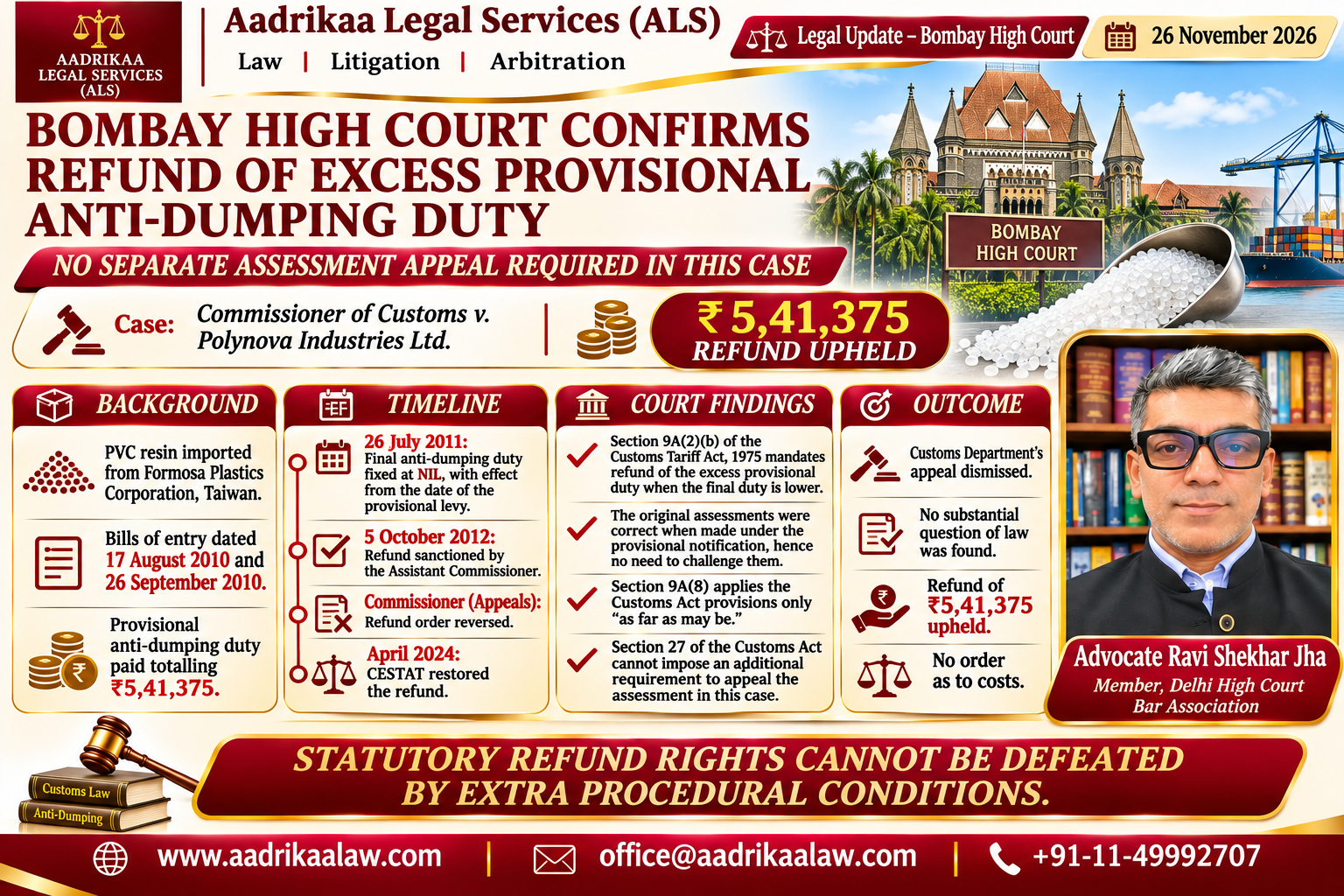
In Commissioner of Customs v. Polynova Industries Ltd., the Bombay High Court dismissed the Customs Department’s appeal and confirmed Polynova Industries Ltd.’s entitlement to a refund of ₹5,41,375 in anti-dumping duty paid on imports of PVC resin from Taiwan.
The decision clarifies the refund mechanism under Section 9A of the Customs Tariff Act, 1975. Where a provisional anti-dumping duty is later reduced in the final notification, the excess paid is refundable under the statute. The Court ruled that an importer need not separately challenge or seek reassessment of the original bill of entry before filing that refund claim.
The dispute arose after final duty was fixed at nil
Polynova imported PVC resin supplied by Formosa Plastics Corporation, Taiwan, under two bills of entry dated 17 August 2010 and 26 September 2010. At the time, a July 2010 government notification had imposed provisional anti-dumping duty on the product. Polynova paid a total of ₹5,41,375 pursuant to that provisional levy.
A subsequent notification, issued on 26 July 2011, determined the final anti-dumping duty for PVC resin exported by Formosa Plastics Corporation at nil. Crucially, the final determination applied from the date on which the provisional duty had originally been imposed.
Polynova then applied for a refund of the duty it had paid. The Assistant Commissioner sanctioned the refund on 5 October 2012. However, the Commissioner of Customs (Appeals) later set aside that order, reasoning that Polynova had not challenged the original assessments of its bills of entry. The Customs, Excise and Service Tax Appellate Tribunal (CESTAT) restored the refund in April 2024, prompting the Customs Department to appeal to the High Court.
Court: the statutory refund follows finalisation of provisional duty
The Department argued that Section 9A(8) of the Customs Tariff Act imports the Customs Act procedures, including those relating to assessment, appeals and refunds. On that basis, it contended that Polynova could not obtain a refund without first contesting the bill-of-entry assessments.
The High Court rejected that argument. It distinguished between an ordinary refund dispute and a refund that results from the statutory finalisation of a provisional anti-dumping levy.
Under Section 9A(2), the government may impose provisional anti-dumping duty while the normal value and dumping margin are being determined. If the final duty is lower than the provisional amount collected, Section 9A(2)(b) requires a refund of the excess.
Because the final notification set the applicable duty at nil, the Court held that the entire provisional duty paid by Polynova had become refundable. The original assessments had been made correctly under the provisional notification then in force; there was therefore no basis or need to appeal those assessments.
“The refund becomes automatic after the Second Notification is issued,” the Court held, adding that there was “no necessity” for the importer to file an appeal against the assessment or seek reassessment.
Section 27 procedure does not override the specific refund entitlement
The Court also addressed the role of Section 27 of the Customs Act, 1962, which generally governs customs refund claims. It held that Section 9A(8) makes Customs Act provisions applicable only “as far as may be.”
In this case, the right to the refund arose directly from the specific provision in Section 9A(2)(b) of the Customs Tariff Act. Therefore, Section 27 did not govern the substantive processing of the claim in a manner that could impose an additional requirement to appeal the original assessment.
The Court found support in the Madras High Court’s earlier decision in Enterprise International Ltd. v. Commissioner of Customs. That decision similarly held that, after provisional anti-dumping duty is finalised at a lower amount, an importer need only apply for a refund of the excess. Authorities cannot add a requirement for reassessment or an appeal when no such condition is prescribed by law.
Appeal dismissed; refund remains payable
The Bombay High Court concluded that the Customs Department had not shown any statutory provision requiring Polynova to challenge the original assessments before claiming the refund. It found that the Assistant Commissioner had correctly processed the claim under Section 9A(2) and that CESTAT had correctly restored the refund order.
The Court held that the appeal raised no substantial question of law and dismissed it, with no order as to costs.
Why the ruling matters for importers
The judgment confirms an important distinction for importers facing provisional anti-dumping duties:
- Provisional duty can be adjusted through the final notification. If the final duty is lower, the excess collected must be refunded under Section 9A(2)(b).
- An appeal against the bill of entry is not automatically required. Where the refund arises solely because final duty replaces a higher provisional duty, the importer can make the refund application without challenging the original assessment.
- Authorities cannot add procedural conditions absent statutory authority. A refund claim cannot be rejected merely because the importer did not seek reassessment or file an appeal, when the Customs Tariff Act itself mandates the refund.
For businesses importing goods subject to provisional anti-dumping duties, the ruling supports prompt refund applications after the government issues a final notification that reduces the duty. The claim should clearly link the duty paid under the provisional notification to the lower final determination and identify the resulting excess amount.
Aadrikaa Legal Services is a trusted legal and regulatory support partner providing end-to-end legal solutions to law firms, corporate organizations, and businesses across India. We specialize in paralegal services, litigation support, tax and regulatory matters, delivering reliable, efficient, and result-oriented legal assistance.
Our services include comprehensive paralegal support, drafting and documentation, legal research, case management, litigation handling, and representation support across various judicial and quasi-judicial forums. We also assist in direct and indirect tax matters, customs, GST, corporate regulatory compliance, and legal advisory.
Source: Bombay High Court
Handy Download:
Write to us at office@aadrikaalaw.com
Tel: +91-11-4999 2707
Ravi Shekhar Jha – Advocate, Bar Council of Delhi