Tag: #TaxLitigations

  • Supreme Court on Taxation of Offshore Indirect Transfers and Cross-Border M&A

    Supreme Court on Taxation of Offshore Indirect Transfers and Cross-Border M&A

    Date: 14.08.2026

    The Vodafone International Holdings B.V. v. Union of India case is a pivotal Supreme Court judgment that shaped the landscape of foreign direct investment (FDI), cross-border mergers and acquisitions, and the taxation of offshore transactions involving Indian assets. This article provides a detailed overview of the case, its background, legal issues, the Supreme Court’s reasoning, and its broader implications for international investors and Indian tax law.

    Background: The Transaction and Dispute

    In 2007, Vodafone International Holdings B.V. (VIH), a Dutch company, acquired the entire share capital of CGP Investments (Holdings) Ltd., a Cayman Islands company. CGP indirectly held a controlling stake (through a complex web of subsidiaries) in Hutchison Essar Limited (HEL), a major Indian telecom operator. The acquisition was valued at approximately US $11.08 billion and was structured as an offshore transaction between two non-resident entities.

    The Indian tax authorities (the Revenue) sought to tax the capital gains arising from this transaction, arguing that although the share transfer occurred offshore, the underlying assets were Indian, and thus the gains were taxable in India. Vodafone contested this, asserting that the transaction was a legitimate share sale outside India and not subject to Indian capital gains tax.

    Key Legal Issues

    1. Taxability of Offshore Transactions: Whether the transfer of shares of a foreign company (CGP) that indirectly held Indian assets could be taxed in India under Section 9(1)(i) of the Income Tax Act, 1961.
    2. “Look Through” Principle: Whether Indian tax law allowed the authorities to “look through” the offshore structure and tax the underlying Indian assets.
    3. Nature of Rights Transferred: Whether the transaction involved only a share sale or also the transfer of other rights and entitlements (such as management rights, brand licenses, options, etc.) that could be considered capital assets in India.
    4. Obligation to Withhold Tax: Whether Vodafone was required to withhold tax at source under Section 195 when making payment to Hutchison.

    The Supreme Court’s Analysis and Findings

    1. Corporate Structure and Substance Over Form

    • The Court recognized that multinational companies often use complex holding structures for commercial, regulatory, and tax reasons. Such structures are legitimate unless proven to be sham or colorable devices for tax evasion.
    • The “look at” principle was emphasized: the legal nature of the transaction must be assessed holistically, not by dissecting each component.

    2. Section 9(1)(i) and Indirect Transfers

    • Section 9(1)(i) taxes income arising from the transfer of a capital asset situated in India. The Court held that the law, as it stood, did not cover indirect transfers (i.e., transfer of shares of a foreign company holding Indian assets).
    • The Court rejected the Revenue’s argument that Section 9(1)(i) was a “look through” provision, noting that such an approach would require explicit legislative language, which was absent at the time.

    3. Nature of Rights and Controlling Interest

    • The Court clarified that controlling interest is an incident of shareholding and not a separate capital asset. The transfer of shares inherently includes the transfer of all rights attached to those shares.
    • Other contractual rights (such as call/put options, brand licenses, non-compete agreements) were either not transferred or were not capital assets situated in India.

    4. Withholding Tax and Representative Assessee

    • Since the transaction was between two non-residents and the asset transferred (CGP shares) was situated outside India, there was no obligation on Vodafone to withhold tax under Section 195.
    • Vodafone could not be treated as a representative assessee under Section 163, as there was no transfer of a capital asset situated in India.

    5. Legitimacy of Tax Planning

    • The Court reaffirmed that tax planning is legitimate if within the framework of law. Only colorable devices or sham transactions designed solely for tax evasion can be disregarded.

    The Judgment and Its Impact

    • The Supreme Court set aside the Bombay High Court’s decision and ruled in favor of Vodafone, holding that the offshore transaction was not taxable in India under the law as it existed at the time.
    • The Court directed the Revenue to return the amount deposited by Vodafone, with interest.
    • The judgment emphasized the need for certainty and clarity in tax laws, especially for foreign investors.

    Broader Implications

    1. Certainty for Foreign Investors: The ruling provided much-needed clarity and assurance to international investors regarding the tax treatment of offshore transactions involving Indian assets.
    2. Legislative Response: In response to the judgment, the Indian government later amended the Income Tax Act (retrospectively) to tax indirect transfers of Indian assets, introducing the so-called “Vodafone tax”.
    3. Principles for Taxing Cross-Border M&A:
      • The situs of shares is determined by the place of incorporation and registration, not by the location of underlying assets.
      • The transfer of shares includes all rights attached to those shares; controlling interest is not a separate asset.
      • Anti-avoidance rules (such as GAAR) must be expressly provided for in the law.

    Conclusion

    The Vodafone judgment stands as a landmark in Indian tax jurisprudence, balancing the interests of revenue with the need for legal certainty and a favorable investment climate. It underscores the importance of clear legislative drafting and the principle that courts cannot expand the scope of tax statutes beyond their explicit language. The case also triggered significant policy and legislative changes, shaping the future of cross-border investments in India.

    Aadrikaa Legal Services is a trusted legal and regulatory support partner providing end-to-end legal solutions to law firms, corporate organizations, and businesses across India. We specialize in paralegal services, litigation support, tax and regulatory matters, delivering reliable, efficient, and result-oriented legal assistance.

    Our services include comprehensive paralegal support, drafting and documentation, legal research, case management, litigation handling, and representation support across various judicial and quasi-judicial forums. We also assist in direct and indirect tax matters, customs, GST, corporate regulatory compliance, and legal advisory.

    Handy Download:

  • Supreme Court Upholds IBC Amendments Recognizing Allottees as Financial Creditors in Real Estate Insolvency

    Supreme Court Upholds IBC Amendments Recognizing Allottees as Financial Creditors in Real Estate Insolvency

    Date: 14.08.2026

    The Supreme Court of India delivered a landmark judgment addressing the constitutional validity of amendments to the Insolvency and Bankruptcy Code, 2016 (IBC), which classified homebuyers (allottees of real estate projects) as “financial creditors.” This article provides a comprehensive overview of the case, the legal arguments, the Court’s reasoning, and the implications for the real estate sector and homebuyers.

    Background

    The IBC was enacted in 2016 to streamline insolvency proceedings and maximize asset value for creditors. However, ambiguity existed regarding the status of homebuyers in insolvency cases against real estate developers. Multiple writ petitions challenged the 2018 amendments to the IBC, which explicitly deemed amounts raised from homebuyers as having the commercial effect of a borrowing, thus making them financial creditors with rights to initiate insolvency proceedings and participate in the Committee of Creditors (CoC).

    Key Amendments Challenged

    1. Explanation to Section 5(8)(f) of IBC:
      • Deems any amount raised from an allottee under a real estate project as having the commercial effect of a borrowing.
    2. Section 21(6A)(b):
      • Provides for representation of large classes of financial creditors (including homebuyers) in the CoC by an authorized representative.
    3. Section 25A:
      • Details the rights and duties of authorized representatives of financial creditors.

    Arguments Presented

    Petitioners (Real Estate Developers)

    • Violation of Article 14 (Equality): Treating homebuyers as financial creditors was argued to be arbitrary and discriminatory, equating them with banks and financial institutions despite fundamental differences.
    • Article 19(1)(g) (Right to Trade): The amendments were claimed to be excessive and disproportionate, potentially jeopardizing solvent developers due to actions by a single homebuyer.
    • Overlap with RERA: Petitioners argued that the Real Estate (Regulation and Development) Act, 2016 (RERA) already provided adequate remedies for homebuyers, making the IBC amendments unnecessary and excessive.

    Respondents (Union of India & Homebuyers)

    • Legislative Intent: The amendments were justified as necessary to protect homebuyers, who often finance a significant portion of real estate projects and face delays or non-completion.
    • Economic Legislation: The legislature has the right to experiment and address economic realities, especially in sectors with widespread consumer grievances.
    • Concurrent Remedies: The IBC and RERA offer parallel remedies, and the IBC is not merely a debt recovery tool but a means to rehabilitate distressed companies.

    Supreme Court’s Analysis and Findings

    1. Legislature’s Right to Experiment

    The Court reaffirmed that economic legislation is entitled to judicial deference, allowing the legislature to address sector-specific issues and experiment with solutions.

    2. Rationale for the Amendments

    • The Insolvency Law Committee found that homebuyers finance real estate projects and should have rights similar to other financial creditors.
    • Delays and defaults in the real estate sector were widespread, justifying the need for stronger remedies for homebuyers.

    3. IBC and RERA: Harmonious Construction

    • The Court held that RERA and IBC operate in different spheres: RERA protects individual interests and project completion, while IBC focuses on the rehabilitation or liquidation of the corporate debtor.
    • In case of conflict, the IBC prevails due to its later enactment and overriding clause.

    4. Classification as Financial Creditors

    • Homebuyers advance funds for future assets, effectively financing the project, which fits the definition of a financial debt under Section 5(8)(f) of the IBC.
    • The amendments were deemed clarificatory, not creating new rights but affirming the existing legal position.

    5. No Violation of Constitutional Rights

    • The amendments do not violate Articles 14, 19(1)(g), or 300-A. The classification is reasonable, and the remedies are proportionate to the issues faced by homebuyers.

    6. Committee of Creditors and Voting

    • The mechanism for representation and voting by homebuyers in the CoC was upheld, with the Court noting that practical issues can be addressed through further legislative refinement.

    Implications of the Judgment

    1. Empowerment of Homebuyers: Homebuyers can now initiate insolvency proceedings against defaulting developers and have a say in the resolution process.
    2. Concurrent Remedies: Homebuyers retain the right to seek remedies under RERA, the Consumer Protection Act, and the IBC.
    3. Sectoral Impact: The judgment brings greater accountability to the real estate sector and aims to restore confidence among homebuyers.
    4. Guidance for Future Legislation: The Court’s reasoning sets a precedent for interpreting economic legislation and balancing stakeholder interests.

    Conclusion

    The Supreme Court’s judgment upholding the constitutional validity of the IBC amendments marks a significant step in protecting homebuyers and ensuring accountability in the real estate sector. By recognizing homebuyers as financial creditors, the Court has provided them with robust legal remedies while maintaining the balance between sectoral regulation and insolvency law.

    This decision is expected to have a lasting impact on the real estate industry, offering hope to countless homebuyers and setting a benchmark for legislative interventions in complex economic sectors.

    Aadrikaa Legal Services is a trusted legal and regulatory support partner providing end-to-end legal solutions to law firms, corporate organizations, and businesses across India. We specialize in paralegal services, litigation support, tax and regulatory matters, delivering reliable, efficient, and result-oriented legal assistance.

    Our services include comprehensive paralegal support, drafting and documentation, legal research, case management, litigation handling, and representation support across various judicial and quasi-judicial forums. We also assist in direct and indirect tax matters, customs, GST, corporate regulatory compliance, and legal advisory.

    Handy Download:

  • Delhi High Court Clarifies Limitation Law in Customs Refunds

    Delhi High Court Clarifies Limitation Law in Customs Refunds

    Date: 14.08.2026

    A recent batch of appeals before the Delhi High Court has brought significant clarity to the application of limitation law in customs refund cases. Senior India Pvt Ltd, a prominent importer, challenged several orders of the Customs, Excise and Service Tax Appellate Tribunal (CESTAT) regarding the classification of imported goods and the timeliness of their refund claims. This article provides a detailed overview of the case, the legal issues involved, and the implications of the Court’s decision.

    Background of the Case

    Senior India Pvt Ltd imported pressure relief valves, which were initially classified under Customs Tariff Item (CTI) 8481 40 00. From September 2018, the company began declaring these goods under CTI 8409 99 41 and paid a higher duty, reportedly at the insistence of Customs authorities. Fourteen Bills of Entry were assessed between September 2018 and February 2019, with two additional Bills in March and May 2019.

    The legal landscape at the time, shaped by earlier Delhi High Court decisions, allowed importers to seek refunds under Section 27 of the Customs Act even if the assessment had not been appealed. Acting on this, Senior India filed two refund applications on 26 August 2019, within the statutory one-year period.

    The Turning Point: Supreme Court Judgment in ITC Limited

    While the refund proceedings were pending, the Supreme Court delivered a landmark judgment in ITC Limited v. Commissioner of Central Excise, Kolkata-IV (2019), holding that a refund claim could not be entertained unless the assessment was first modified in appeal. This fundamentally changed the legal basis for refund claims.

    Within days, Senior India sought to amend the Bills of Entry under Section 149 of the Customs Act and requested that refund proceedings be kept in abeyance. However, the refund authority rejected one claim as premature, and the company subsequently filed appeals under Section 128, seeking exclusion of the period spent on the refund process from the limitation period, invoking principles from Section 14 of the Limitation Act.

    Key Legal Issues

    The High Court focused on two main questions:

    1. Whether the authorities were justified in denying the benefit of Section 14 of the Limitation Act to Senior India, given the change in law by the Supreme Court’s ITC Limited judgment.
    2. Whether CESTAT was correct in dismissing an appeal as time-barred when the underlying appeal had been filed within the prescribed period.

    The Court’s Analysis and Findings

    • Application of Section 14 Principles: The Court recognized that while the Limitation Act does not directly apply to customs appeals, the principles underlying Section 14 (exclusion of time spent in bona fide proceedings) do apply. The Court found that Senior India had acted diligently, pursuing remedies as per the law prevailing at the time, and promptly adjusted its approach after the Supreme Court’s decision.
    • Exclusion of Time: The period during which Senior India pursued the refund remedy and sought amendment of Bills of Entry was excluded from the limitation calculation. The Court held that, due to the legal transition caused by the ITC Limited judgment, the authorities should have allowed this exclusion.
    • Statutory Extension Due to COVID-19: The Court also noted that the period for filing appeals was further extended by government notifications issued during the COVID-19 pandemic, making Senior India’s appeals timely.
    • Error in Dismissing Appeals as Time-Barred: In one case, the Court found that the appeal had been filed well within the statutory period, and its dismissal by CESTAT as time-barred was manifestly erroneous.

    Outcome and Directions

    • The High Court set aside the orders of CESTAT and the Commissioner (Appeals) that had rejected Senior India’s appeals on limitation grounds.
    • The appeals were restored for decision on merits, with instructions to the authorities not to revisit the limitation issue.
    • The Court directed that the restored appeals be decided within four months, and that refund and amendment applications be processed in accordance with the final outcome.

    Implications of the Judgment

    This decision is significant for importers and legal practitioners dealing with customs disputes:

    1. Clarifies Limitation Law: The judgment affirms that bona fide pursuit of remedies under the law as it stood can justify exclusion of time from limitation, especially when the legal position changes due to a higher court ruling.
    2. Ensures Fairness: The Court’s approach prevents penalizing parties for following the law as it existed before a judicial shift.
    3. Guidance for Future Cases: The decision provides a roadmap for handling similar disputes where refund claims or appeals are affected by changes in legal interpretation.

    Conclusion

    The Delhi High Court’s ruling in the Senior India Pvt Ltd case underscores the importance of judicial flexibility and fairness in applying limitation law, especially in the context of evolving legal standards. Importers and legal professionals should take note of this precedent when navigating refund and appeal processes under the Customs Act.

    Aadrikaa Legal Services is a trusted legal and regulatory support partner providing end-to-end legal solutions to law firms, corporate organizations, and businesses across India. We specialize in paralegal services, litigation support, tax and regulatory matters, delivering reliable, efficient, and result-oriented legal assistance.

    Our services include comprehensive paralegal support, drafting and documentation, legal research, case management, litigation handling, and representation support across various judicial and quasi-judicial forums. We also assist in direct and indirect tax matters, customs, GST, corporate regulatory compliance, and legal advisory.

    Handy Download:

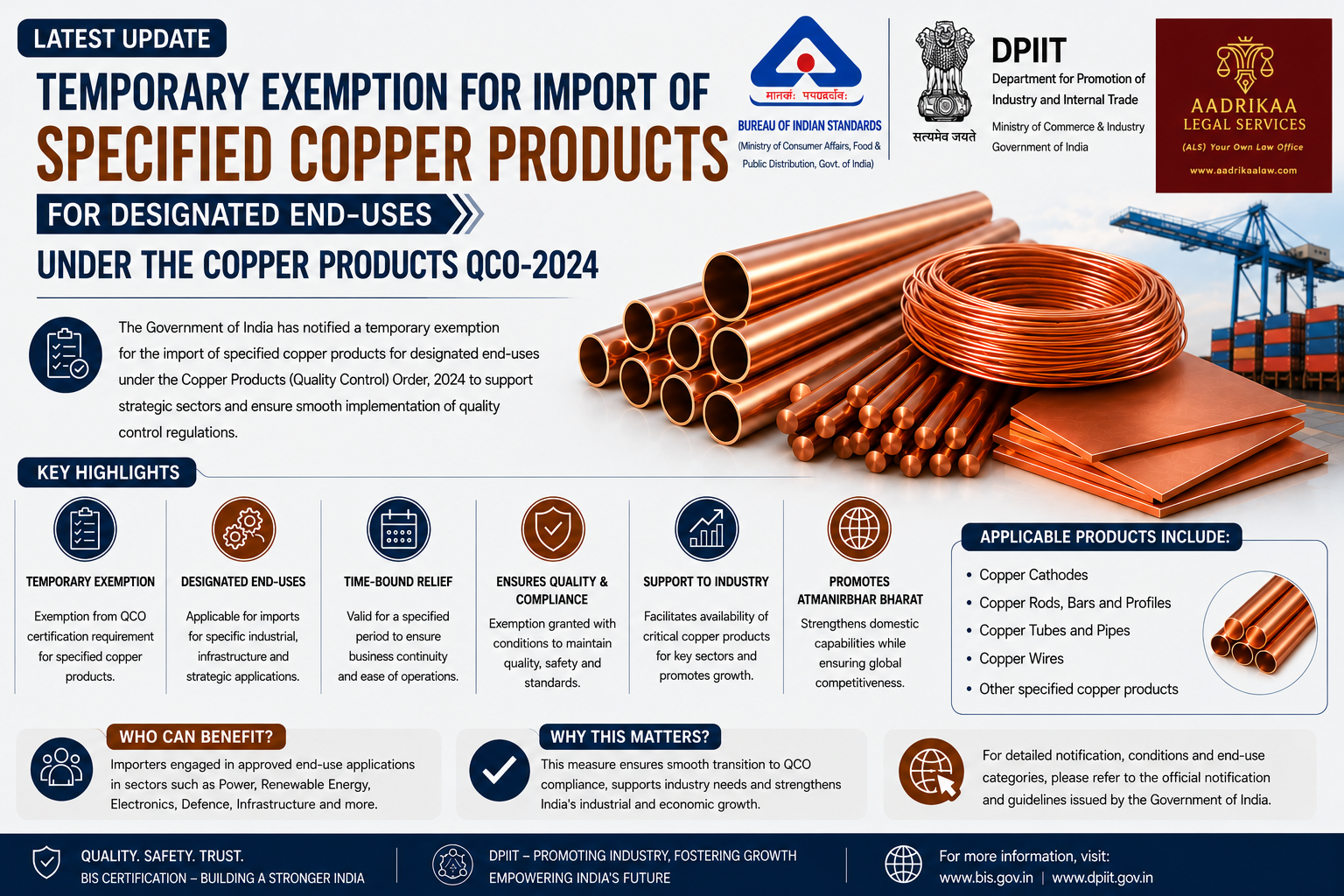
  • Temporary Exemption for Import of Specified Copper Products for Designated End-Uses under the Copper Products QCO-2024

    Temporary Exemption for Import of Specified Copper Products for Designated End-Uses under the Copper Products QCO-2024

    Date: 13.08.2026

    The Government of India has issued a significant order granting temporary exemptions for the import of specific copper products, addressing the needs of various industrial sectors. This move aims to bridge the gap between domestic supply and specialized requirements not currently met by Indian manufacturers or covered under the Copper Products (Quality Control) Order, 2024.

    Background and Rationale

    Industry stakeholders and associations highlighted challenges in sourcing certain high-purity and specialized copper products domestically, either due to lack of standards coverage or insufficient quality and quantity. Responding to these concerns, the Department for Promotion of Industry and Internal Trade (DPIIT), in consultation with the Bureau of Indian Standards (BIS), has provided a one-year exemption for select copper products, strictly for designated end-uses.

    List of Exempted Copper Products and Their End-Uses

    The exemption covers a range of copper products, each tied to a specific industrial application. Here’s a summary of the key products and their permitted uses:

    1. Oxygen Free Copper rods, bars, strips, and sheets (min. purity 99.995%, max. oxygen 5 PPM)
      • End-use: Vacuum interrupters
    2. Silver bearing Oxygen Free Copper, Zirconium Copper, High Conductivity Phosphorous-Deoxidised Copper rods, bars, and strips
      • End-use: Generator rotor coils, generators, electrical shunts
    3. Beryllium Alloy Copper Bar (End Wadge/Rotor Center Wedge-material grade)
      • End-use: Generators
    4. Oxygen Free Copper strips (min. purity 99.995%, max. oxygen 5 PPM)
      • End-use: Automotive bus bars for battery packs
    5. OFC Grade Copper Tape (0.18 mm x 81 mm and 0.095 mm x 85 mm)
      • End-use: RF feeder cables
    6. Billet & Section of Copper Alloy Grades (CuCr 90:10, CuZr 50:50, CuSi 90:10, CuP 85:15, CuTe 50:50)
      • End-use: Electrical contacts, short circuit rings, rotor bars for industrial and traction motors
    7. Copper Alloys C15000 (Zirconium Copper) and C18150 (Chromium Zirconium Copper) billets
      • End-use: Short circuit rings and rotor bars for traction and industrial motors
    8. Copper Alloy Strips (TRKFC 4, C151, DK Alloy, DSC-3N 1/2H, DK-3)
      • End-use: Bus bars for automobiles
    9. ETP Copper Plate in Coils (Grade C11000, Cu-ETP)
      • End-use: Electrical applications
    10. Hard Drawn Grooved Copper Tin alloy (150 sqmm and above, GT-SN)
      • End-use: Overhead electrical conductors
    11. Hard-Drawn Copper Wire (Dia 2.6mm, 99.9%+ purity)
      • End-use: Wiring harnesses for the automobile industry
    12. Enameled Copper Wire/Magnet Wire (0.01 to 0.16 mm, various grades)
      • End-use: Electrical wound components
    13. Copper Finned Tubes (externally and internally finned, various grades)
      • End-use: Chillers
    14. High Strength Copper Alloy Tubes (multiple grades)
      • End-use: Air-conditioning systems and electrical applications

    Conditions for Availing the Exemption

    To ensure traceability and promote future indigenization, importers must comply with the following conditions:

    1. Notification to BIS: Inform the Bureau of Indian Standards within 7 days of consignment clearance, using company letterhead and authorized signatory, via email.
    2. Quarterly Reporting: Maintain and submit quarterly records of imported goods to Central Government authorities, again on company letterhead and signed, via email.
    3. Indigenization Plan: Submit a plan for local manufacturing (indigenization) of the imported goods to the Central Government.

    Scope and Limitations

    • The exemption is valid for one year from the date of the order’s publication.
    • It applies strictly to the products and end-uses listed, and only to actual users (not traders or resellers).
    • The government reserves the right to review and amend the list of products and end-uses as needed.

    Implications for Industry

    This exemption provides immediate relief to sectors reliant on specialized copper products, such as electrical, automotive, and industrial equipment manufacturers. It also encourages importers to plan for future domestic production, aligning with the government’s broader Make in India initiative.

    For further details or compliance queries, stakeholders should contact the relevant government departments as specified in the official order.

    This proactive measure is expected to support critical industries while paving the way for enhanced domestic capabilities in the copper sector.

    Aadrikaa Legal Services is a trusted legal and regulatory support partner providing end-to-end legal solutions to law firms, corporate organizations, and businesses across India. We specialize in paralegal services, litigation support, tax and regulatory matters, delivering reliable, efficient, and result-oriented legal assistance.

    Our services include comprehensive paralegal support, drafting and documentation, legal research, case management, litigation handling, and representation support across various judicial and quasi-judicial forums. We also assist in direct and indirect tax matters, customs, GST, corporate regulatory compliance, and legal advisory.

    Handy Download:

  • Supreme Court Strikes Down West Bengal Housing Industry Regulation Act, 2017: Repugnancy with RERA and the Primacy of Central Real Estate Regulation

    Supreme Court Strikes Down West Bengal Housing Industry Regulation Act, 2017: Repugnancy with RERA and the Primacy of Central Real Estate Regulation

    Date: 13.08.2026

    The Supreme Court of India, in a landmark judgment, declared the West Bengal Housing Industry Regulation Act, 2017 (WB-HIRA) unconstitutional due to its repugnancy with the central Real Estate (Regulation and Development) Act, 2016 (RERA). This article provides a detailed analysis of the case, the legislative background, the core legal issues, and the implications for real estate regulation in India.

    Background: The Challenge to WB-HIRA

    The Forum for People’s Collective Efforts (FPCE) challenged the constitutional validity of WB-HIRA, arguing that:

    1. Both WB-HIRA and RERA fall under the Concurrent List (Entries 6 and 7) of the Constitution.
    2. WB-HIRA did not receive Presidential assent as required under Article 254(2).
    3. WB-HIRA contains provisions inconsistent with RERA or is a virtual replica of it.
    4. Parliament, having legislated on the subject, precludes the State from enacting parallel legislation.

    Legislative History: From State Laws to a National Framework

    Before RERA, several states, including West Bengal, had their own real estate laws. Notably:

    • West Bengal enacted the WB 1993 Act, which received Presidential assent.
    • Maharashtra and Kerala also had their own acts, later repealed after RERA’s enactment.
    • RERA was introduced to address the lack of consumer protection, transparency, and standardization in the real estate sector.

    RERA: Salient Features

    RERA was designed as a comprehensive, uniform framework for real estate regulation across India. Key features include:

    1. Mandatory Registration: All real estate projects and agents must register with the regulatory authority before advertising or selling.
    2. Transparency: Promoters must disclose project details, approvals, and progress on a public website.
    3. Consumer Protection: Limits on advance payments, model agreements, and clear refund/compensation mechanisms.
    4. Dispute Resolution: Establishment of Real Estate Regulatory Authorities and Appellate Tribunals for speedy redressal.
    5. Overriding Effect: RERA explicitly states its provisions override any inconsistent state laws (Section 89).

    WB-HIRA: Overlap and Variance with RERA

    While WB-HIRA closely mirrored RERA, several key differences and inconsistencies were identified:

    • Definitions: WB-HIRA’s definitions of ‘car parking area’, ‘garage’, and ‘force majeure’ differed from RERA, often to the detriment of homebuyers.
    • Scope: WB-HIRA applied to all projects in West Bengal, not just those in planning areas.
    • Regulatory Powers: WB-HIRA lacked certain consumer safeguards present in RERA, such as the power to refer monopoly issues to the Competition Commission of India.
    • Advisory Councils: WB-HIRA established a State Advisory Council, whereas RERA provided for a Central Advisory Council.
    • Compounding of Offences: RERA allowed for compounding; WB-HIRA did not.
    • Adjudication: RERA required a judicial officer for compensation claims; WB-HIRA vested this in the regulatory authority.

    The Supreme Court’s Analysis

    1. Legislative Competence

    • Both RERA and WB-HIRA fall under the Concurrent List (Entries 6 and 7: transfer of property and contracts).
    • The State’s initial claim that WB-HIRA was an ‘industry’ law under the State List was abandoned during arguments.

    2. Repugnancy under Article 254

    • The Court applied three tests for repugnancy:
      1. Direct conflict between provisions.
      2. Parliament’s intent to occupy the entire field.
      3. Both laws covering the same subject matter.
    • WB-HIRA was found to be repugnant on all counts: it was a near-verbatim copy of RERA, with some provisions directly conflicting or omitting key consumer protections.

    3. Presidential Assent

    • WB-HIRA did not receive Presidential assent, a requirement for state laws repugnant to central laws in the Concurrent List.

    4. Sections 88 and 89 of RERA

    • Section 88 (“in addition to and not in derogation of”) does not permit parallel state regimes on the same subject.
    • Section 89 gives RERA overriding effect over inconsistent state laws.

    The Verdict and Its Implications

    • WB-HIRA Struck Down: The Supreme Court declared WB-HIRA unconstitutional and void due to repugnancy with RERA.
    • No Revival of Old State Law: The earlier WB 1993 Act, already repealed, does not revive as a result of this judgment.
    • Protection of Past Actions: Registrations, sanctions, and permissions granted under WB-HIRA before the judgment remain valid (by virtue of Article 142 powers).
    • Uniformity Restored: RERA now applies uniformly across West Bengal, ensuring consistent consumer protection and regulatory standards.

    Conclusion

    The Supreme Court’s decision in FPCE v. State of West Bengal reinforces the primacy of central legislation in the real estate sector and ensures that homebuyers across India are protected by a uniform regulatory framework. States cannot enact parallel laws that duplicate or dilute central protections without Presidential assent. This judgment is a significant step towards transparency, accountability, and consumer rights in Indian real estate.

    Aadrikaa Legal Services is a trusted legal and regulatory support partner providing end-to-end legal solutions to law firms, corporate organizations, and businesses across India. We specialize in paralegal services, litigation support, tax and regulatory matters, delivering reliable, efficient, and result-oriented legal assistance.

    Our services include comprehensive paralegal support, drafting and documentation, legal research, case management, litigation handling, and representation support across various judicial and quasi-judicial forums. We also assist in direct and indirect tax matters, customs, GST, corporate regulatory compliance, and legal advisory.

    Handy Download:

  • Delhi HC on Scope of IP-I Registration, Telecom Licensing, and Arbitral Award Review under Section 34 of the Arbitration and Conciliation Act, 1996

    Delhi HC on Scope of IP-I Registration, Telecom Licensing, and Arbitral Award Review under Section 34 of the Arbitration and Conciliation Act, 1996

    Date: 13.08.2026

    The Delhi High Court recently delivered a significant judgment in the case between the Union of India (Department of Telecommunications) and Sterlite Technologies Limited, addressing complex issues around telecom infrastructure licensing, regulatory compliance, and the scope of arbitral review. This article provides a detailed analysis of the dispute, the legal arguments, and the implications of the court’s decision.

    Background of the Dispute

    Sterlite Technologies Limited (STL), a leading provider of digital network solutions, was granted an Infrastructure Providers Category-I (IP-I) Registration Certificate by the Department of Telecommunications (DoT). This certificate authorized STL to provide passive telecom infrastructure, such as fiber ducts and related facilities, but explicitly barred it from dealing with active telecom equipment or providing end-to-end bandwidth services, which require a separate telecom service provider (TSP) license.

    STL, through its wholly owned subsidiary Speedon Network Limited (SNL), entered into Master Service Agreements (MSAs) with various TSPs, notably Citycom Networks and Microscan Computers. The payment structure under these agreements was based on subscriber base and revenue sharing, rather than traditional lease rentals for passive infrastructure. The DoT alleged that STL, via these arrangements, was effectively functioning as a TSP without the necessary license, thereby violating the terms of its IP-I registration and causing loss of government revenue.

    Key Events Leading to Arbitration

    1. Inspection and Allegations:
      • In February 2015, DoT inspected STL’s premises in Pune and concluded that STL was operating beyond its permitted scope by selling bandwidth and managing active equipment through SNL.
      • The inspection report alleged unauthorized services and revenue evasion exceeding Rs. 2.5 crores.
    2. Correspondence and Show Cause Notice:
      • STL provided detailed responses, clarifying that active equipment belonged to the TSPs, not STL or SNL.
      • In July 2018, DoT issued a show cause notice for violation of IP-I terms, followed by a demand notice in August 2020 for Rs. 8.55 crores.
    3. Arbitration Proceedings:
      • STL challenged the demand, invoking the arbitration clause in the IP-I certificate.
      • The arbitrator ruled in favor of STL, declaring the demand notice illegal, arbitrary, and unjustified.

    Legal Arguments Presented

    Union of India (Petitioner)

    • Ownership and Operation: Argued that STL and SNL, as related entities, owned and operated active equipment without a license, and that billing based on bandwidth proved provision of end-to-end services.
    • Damages: Claimed inherent right to seek damages for breach of registration terms, even without explicit contractual provisions.

    Sterlite Technologies Limited (Respondent)

    • Separation of Entities: Emphasized that SNL and STL are legally distinct, with SNL holding its own IP-I registration and later a unified license.
    • Scope of Services: Asserted that STL only provided passive infrastructure, with active equipment and bandwidth services managed and billed by the TSPs.
    • Contractual Interpretation: Highlighted that the MSAs and subsequent novation agreements clarified the roles and responsibilities, limiting STL to passive infrastructure.

    Court’s Analysis and Findings

    The High Court, upholding the arbitrator’s award, made several key observations:

    1. Scope of IP-I Registration:
      • The regulatory framework and the IP-I certificate clearly prohibit IP-I holders from providing active services or end-to-end bandwidth.
      • The evidence showed STL provided only passive infrastructure, with TSPs responsible for active equipment and subscriber services.
    2. Ownership of Equipment:
      • The court found no conclusive proof that STL owned or operated active equipment. Lease agreements and correspondence supported STL’s position.
    3. Billing and Revenue Model:
      • The MSAs did not establish that STL’s charges were based on bandwidth utilization by end subscribers. The arbitrator’s factual findings on this point were upheld.
    4. Legal Entity Distinction:
      • SNL and STL were recognized as separate legal entities, each with distinct registrations and licenses. The court rejected the argument that SNL was merely a faΓ§ade for STL.
    5. Demand Notice Validity:
      • The demand notice lacked statutory backing, as there was no provision in the IP-I certificate or the Indian Telegraph Act for such a penalty. The court emphasized that damages under Section 73 of the Indian Contract Act require proof of actual loss, which was absent.
    6. Scope of Judicial Review:
      • The court reiterated the limited scope of interference under Section 34 of the Arbitration and Conciliation Act, stating that plausible views taken by arbitrators should not be disturbed unless they are patently illegal or contrary to public policy.

    Implications of the Judgment

    • Regulatory Clarity: The judgment reinforces the distinction between passive infrastructure providers and licensed TSPs, providing clarity for industry participants.
    • Arbitral Autonomy: It underscores the judiciary’s deference to arbitral awards, limiting court intervention to narrow grounds.
    • Contractual Precision: The case highlights the importance of clear contractual definitions and compliance with regulatory frameworks in the telecom sector.

    Conclusion

    The Delhi High Court’s decision in Union of India vs. Sterlite Technologies Limited sets an important precedent for telecom infrastructure regulation and the enforcement of arbitral awards. By upholding the arbitrator’s reasoned findings and emphasizing the limits of judicial review, the court has provided valuable guidance for both industry stakeholders and legal practitioners.

    Aadrikaa Legal Services is a trusted legal and regulatory support partner providing end-to-end legal solutions to law firms, corporate organizations, and businesses across India. We specialize in paralegal services, litigation support, tax and regulatory matters, delivering reliable, efficient, and result-oriented legal assistance.

    Our services include comprehensive paralegal support, drafting and documentation, legal research, case management, litigation handling, and representation support across various judicial and quasi-judicial forums. We also assist in direct and indirect tax matters, customs, GST, corporate regulatory compliance, and legal advisory.

    Handy Download:

  • Madras High Court Quashes Customs Order and Emphasizes Right to Fair Hearing in Duty Drawback Disputes

    Madras High Court Quashes Customs Order and Emphasizes Right to Fair Hearing in Duty Drawback Disputes

    Date: 13.08.2026

    A recent judgment by the Madras High Court has significant implications for exporters and customs authorities alike. The case of M/s. Meegan Exports versus the Assistant Commissioner of Customs highlights the importance of due process, the right to be heard, and adherence to principles of natural justice in customs proceedings.

    Background of the Case

    M/s. Meegan Exports, represented by its proprietor Mr. Aashish Modi, exported construction materials to the Maldives under nine shipping bills between April and August 2022. The company availed itself of the duty drawback scheme, which allows exporters to claim a refund of certain duties paid on inputs used in exported goods.

    However, customs authorities initiated proceedings under Section 75(1) of the Customs Act, 1962, and relevant Drawback Rules, alleging that Meegan Exports failed to realize export sale proceeds within the period prescribed by the Foreign Exchange Management Act (FEMA), 1999. This led to the issuance of an Order-in-Original and a recovery letter demanding repayment of the availed drawback.

    Key Issues Raised

    1. Lack of Opportunity to be Heard
      • Meegan Exports contended that it never received the show cause notice and was not given a chance for a personal hearing before the adverse order was passed.
    2. Realization of Export Proceeds
      • The petitioner produced receipts from the Ministry of Commerce, Directorate General of Foreign Trade, evidencing realization of export proceeds, countering the basis for the customs action.
    3. Customs Authorities’ Stand
      • The respondents argued that notices were sent to the address on record and that the petitioner failed to respond despite multiple opportunities.

    The High Court’s Findings

    Justice Hemant Chandangoudar, after considering submissions from both sides, made several important observations:

    • No Proof of Non-Receipt: The petitioner did not provide concrete evidence that the show cause notice was not received.
    • Possession of Realization Receipts: Since Meegan Exports had receipts showing realization of export proceeds, enforcing the impugned order would cause undue monetary loss.
    • No Prejudice to Customs: Granting another opportunity to the petitioner would not prejudice the customs authorities.

    The Court’s Order

    The High Court set aside both the Order-in-Original and the recovery letter. The matter was remanded to the customs authorities for fresh consideration, with clear directions:

    1. Personal Hearing: The petitioner must be given an opportunity for a personal hearing.
    2. Consideration of Evidence: All documents, including bank realization certificates, must be reviewed.
    3. Timely Disposal: The process must be completed within two months from the date of receipt of the court’s order.
    4. Proper Notice: Notices must be sent to the updated address provided by the petitioner.

    Implications for Exporters and Authorities

    This judgment reinforces several key principles:

    • Natural Justice: Authorities must ensure that affected parties receive proper notice and a fair chance to present their case.
    • Documentation: Exporters should maintain and promptly submit all relevant documents, such as bank realization certificates, to defend their claims.
    • Procedural Fairness: Even if procedural lapses occur, courts may grant another opportunity to prevent undue hardship, provided no prejudice is caused to the authorities.

    Conclusion

    The Madras High Court’s decision in the Meegan Exports case serves as a reminder of the critical role of procedural fairness in administrative actions. Exporters facing similar issues should be vigilant about responding to notices and maintaining comprehensive records, while authorities must adhere strictly to principles of natural justice.

    This case sets a precedent for balancing enforcement with fairness, ensuring that justice is not only done but seen to be done.

    Aadrikaa Legal Services is a trusted legal and regulatory support partner providing end-to-end legal solutions to law firms, corporate organizations, and businesses across India. We specialize in paralegal services, litigation support, tax and regulatory matters, delivering reliable, efficient, and result-oriented legal assistance.

    Our services include comprehensive paralegal support, drafting and documentation, legal research, case management, litigation handling, and representation support across various judicial and quasi-judicial forums. We also assist in direct and indirect tax matters, customs, GST, corporate regulatory compliance, and legal advisory.

    Handy Download:

  • CESTAT Kolkata Overturns Customs Valuation and Penalties on Polyester Quilt Cover Imports

    CESTAT Kolkata Overturns Customs Valuation and Penalties on Polyester Quilt Cover Imports

    Date: 13.08.2026

    The Customs, Excise and Service Tax Appellate Tribunal (CESTAT) Kolkata recently delivered a significant judgment in the case involving M/s. Annapurna Industries and the classification, valuation, and penalization of imported polyester quilt covers. This article provides a detailed analysis of the case, the legal issues involved, and the implications for importers and customs authorities.

    Background of the Case

    M/s. Annapurna Industries imported polyester quilt covers from China, declaring them under Customs Tariff Heading (CTH) 63022200 at a transaction value of USD 1.20–1.25 per piece (CIF). Customs authorities, after a first-check examination, observed that the goods were one-side folded and two sides stitched. They opined that these could be converted into bed sheets by removing the stitches, leading to:

    1. Rejection of the declared value under Rule 12 of the Customs Valuation Rules, 2007.
    2. Enhancement of the assessable value to USD 2.85 per piece.
    3. Confiscation of goods under Section 111(m) of the Customs Act.
    4. Imposition of redemption fine and penalty.

    Faced with heavy demurrage and detention charges, Annapurna Industries paid the enhanced duty, fine, and penalty under protest to secure release of the goods, and subsequently appealed the decision.

    Key Legal Issues Examined

    The Tribunal addressed four main questions:

    1. Can imported goods be re-characterized based on their potential for further processing?
    2. Is it lawful to enhance valuation solely on the basis of contemporaneous imports?
    3. Are confiscation and redemption fine sustainable without proven misclassification or undervaluation?
    4. Is the penalty under Section 112(a) of the Customs Act justified in this context?

    1. Classification of Goods: Actual Condition vs. Hypothetical Use

    The Tribunal reaffirmed the principle that goods must be assessed in the condition in which they are imported, not on the basis of what they could become after further processing. The Department’s assumption that the quilt covers could be converted into bed sheets was deemed hypothetical and not a valid basis for reclassification. The Tribunal noted:

    • The goods were presented as stitched quilt covers, fitting the statutory definition of “made-up articles.”
    • The Textile Committee, an expert body, had previously classified similar goods under Heading 6302, supporting the appellant’s position.
    • Previous CESTAT decisions (e.g., Indra Fab, C.F. Inc., and M/s. Annapurna Industries & Others) upheld similar classifications.

    2. Valuation: Transaction Value vs. Comparables

    The Tribunal found that Customs had rejected the declared transaction value without objective evidence, relying instead on unrelated imports of “bed sheets” without ensuring comparability in terms of manufacturer, quality, GSM, construction, brand, finish, commercial level, or quantity. Key points:

    • Rule 12 of the Valuation Rules allows rejection of transaction value only with reasonable doubt supported by evidence.
    • No evidence of additional remittance, relationship, fabricated invoices, or false pricing was found.
    • Legal precedents (Eicher Tractors, Mirah Exports, Mahindra & Mahindra, etc.) require positive evidence for value rejection.

    3. Confiscation and Redemption Fine

    Since misclassification and undervaluation were not established, the foundation for confiscation under Section 111(m) and redemption fine under Section 125 was absent. The Tribunal also noted that Section 125 requires a market price determination before fixing redemption fine, which was not conducted in this case.

    4. Penalty Under Section 112(a)

    With the main allegations unproven, the Tribunal held that the ingredients for imposing a penalty under Section 112(a) did not exist, and thus the penalty was set aside.

    Final Outcome and Implications

    The CESTAT Kolkata set aside the impugned orders, allowing the appeals filed by Annapurna Industries with consequential relief. This judgment reinforces several important principles for importers and customs authorities:

    1. Goods must be classified and valued as presented at import, not based on hypothetical future use.
    2. Transaction value cannot be rejected without concrete evidence of undervaluation or misdeclaration.
    3. Penalties and fines require a solid legal foundation and proper procedural compliance.

    Conclusion

    The Annapurna Industries case is a landmark in clarifying the approach to classification, valuation, and penalization of imported goods. It underscores the need for objective evidence and adherence to statutory procedures, providing valuable guidance for both importers and customs officials.

    Aadrikaa Legal Services is a trusted legal and regulatory support partner providing end-to-end legal solutions to law firms, corporate organizations, and businesses across India. We specialize in paralegal services, litigation support, tax and regulatory matters, delivering reliable, efficient, and result-oriented legal assistance.

    Our services include comprehensive paralegal support, drafting and documentation, legal research, case management, litigation handling, and representation support across various judicial and quasi-judicial forums. We also assist in direct and indirect tax matters, customs, GST, corporate regulatory compliance, and legal advisory.

    Handy Download:

  • Punjab and Haryana High Court Dismisses Anticipatory Bail Petitions in Multi-Crore GBP Real Estate Fraud

    Punjab and Haryana High Court Dismisses Anticipatory Bail Petitions in Multi-Crore GBP Real Estate Fraud

    Date: 12.08.2026

    The Punjab and Haryana High Court at Chandigarh, presided over by Hon’ble Mr. Justice Gurbir Singh, recently delivered a significant order disposing of 17 criminal petitions filed by Anupam Gupta. These petitions were related to allegations of large-scale real estate fraud involving Gupta Builders and Promoters Pvt. Ltd. (GBP) and its various projects across Punjab and Chandigarh. The order addresses anticipatory bail applications and provides a detailed analysis of the facts, legal arguments, and judicial reasoning.

    Background of the Case

    Anupam Gupta, along with other directors and associates of GBP, faced multiple FIRs alleging cheating, forgery, and criminal conspiracy. The complaints stemmed from investors who claimed to have been lured into investing in various GBP projects through false promises, misleading advertisements, and assurances of property allotment or buy-back agreements. Many projects were found to be unlicensed or not approved by the Real Estate Regulatory Authority (RERA), yet were marketed and sold to the public.

    Key Projects and FIRs Involved

    The petitions covered a wide range of projects and complainants, with the total amount involved running into several crores. Some notable projects and corresponding FIRs include:

    1. Aerosiee + Time Square (FIR No. 0099): Rs. 30.64 lakh, not RERA approved.
    2. Tecktown, Zirakpur (FIR No. 0065): Rs. 68 lakh, RERA approved.
    3. Centrum, Zirakpur (FIR No. 0066): Rs. 1.23 crore, RERA approved.
    4. Smart City, Banur (FIR No. 0051): Rs. 2 crore, not RERA approved.
    5. Camelia, Kharar (FIRs No. 0120 & 0119): Over Rs. 4.7 crore, RERA approved.
    6. Aeirosee (FIR No. 0104): Rs. 22.39 crore, not RERA approved.

    In total, the prosecution cited approximately 115 complaints involving around Rs. 40 crore and 19 FIRs against GBP directors and associates.

    Legal Arguments Presented

    Petitioner’s Stand

    • Anupam Gupta, represented by senior counsel, argued that he was not a director or shareholder of GBP but merely a business consultant and one of nearly 500 brokers associated with the company.
    • He claimed all transactions were between investors and GBP, with funds deposited directly into the company’s accounts.
    • Gupta asserted that he had no role in the management or financial operations of GBP and that his own company, M/s Green Realtors and Marketers Pvt. Ltd., had a separate sales agreement with GBP.
    • He highlighted his cooperation with investigations, surrender of his passport, and absence of any direct financial benefit from the complainants.

    Prosecution’s Stand

    • The State opposed anticipatory bail, emphasizing that Gupta was declared a Proclaimed Offender in several cases and had evaded investigation.
    • Evidence showed Gupta acted as Sales Director, organized seminars, and represented GBP in public forums, directly influencing investor decisions.
    • Substantial funds (over Rs. 1.88 crore) were transferred from GBP to Gupta’s company, with no satisfactory explanation provided.
    • The prosecution argued that custodial interrogation was necessary due to the scale of the fraud and the need to uncover the full extent of the conspiracy.

    Judicial Reasoning and Key Findings

    • The Court reviewed Supreme Court precedents on anticipatory bail, especially for proclaimed offenders, noting that while there is no absolute bar, such relief is rarely granted except in exceptional circumstances.
    • The Court found that Gupta, as the public face of GBP, played a significant role in attracting investments and could not distance himself from the alleged fraud.
    • Given the gravity of the offence, the number of victims, and the ongoing insolvency proceedings against GBP, the Court held that granting anticipatory bail could hamper the investigation.

    Final Order

    All 17 petitions filed by Anupam Gupta were dismissed. The Court clarified that its observations should not be construed as an opinion on the merits of the case, and the investigation should proceed unhindered.

    Implications

    This order underscores the judiciary’s approach to large-scale financial frauds in the real estate sector, especially where public trust and investor interests are at stake. It also highlights the importance of due diligence by investors and the need for regulatory compliance by real estate developers.

    Aadrikaa Legal Services is a trusted legal and regulatory support partner providing end-to-end legal solutions to law firms, corporate organizations, and businesses across India. We specialize in paralegal services, litigation support, tax and regulatory matters, delivering reliable, efficient, and result-oriented legal assistance.

    Our services include comprehensive paralegal support, drafting and documentation, legal research, case management, litigation handling, and representation support across various judicial and quasi-judicial forums. We also assist in direct and indirect tax matters, customs, GST, corporate regulatory compliance, and legal advisory.

    Handy Download:

  • Bombay High Court Clarifies Partnership Retirement and Loan Repayment Rights

    Bombay High Court Clarifies Partnership Retirement and Loan Repayment Rights

    Date: 12.08.2026

    A recent judgment by the Bombay High Court has brought to light critical issues surrounding partnership dissolution, retirement, and financial claims within family-run firms. The case, involving Sandeep Dixit and his family members, offers valuable insights into the interpretation of partnership deeds, the enforceability of informal agreements, and the scope of arbitral awards under Indian law.

    Background of the Dispute

    The dispute arose within a family partnership firm, where Sandeep Dixit (Petitioner) and his wife, Rekha Dixit (Respondent No. 1), along with their children and Sandeep’s mother, were partners. Rekha Dixit was admitted as a partner in August 2021, contributing Rs. 25,000 as capital and advancing a substantial loan of Rs. 5 crores to the firm. The partnership deed allowed for interest on capital contributions but was ambiguous regarding interest on loans.

    Key Issues in the Case

    1. Nature of the Partnership and Loan
      • The partnership was claimed to be “at will,” allowing dissolution or retirement by notice.
      • Rekha Dixit advanced a Rs. 5 crore loan, with interest payments of Rs. 2.5 lakhs per month until July 2022, after which payments ceased due to matrimonial disputes.
    2. Dissolution vs. Retirement
      • Rekha initially sought dissolution but later restricted her claim to retirement and financial settlement.
      • The court examined whether a notice of dissolution could be treated as a notice of retirement under the partnership deed and the Indian Partnership Act.
    3. Entitlement to Profits and Loan Repayment
      • The arbitrator awarded Rekha a 20% share in profits as of September 2022 and repayment of the Rs. 5 crore loan with 9% annual interest.
      • The Petitioner challenged the award, arguing that the partnership deed did not provide for interest on loans and that WhatsApp messages cited as evidence did not constitute a binding contract.

    Court’s Analysis and Findings

    Validity of Retirement Notice

    • The court held that the statement of claim (SOC) could be treated as a valid notice of retirement, as the partnership deed required only a one-month notice without specifying the form.
    • The court relied on precedents where dissolution notices were accepted as retirement notices if the partnership deed allowed such flexibility.

    Loan and Interest Claims

    • The court found that while the Rs. 5 crore loan was proven, the partnership deed did not explicitly provide for interest on such loans.
    • The arbitrator’s reliance on WhatsApp messages as a contract for 9% interest was deemed unsustainable, as this was not the pleaded case and contradicted the deed’s terms.
    • The award of 9% interest on the loan was quashed, but the principal repayment and profit share were upheld.

    Severability of the Award

    • The court exercised its power to sever the unsustainable part (interest award) from the rest, maintaining the valid portions of the arbitral award.

    Legal Principles Established

    1. Interpretation of Partnership Deeds: Courts will closely scrutinize the deed’s language and intent, especially regarding financial entitlements and partner exits.
    2. Role of Extrinsic Evidence: Informal communications (like WhatsApp messages) may not override formal contract terms unless clearly pleaded and proven as binding agreements.
    3. Arbitral Award Review: Courts can partially set aside arbitral awards if certain components are found to be illegal or contrary to public policy, while preserving the rest.

    Practical Implications for Partnerships

    • Clarity in Agreements: All financial arrangements, especially loans and interest terms, should be explicitly documented in the partnership deed.
    • Notice Requirements: Partners should follow the deed’s notice provisions for retirement or dissolution to avoid disputes.
    • Evidence in Arbitration: Parties must ensure that their claims and supporting evidence align with the contract and are clearly pleaded.

    Conclusion

    The Sandeep Dixit judgment underscores the importance of precise drafting in partnership agreements and the limits of informal arrangements in legal disputes. It also highlights the judiciary’s balanced approach in upholding valid contractual rights while correcting arbitral overreach. This case serves as a crucial reference for partners, legal practitioners, and arbitrators dealing with similar disputes in India.

    Aadrikaa Legal Services is a trusted legal and regulatory support partner providing end-to-end legal solutions to law firms, corporate organizations, and businesses across India. We specialize in paralegal services, litigation support, tax and regulatory matters, delivering reliable, efficient, and result-oriented legal assistance.

    Our services include comprehensive paralegal support, drafting and documentation, legal research, case management, litigation handling, and representation support across various judicial and quasi-judicial forums. We also assist in direct and indirect tax matters, customs, GST, corporate regulatory compliance, and legal advisory.

    Handy Download: