Tag: #Telegram

  • CESTAT Mumbai Overturns Customs Penalty: Brass Scrap Classification and Valuation

    CESTAT Mumbai Overturns Customs Penalty: Brass Scrap Classification and Valuation

    Date: 20.08.2026

    The Customs, Excise & Service Tax Appellate Tribunal (CESTAT) Mumbai recently delivered a significant order in the case of A.P. Trading Company versus the Commissioner of Customs (Import), Nhava Sheva. This case revolved around the classification, valuation, and confiscation of imported brass scrap, raising important questions about customs procedures, the interpretation of tariff entries, and the evidentiary standards for mis-declaration.

    Background of the Case

    A.P. Trading Company, based in Bhiwandi, Maharashtra, is engaged in the import and sale of brass scrap. In May 2013, the company imported a consignment described as ‘Brass Scrap Pallu as per ISRI’ from a UAE supplier. The goods were declared under Customs Tariff Item (CTI) 7404 0022, with a declared value of Rs. 62,27,262. However, upon examination, customs officers found that only 25% of the consignment was brass scrap, while 75% consisted of secondary defective brass pipes, which they considered serviceable and not scrap.

    Customs Department’s Actions

    The customs authorities alleged mis-declaration, rejected the transaction value, and re-determined the value based on contemporary prices and London Metal Exchange (LME) rates. They imposed a differential duty of Rs. 5,25,460, confiscated the goods (allowing release on payment of a Rs. 1,50,000 redemption fine), and levied a penalty of Rs. 75,000 on the importer. The company appealed, but the Commissioner (Appeals) upheld the original order, prompting a further appeal to the CESTAT.

    Key Legal Issues

    The Tribunal identified two main issues:

    1. Whether the re-determination/enhancement of the assessable value and duty demand was sustainable.
    2. Whether the imposition of redemption fine and penalty was legally justified.

    Arguments by the Appellant

    • The importer argued that the entire consignment was ordered as per ISRI specifications for brass scrap, and the contract, invoice, and packing list supported this.
    • A Chartered Engineer’s report stated the goods were rejected/discarded heat exchanger/boiler tubes, not serviceable, and thus qualified as scrap.
    • The customs officers’ contrary assessment was based on visual inspection, not expert analysis.
    • The department failed to provide evidence of contemporaneous prices or identical goods to justify value enhancement under Rule 5 of the Customs Valuation Rules, 2007.

    Tribunal’s Analysis and Findings

    1. Classification and Valuation

    • The Tribunal noted that ISRI specifications and customs tariff entries cover a wide range of brass scrap types, including ‘pallu’, ‘ebony’, and ‘melon’.
    • The contract and documentation clearly indicated the goods were ordered as brass scrap.
    • There was a contradiction between the customs officers’ assessment and the Chartered Engineer’s expert report regarding the serviceability and nature of the goods.
    • The customs tariff and ISRI guidelines do not prescribe strict size or length limits for brass scrap unless mutually agreed by buyer and seller.

    2. Mis-declaration and Penalty

    • The Tribunal found no concrete evidence of mis-declaration. The department relied solely on visual inspection, without expert corroboration or documentary proof of serviceability.
    • Precedents (e.g., Prateek Traders v. Commissioner of Customs, Ahmedabad) establish that visual inspection alone is insufficient to classify goods as serviceable when expert opinion suggests otherwise.
    • The request for mutilation by the importer, if accepted, would have further supported the claim that the goods were indeed scrap.

    3. Procedural Lapses

    • The authorities did not adequately discuss the grounds for reclassification or provide details of contemporaneous values for identical goods.
    • There was no evidence of additional consideration or flow-back to justify value enhancement.

    Final Order and Implications

    The CESTAT set aside the impugned order, ruling in favor of A.P. Trading Company. The Tribunal held that the duty demand, fine, and penalty were unsustainable due to lack of evidence and improper procedure. This decision underscores the importance of:

    • Relying on expert reports over mere visual inspection for classification disputes.
    • Providing concrete evidence when alleging mis-declaration or enhancing value.
    • Adhering to procedural fairness and transparency in customs adjudication.

    Conclusion

    The A.P. Trading Company case serves as a crucial precedent for importers and customs authorities alike. It highlights the need for objective, evidence-based assessments and reinforces the legal protections available to importers against arbitrary or unsupported customs actions. Importers should ensure thorough documentation and, when necessary, seek expert opinions to support their case in classification and valuation disputes.

    Aadrikaa Legal Services is a trusted legal and regulatory support partner providing end-to-end legal solutions to law firms, corporate organizations, and businesses across India. We specialize in paralegal services, litigation support, tax and regulatory matters, delivering reliable, efficient, and result-oriented legal assistance.

    Our services include comprehensive paralegal support, drafting and documentation, legal research, case management, litigation handling, and representation support across various judicial and quasi-judicial forums. We also assist in direct and indirect tax matters, customs, GST, corporate regulatory compliance, and legal advisory.

    Handy Download:

  • Madras High Court Clarifies RERA Registration Exemption and Jurisdiction Over Unregistered Projects

    Madras High Court Clarifies RERA Registration Exemption and Jurisdiction Over Unregistered Projects

    Date: 19.08.2026

    A recent judgment by the Madras High Court in the case of Devinarayan Housing and Property Developments Private Limited vs. Manu Karan & Others has clarified crucial aspects of the Real Estate (Regulation and Development) Act, 2016 (RERA) regarding project registration and the rights of home buyers in unregistered projects. This article provides a detailed analysis of the case, its background, legal questions, and the implications for developers and home buyers.

    Case Background

    • Parties Involved:
      • Appellants: Devinarayan Housing and Property Developments Pvt. Ltd. (developers)
      • Respondents: Manu Karan and Archana Karan (home buyers)
    • Project Details:
      • Sale and construction agreement dated 20.07.2017 for an apartment in ‘Devi Narayan’s Saisagar’, Chennai.
      • Apartment cost: Rs. 3.3 crore; buyers paid Rs. 3.06 crore.
      • Dispute arose due to non-handover of possession and refund issues.

    Legal Proceedings Timeline

    1. Home Buyers’ Complaints:
      • Filed for compensation and execution of sale deed before RERA authorities.
    2. Developers’ Defense:
      • Claimed project was completed before RERA came into force and thus exempt from registration.
    3. Adjudicating Officer’s Order:
      • Directed developers to pay compensation to buyers.
    4. Appeals:
      • Developers appealed to the Tamil Nadu Real Estate Appellate Tribunal (TNREAT), which upheld the compensation order.
      • Buyers appealed against the dismissal of their complaint for sale deed registration; TNREAT ruled in their favor.
    5. High Court Appeal:
      • Developers challenged TNREAT’s decisions in the Madras High Court.

    Key Legal Questions Addressed

    1. Does RERA Registration Apply?

    • Section 3(2)(a) of RERA: Exempts projects from registration if either:
      • The land area does not exceed 500 sq. meters, or
      • The number of apartments does not exceed eight (inclusive of all phases).
    • Court’s Interpretation:
      • The word “or” is to be read disjunctively, not conjunctively.
      • If a project meets either condition, it is exempt from registration.
      • In this case, although the land exceeded 500 sq. meters, only eight apartments were constructed, qualifying for exemption.

    2. Can Home Buyers of Unregistered Projects Seek Relief Under RERA?

    • Section 31 of RERA: Allows aggrieved persons to file complaints for violations of the Act.
    • Court’s Ruling:
      • RERA authorities have jurisdiction only over registered projects.
      • Home buyers of unregistered projects cannot seek remedies under RERA.
      • Their recourse lies with civil courts or consumer forums.

    Implications of the Judgment

    For Developers

    1. Clarity on Registration Exemptions:
      • Projects with eight or fewer apartments, regardless of land size, are exempt from RERA registration.
    2. Reduced Compliance Burden:
      • Developers of small projects are not subject to RERA’s regulatory requirements.

    For Home Buyers

    1. Limited RERA Protection:
      • Buyers in unregistered projects cannot approach RERA authorities for grievances.
    2. Alternative Remedies:
      • Must seek redress through civil courts or consumer forums.

    Conclusion

    The Madras High Court’s decision provides much-needed clarity on the scope of RERA’s applicability, especially for small-scale real estate projects. While it offers relief to developers of such projects, home buyers must be aware of their limited protection under RERA and consider alternative legal avenues for dispute resolution. This ruling sets a significant precedent for future disputes involving RERA registration and the rights of allottees in unregistered projects.

    Aadrikaa Legal Services is a trusted legal and regulatory support partner providing end-to-end legal solutions to law firms, corporate organizations, and businesses across India. We specialize in paralegal services, litigation support, tax and regulatory matters, delivering reliable, efficient, and result-oriented legal assistance.

    Our services include comprehensive paralegal support, drafting and documentation, legal research, case management, litigation handling, and representation support across various judicial and quasi-judicial forums. We also assist in direct and indirect tax matters, customs, GST, corporate regulatory compliance, and legal advisory.

    Handy Download:

  • Supreme Court’s Examination of Pre-Deposit Clauses in Government Arbitration Contracts

    Supreme Court’s Examination of Pre-Deposit Clauses in Government Arbitration Contracts

    Date: 19.08.2026

    The Supreme Court of India’s recent judgment in the case of M/S Santosh Associate Private Limited vs. Haryana State Industrial and Infrastructure Development Corporation Ltd. has brought renewed attention to the constitutionality and fairness of pre-deposit clauses in government contracts. This article provides a detailed analysis of the dispute, the legal arguments, and the broader implications for arbitration and contract law in India.

    Background of the Dispute

    In 2017, Santosh Associate Pvt. Ltd. was awarded a government contract for storm water drainage works in Gurugram, Haryana. The contract included an arbitration clause (Clause 25-A(vii)) requiring contractors to deposit 10% of any claim exceeding β‚Ή1,00,000 as a security before initiating arbitration. When disputes arose over final payments after a reduction in project scope, the contractor sought arbitration without making the required deposit. The respondent objected, and both the Sole Arbitrator and the Commercial Court dismissed the contractor’s claim for non-compliance with the pre-deposit requirement.

    Key Legal Issues

    The central legal question is whether a contractual clause mandating only the contractor (and not the government entity) to make a substantial pre-deposit before arbitration is constitutional and consistent with Indian contract and arbitration law.

    Arguments by the Appellant (Contractor)

    1. Violation of Article 14 (Equality Before Law): The clause discriminates against contractors by imposing a financial burden not required of the government, violating the principle of equal treatment.
    2. No Rational Nexus: The 10% deposit does not logically serve the purpose of deterring frivolous claims, as such claims can be addressed by awarding costs at the end of arbitration.
    3. Disproportionate Burden: The required deposit is significantly higher than court fees for similar claims, making arbitration less accessible.
    4. Precedent Support: Relied on Supreme Court judgments (e.g., ICOMM Tele Ltd., Lombardi Engineering Ltd., and CORE) that struck down similar clauses as arbitrary and contrary to the objectives of arbitration.

    Arguments by the Respondent (Government Entity)

    1. Binding Precedent: Cited S.K. Jain vs. State of Haryana, where a similar refundable pre-deposit clause was upheld as reasonable and non-arbitrary.
    2. Legitimate Purpose: Argued that refundable deposits deter frivolous claims without being punitive, and are thus valid.
    3. Material Differences in Clauses: Emphasized that only clauses with punitive forfeiture or those foreclosing access to arbitration have been struck down, not refundable deposit clauses.

    Supreme Court’s Reasoning

    The Court reviewed the evolution of judicial thinking on pre-deposit clauses:

    • S.K. Jain (2009): Upheld refundable pre-deposit clauses as reasonable deterrents against frivolous claims.
    • ICOMM Tele Ltd. (2019): Struck down a clause with forfeiture provisions as arbitrary and contrary to Article 14.
    • Lombardi Engineering Ltd. (2024) & CORE (2025): Affirmed that party autonomy in contracts cannot override constitutional rights, and that excessive or one-sided pre-deposit clauses may be invalid.

    The Court noted that while it found merit in the reasoning of ICOMM Tele Ltd., it was bound by the larger bench decision in S.K. Jain unless a larger bench overruled it. The Court also highlighted the importance of ensuring that arbitration remains accessible and does not become more onerous than litigation.

    Reference to Larger Bench

    Given the conflicting precedents and the constitutional questions involved, the Supreme Court referred the following issues to a larger bench:

    1. Whether requiring only the contractor to make a pre-deposit violates the principle of equal treatment in arbitration.
    2. Whether such pre-deposit conditions discourage alternative dispute resolution and undermine its objectives.
    3. Whether these clauses are arbitrary and violate the right to sue under Article 14 and Section 28 of the Indian Contract Act.
    4. Whether refundable pre-deposit clauses are valid.
    5. Whether S.K. Jain remains a binding precedent.

    Implications for Contractors and Government Bodies

    • For Contractors: The outcome will determine whether they can be compelled to make substantial deposits before seeking arbitration, impacting access to justice and the cost-effectiveness of arbitration.
    • For Government Bodies: The decision will clarify the extent to which they can use pre-deposit clauses to deter frivolous claims without violating constitutional principles.
    • For Arbitration Law: The case will shape the balance between party autonomy in contracts and the need for fairness and equality in dispute resolution.

    Conclusion

    The Supreme Court’s referral of these issues to a larger bench underscores the significance of ensuring that arbitration remains a fair, accessible, and constitutionally compliant mechanism for resolving disputes. The final decision will have far-reaching consequences for government contracting and the future of arbitration in India.

    Aadrikaa Legal Services is a trusted legal and regulatory support partner providing end-to-end legal solutions to law firms, corporate organizations, and businesses across India. We specialize in paralegal services, litigation support, tax and regulatory matters, delivering reliable, efficient, and result-oriented legal assistance.

    Our services include comprehensive paralegal support, drafting and documentation, legal research, case management, litigation handling, and representation support across various judicial and quasi-judicial forums. We also assist in direct and indirect tax matters, customs, GST, corporate regulatory compliance, and legal advisory.

    Handy Download:

  • Supreme Court on Limits of Appellate Enhancement and Concurrent Sentencing for Multiple Life Terms

    Supreme Court on Limits of Appellate Enhancement and Concurrent Sentencing for Multiple Life Terms

    Date: 19.08.2026

    A recent Supreme Court of India judgment in the case of Gopi @ Sahaya Puruna versus The State has brought significant clarity to the law regarding sentencing in criminal cases, especially concerning the enhancement of sentences and the running of multiple sentences. This article provides a detailed overview of the case, the legal issues involved, and the implications of the Court’s decision.

    Background of the Case

    The case revolves around a gruesome incident that occurred in Kanyakumari District, where Dr. A. Malik Mohammed, his wife Katheeja Bibi, and their watchman Gnanaprakasam were brutally murdered. The main accused, Ambarasu (a former driver of Dr. Mohammed), and his associate Gopi (the appellant), were charged with multiple offences including murder, abduction, robbery, and destruction of evidence.

    Sequence of Events

    1. Incident: On November 8, 2007, Ambarasu and Gopi entered Dr. Mohammed’s residence, killed the watchman and Dr. Mohammed, abducted Mrs. Bibi, robbed her valuables, and later burned her alive.
    2. Investigation: The bodies were discovered after Mrs. Bibi’s brother reported suspicious circumstances to the police. Both accused were arrested and tried for several offences under the Indian Penal Code (IPC).
    3. Trial Court Verdict: Gopi was convicted on multiple counts, including conspiracy, house trespass, three counts of murder, abduction, robbery, and destruction of evidence. He received several life sentences and fixed-term sentences, all directed to run consecutively.
    4. High Court Proceedings: On appeal, the High Court acquitted Gopi of conspiracy but upheld other convictions. It also enhanced his sentence from life imprisonment to imprisonment for the remainder of his natural life and confirmed the consecutive running of sentences.

    Key Legal Issues

    The Supreme Court was called upon to decide two main issues:

    1. Whether the High Court was justified in enhancing the sentence from life imprisonment to imprisonment for the remainder of natural life in the absence of an appeal for enhancement by the State or victim.
    2. Whether the direction for sentences to run consecutively was legally valid.

    Supreme Court’s Analysis and Ruling

    Enhancement of Sentence

    • The Court reaffirmed that an appellate court cannot enhance a convict’s sentence in an appeal filed by the accused unless there is a specific appeal for enhancement by the State, victim, or complainant.
    • Citing precedents, the Court emphasized that the right of appeal is a valuable statutory and constitutional right for the accused, and enhancing the sentence in such appeals is impermissible.
    • The Supreme Court set aside the High Court’s order enhancing Gopi’s sentence, restoring the original life imprisonment sentence.

    Consecutive vs. Concurrent Sentences

    • The Court clarified that when a convict is awarded multiple life sentences or a combination of life and fixed-term sentences, these must run concurrently, not consecutively.
    • This is based on the principle that life imprisonment means imprisonment for the remainder of the convict’s natural life, making consecutive life sentences or consecutive running with fixed-term sentences unworkable and contrary to law.
    • The Supreme Court modified the lower courts’ directions, ordering that all sentences run concurrently.

    Implications of the Judgment

    1. Protection of Accused’s Rights: The judgment reinforces the principle that appellate courts cannot worsen the position of an accused in their own appeal unless specifically sought by the prosecution or victim.
    2. Sentencing Clarity: It settles the law that multiple life sentences or life sentences with fixed-term sentences must run concurrently, ensuring uniformity and fairness in sentencing.
    3. Judicial Oversight: The decision curtails the scope of suo moto enhancement of sentences by appellate courts, upholding due process and statutory safeguards.

    Conclusion

    The Supreme Court’s decision in the case of Gopi @ Sahaya Puruna is a landmark ruling that clarifies important aspects of criminal sentencing in India. It upholds the rights of the accused, ensures consistency in the application of sentencing laws, and limits judicial overreach in the enhancement of sentences. This judgment will serve as a guiding precedent for future cases involving similar legal questions.

    Aadrikaa Legal Services is a trusted legal and regulatory support partner providing end-to-end legal solutions to law firms, corporate organizations, and businesses across India. We specialize in paralegal services, litigation support, tax and regulatory matters, delivering reliable, efficient, and result-oriented legal assistance.

    Our services include comprehensive paralegal support, drafting and documentation, legal research, case management, litigation handling, and representation support across various judicial and quasi-judicial forums. We also assist in direct and indirect tax matters, customs, GST, corporate regulatory compliance, and legal advisory.

    Handy Download:

  • Constitutional Limits on Bail Conditions for Foreign Nationals under the NDPS Act

    Constitutional Limits on Bail Conditions for Foreign Nationals under the NDPS Act

    Date: 19.08.2026

    The Supreme Court of India delivered a significant order in the case of Frank Vitus v. Narcotics Control Bureau, addressing the legality and practicality of certain bail conditions imposed on foreign nationals under the Narcotic Drugs and Psychotropic Substances Act, 1985 (NDPS Act). The judgment not only impacts the appellant, a Nigerian national, but also sets important precedents for bail jurisprudence in India, especially concerning the rights of accused foreign nationals.

    Background of the Case

    Frank Vitus, a Nigerian national, was arrested in May 2014 and prosecuted under Sections 8, 22, 23, and 29 of the NDPS Act. After several years in custody, he was granted bail in May 2022, subject to stringent conditions, including:

    1. Furnishing a certificate of assurance from the Nigerian Embassy/High Commission that he would not leave India and would appear before the trial court as required.
    2. Dropping a PIN on Google Maps to make his location available to the investigating officer.

    Vitus challenged these conditions, arguing that they were either impossible to comply with or infringed upon his fundamental rights.

    Legal Issues Considered

    The Supreme Court examined two primary issues:

    1. Whether the requirement for a certificate of assurance from the Embassy/High Commission is feasible or necessary in every case involving a foreign national.
    2. Whether the condition to drop a PIN on Google Maps violates the right to privacy under Article 21 of the Constitution.

    Analysis by the Court

    1. Certificate of Assurance from Embassy/High Commission

    • The Court noted that the precedent for this condition came from the 1994 Supreme Court Legal Aid Committee case, which was intended as a one-time direction for undertrials facing prolonged detention due to delayed trials.
    • The Court clarified that such a certificate should not be a mandatory condition in every case involving a foreign national. If the Embassy/High Commission refuses or fails to issue the certificate within a reasonable time, the court must have the power to dispense with this requirement.
    • The Court emphasized that an accused cannot be denied bail for failing to comply with a condition that is impossible to fulfill, especially when the grant of such a certificate is beyond the accused’s control.

    2. Dropping a PIN on Google Maps

    • The Court examined technical details provided by Google LLC, which clarified that dropping a PIN does not enable real-time tracking and is under the user’s control.
    • However, the Court held that any bail condition enabling the police to track every movement of an accused via technology would violate the right to privacy under Article 21.
    • The Court found the Google Maps PIN condition redundant and unnecessary, as it neither serves the purpose of bail conditions nor respects the privacy of the accused.

    3. Principles for Imposing Bail Conditions

    • The Court reiterated that bail conditions must not be arbitrary, fanciful, or so onerous as to frustrate the grant of bail itself.
    • The object of bail conditions is to ensure the accused does not interfere with the investigation, remains available for trial, and does not tamper with evidence.
    • The accused’s constitutional rights, including the presumption of innocence and the right to privacy, must be curtailed only to the minimum extent necessary.

    Final Decision

    The Supreme Court ordered the deletion of the following bail conditions imposed on Frank Vitus:

    • The requirement to obtain a certificate of assurance from the Nigerian Embassy/High Commission.
    • The requirement to drop a PIN on Google Maps to share his location.

    The Court directed that the case be listed on July 15, 2024, for further orders regarding compliance with other bail conditions. The appellant remains on bail, and the judgment sets a clear precedent that bail conditions must be reasonable, practical, and respectful of fundamental rights.

    Implications of the Judgment

    • For Foreign Nationals: Courts must consider the practicality of bail conditions and cannot impose requirements that are impossible for the accused to fulfill, such as obtaining certificates from foreign embassies.
    • For All Accused: Bail conditions must not infringe upon fundamental rights, especially the right to privacy. Technological monitoring as a bail condition is generally impermissible.
    • For the Legal System: The judgment reinforces the principle that bail conditions should serve the interests of justice without being arbitrary or excessively restrictive.

    Conclusion

    The Supreme Court’s order in Frank Vitus v. Narcotics Control Bureau is a landmark in protecting the rights of accused persons, particularly foreign nationals, and ensuring that bail conditions remain just, reasonable, and constitutionally compliant. This decision will guide lower courts in framing bail conditions that are both effective and respectful of individual liberties.

    Aadrikaa Legal Services is a trusted legal and regulatory support partner providing end-to-end legal solutions to law firms, corporate organizations, and businesses across India. We specialize in paralegal services, litigation support, tax and regulatory matters, delivering reliable, efficient, and result-oriented legal assistance.

    Our services include comprehensive paralegal support, drafting and documentation, legal research, case management, litigation handling, and representation support across various judicial and quasi-judicial forums. We also assist in direct and indirect tax matters, customs, GST, corporate regulatory compliance, and legal advisory.

    Handy Download:

  • CESTAT Kolkata Orders 12% Interest on Delayed Customs Refund

    CESTAT Kolkata Orders 12% Interest on Delayed Customs Refund

    Date: 19.08.2026

    The Customs, Excise & Service Tax Appellate Tribunal (CESTAT), Kolkata, recently delivered a significant judgment in the case involving M/s Atcorp Global Pvt. Ltd. and the Commissioner of Customs (Port), Kolkata. The dispute centered on the rate and period of interest payable on a substantial customs duty refund, highlighting key legal principles and procedural delays in customs administration.

    Background of the Case

    • Parties Involved:
      • Appellant: M/s Atcorp Global Pvt. Ltd.
      • Respondent: Commissioner of Customs (Port), Kolkata
    • Nature of Dispute:
      • Atcorp Global imported Yellow/Green peas between December 2017 and February 2018, initially paying 50% Basic Customs Duty (BCD).
      • Later, they discovered eligibility for NIL BCD under Notification No. 93/2017-Cus dated 21.12.2017 and sought re-assessment and refund of excess duty paid.
      • The refund process was marred by significant delays and multiple rounds of litigation.

    Chronology of Events

    1. Import and Duty Payment:
      • Goods imported under five Bills of Entry (Dec 2017–Feb 2018).
      • Excess duty paid due to initial misclassification.
    2. Re-assessment Request:
      • Application for re-assessment filed on 18.09.2018 under Section 149 of the Customs Act, 1962.
      • No timely response from Customs authorities.
    3. Refund Claim:
      • Refund application filed on 19.11.2018.
      • Initial rejection due to pending re-assessment.
    4. Litigation and Delays:
      • Multiple appeals and reminders from 2019 to 2025.
      • Final re-assessment order passed only on 17.09.2025.
      • Refund of Rs. 2,89,56,399 sanctioned on 01.12.2025, credited on 20.01.2026.
    5. Interest Dispute:
      • Commissioner (Appeals) granted interest at 6% from 20.02.2019.
      • Atcorp Global appealed for 12% interest, citing consistent High Court and Tribunal precedents.
      • Revenue appealed, arguing interest should accrue only from the date of re-assessment.

    Legal Issues and Arguments

    1. Date from Which Interest is Payable

    • Importer’s Stand: Interest should accrue from three months after the initial refund application (i.e., from 20.02.2019), as per Supreme Court rulings (Ranbaxy Laboratories Ltd. vs. Union of India).
    • Revenue’s Stand: Interest should start only after re-assessment (17.09.2025).

    2. Applicable Rate of Interest

    • Importer’s Stand: Sought 12% interest, referencing multiple High Court and Tribunal decisions (e.g., Riba Textiles Ltd., Green Valley Industries Pvt. Ltd., Parle Agro Pvt. Ltd.).
    • Revenue’s Stand: Argued for 6% interest, citing statutory provisions and notifications.

    Tribunal’s Analysis and Findings

    • Delay Attributed to Revenue: The Tribunal noted that the delay in re-assessment and refund was due to inaction by Customs authorities, not the importer.
    • Interest Period: Following Supreme Court precedents, the Tribunal held that interest is payable from three months after the refund application date (20.02.2019), not from the date of re-assessment.
    • Interest Rate: The Tribunal relied on recent High Court and Tribunal rulings, especially the Calcutta High Court’s decision in Rajendra Kumar Jain vs. Commissioner of Customs (Port), Kolkata, which established 12% as the appropriate rate in the absence of a statutory provision for pre-deposit refunds.

    Key Judgments Cited

    • Ranbaxy Laboratories Ltd. vs. Union of India (2012): Interest on delayed refunds accrues from three months after the refund application.
    • Sandvik Asia Ltd. vs. CIT, Pune: Compensation for inordinate delay in refund, supporting higher interest rates.
    • Recent High Court/Tribunal Decisions: Consistently awarded 12% interest in similar cases (Riba Textiles Ltd., Green Valley Industries Pvt. Ltd., Parle Agro Pvt. Ltd., Berger Paints India Ltd.).

    Final Order and Impact

    • Revenue’s Appeal Dismissed: Tribunal upheld that interest is payable from 20.02.2019.
    • Importer’s Appeal Allowed: Tribunal enhanced the interest rate from 6% to 12% for the period from 20.02.2019 until the date of refund.
    • Direction: Revenue to pay the balance 6% interest within eight weeks of the order.

    Significance of the Ruling

    1. Clarifies Interest Computation: Reinforces that interest on delayed customs refunds accrues from three months after the refund application, not from the date of re-assessment.
    2. Sets Precedent for Higher Interest: Affirms 12% as the appropriate rate in cases of administrative delay, especially where no statutory rate is prescribed.
    3. Accountability for Delays: Highlights the need for timely action by customs authorities and provides compensation for importers facing undue delays.

    Conclusion

    The CESTAT Kolkata’s decision in the Atcorp Global case is a landmark for importers seeking timely refunds and fair compensation for administrative delays. It underscores the judiciary’s commitment to upholding statutory rights and ensuring accountability in customs administration.

    Aadrikaa Legal Services is a trusted legal and regulatory support partner providing end-to-end legal solutions to law firms, corporate organizations, and businesses across India. We specialize in paralegal services, litigation support, tax and regulatory matters, delivering reliable, efficient, and result-oriented legal assistance.

    Our services include comprehensive paralegal support, drafting and documentation, legal research, case management, litigation handling, and representation support across various judicial and quasi-judicial forums. We also assist in direct and indirect tax matters, customs, GST, corporate regulatory compliance, and legal advisory.

    Handy Download:

  • Supreme Court on Import Licensing, Ownership of Imported Goods, and Customs Confiscation under Indian Customs Law

    Supreme Court on Import Licensing, Ownership of Imported Goods, and Customs Confiscation under Indian Customs Law

    Date: 19.08.2026

    This article provides a comprehensive overview of the Supreme Court of India’s decision in the case of Union of India vs. Sampat Raj Dugar and Another (1992), a pivotal judgment interpreting the interplay between import licensing, property rights in imported goods, and the powers of customs authorities under Indian law.

    Background of the Case

    • Parties Involved:
      • Petitioner: Union of India (Customs Authorities)
      • Respondents: Sampat Raj Dugar (exporter, based abroad) and Ms. Renu Pahilaj (importer, based in India)
    • Subject Matter: Import of raw silk under an advance import licence, subsequent non-fulfillment of licence conditions, and the question of ownership and confiscation of goods.

    Key Facts

    1. Advance Import Licence: Ms. Renu Pahilaj obtained a licence to import raw silk, with the condition that the imported silk would be used to manufacture garments for export.
    2. Non-Compliance: She received three consignments but failed to fulfill the export condition.
    3. New Consignments: Sampat Raj Dugar, an exporter from Hong Kong, sent four more consignments to Ms. Pahilaj. The documents of title were to be released only upon payment.
    4. Abandonment: Due to ongoing proceedings and alleged misrepresentation, Ms. Pahilaj did not pay or collect the documents, effectively abandoning the goods.
    5. Customs Action: The customs authorities confiscated the goods and imposed penalties, arguing that the importer was deemed the owner and responsible for violations.
    6. Exporter’s Claim: Mr. Dugar claimed ownership of the goods (since payment was not made and documents not collected) and sought permission to re-export them.

    Legal Issues Examined

    1. Ownership of Imported Goods

    • Clause 5(3)(ii) of Imports (Control) Order, 1955: Deems the licensee as the owner of goods from import until customs clearance.
    • Supreme Court’s Interpretation:
      • This legal fiction is created to hold the licensee responsible for compliance with import regulations.
      • However, if the importer abandons the goods (by not paying or collecting documents), the fiction does not override actual ownership rights. The exporter retains title if the importer never takes possession or pays.

    2. Confiscation and Validity of Import

    • Customs Act, 1962 – Section 111(d) & (o):
      • Goods can be confiscated if imported contrary to law or if conditions of exemption are violated.
      • The Court held that since the goods were imported under a valid licence (which was cancelled only after import), the import was not illegal at the time.
      • Non-compliance with licence conditions may justify cancellation of the licence or penalties, but does not retroactively make the import illegal or justify confiscation.

    3. Right to Re-Export

    • The exporter, who retained ownership, was entitled to re-export the goods, provided the import was not contrary to law and subject to payment of applicable dues.

    Court’s Ruling and Reasoning

    • Ownership: The Supreme Court clarified that the deeming provision in the Imports (Control) Order is limited to regulatory compliance and does not transfer actual ownership if the importer abandons the goods.
    • Confiscation: Confiscation under the Customs Act requires that the import be contrary to law at the time of import. Subsequent cancellation of the licence does not retrospectively taint the import.
    • Exporter’s Rights: The exporter, not being party to any fraud or misuse, retains the right to reclaim or re-export the goods if the importer fails to take delivery.
    • Policy Implications: The judgment protects exporters from losing goods and payment due to the importer’s default, supporting fair international trade practices.

    Key Takeaways for Importers, Exporters, and Legal Practitioners

    1. Import Licensing Conditions: Importers must strictly comply with licence conditions to avoid penalties or cancellation.
    2. Ownership and Title: Actual transfer of title depends on payment and receipt of documents, not just regulatory definitions.
    3. Customs Powers: Confiscation is not automatic upon licence cancellation; the legality of import is judged at the time of entry.
    4. Exporter Protections: Exporters can reclaim or re-export goods if the importer defaults, provided the import was lawful.
    5. Legal Fiction vs. Reality: Regulatory fictions serve administrative purposes but do not override substantive property rights in all circumstances.

    Conclusion

    The Supreme Court’s decision in Union of India vs. Sampat Raj Dugar sets a significant precedent on the limits of regulatory fictions in import law, the protection of exporters’ rights, and the proper scope of customs authorities’ powers. It underscores the importance of distinguishing between regulatory compliance and actual ownership, ensuring fairness in international trade transactions.

    Aadrikaa Legal Services is a trusted legal and regulatory support partner providing end-to-end legal solutions to law firms, corporate organizations, and businesses across India. We specialize in paralegal services, litigation support, tax and regulatory matters, delivering reliable, efficient, and result-oriented legal assistance.

    Our services include comprehensive paralegal support, drafting and documentation, legal research, case management, litigation handling, and representation support across various judicial and quasi-judicial forums. We also assist in direct and indirect tax matters, customs, GST, corporate regulatory compliance, and legal advisory.

    Handy Download:

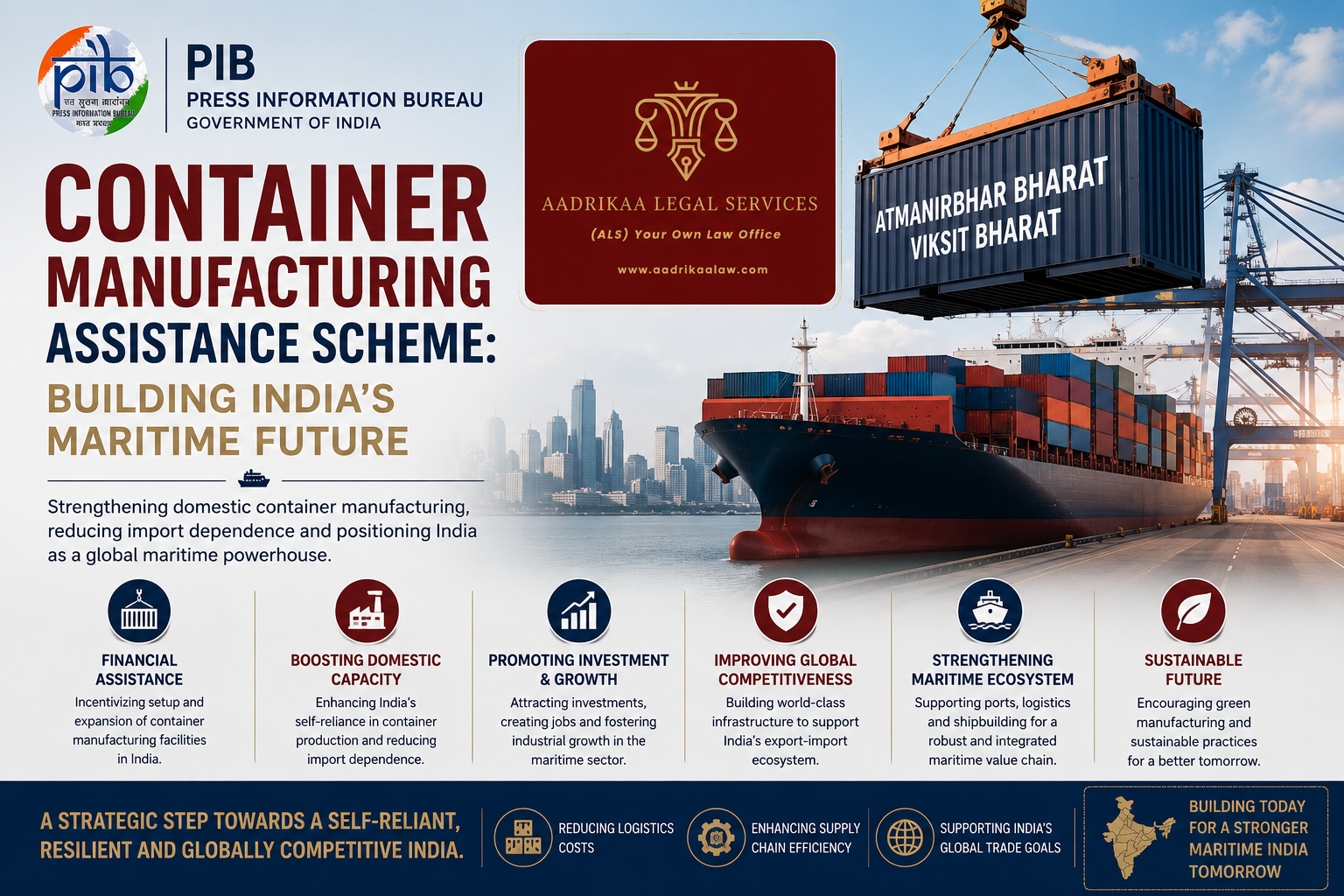
  • Container Manufacturing Assistance Scheme: Building India’s Maritime Future

    Container Manufacturing Assistance Scheme: Building India’s Maritime Future

    Date: 18.08.2026

    India is accelerating its maritime ambitions with the Container Manufacturing Assistance Scheme (CMAS), a transformative initiative designed to establish a robust domestic container manufacturing ecosystem. This article provides a comprehensive overview of CMAS, its strategic importance, recent milestones, and the broader reforms shaping India’s maritime sector, with direct links to official sources and references.

    The Need for Domestic Container Manufacturing

    Maritime transport is the backbone of global trade, with about 80% of merchandise trade by volume carried by sea (UNCTAD Review of Maritime Transport). Containerized cargo accounts for nearly two-thirds of the value of international trade, making efficient container logistics critical for supply chains. Recent disruptions and geopolitical tensions have exposed vulnerabilities in global shipping, prompting countries like India to focus on domestic manufacturing of critical logistics assets such as shipping containers.

    India currently imports nearly 2 million empty containers annually, making it susceptible to global market fluctuations and supply-chain disruptions. The CMAS aims to reduce this dependence, strengthen supply-chain resilience, and support India’s long-term trade ambitions. The scheme complements initiatives like Make in India, Maritime Amrit Kaal Vision 2047, and multimodal logistics development.

    What is the Container Manufacturing Assistance Scheme (CMAS)?

    Announced in the Union Budget 2026–27, CMAS is a targeted initiative with a β‚Ή10,000 crore outlay over five years. Its objectives include:

    • Establishing new Greenfield manufacturing facilities
    • Expanding existing Brownfield units
    • Providing operational support to enhance competitiveness
    • Supporting testing infrastructure, skilling, and capacity building

    The scheme targets an annual domestic manufacturing capacity of up to 7.5 lakh Twenty-foot Equivalent Units (TEUs)β€”about ten times the current capacity. This is expected to create a market opportunity of nearly β‚Ή80,000 lakh crore and position India as a reliable global supplier of shipping containers.

    For more details, see the Ministry of Ports, Shipping and Waterways official document.

    Building an Integrated Maritime Ecosystem

    CMAS is part of a broader strategy to create an integrated, domestically anchored container ecosystem. In February 2026, the Ministry of Ports, Shipping and Waterways signed an MoU to establish the Bharat Container Shipping Line (BCSL), bringing together major public sector stakeholders. The initiative includes investments of around β‚Ή99,149 crore in fleet development and domestic container procurement.

    This approach complements other government initiatives:

    • PM Gati Shakti: Enhancing connectivity between ports, railways, highways, and industrial centers
    • National Logistics Policy: Supporting operational efficiency
    • Sagarmala Programme: Promoting port-led development

    These efforts collectively support a resilient logistics network for India’s growing trade volumes.

    Employment and Industrial Growth

    CMAS is expected to generate around 3,000 direct jobs and over 50,000 indirect jobs in container manufacturing and allied industries. The scheme will also stimulate growth in ancillary sectors such as corner castings, wooden frames, and Corten steel production.

    Recent Progress and Industry Response

    A major milestone was achieved in July 2026 with the rollout of India’s first domestically manufactured EXIM shipping container for A.P. Moller–Maersk. Manufactured to international ISO and CSC standards, this container is suitable for global deployment. Maersk’s subsequent order for 1,000 additional Made-in-India containers with DCM Shriram Group signals growing confidence in India’s manufacturing capabilities. For more, see the DG Shipping address.

    Part of Wider Maritime Transformation

    CMAS is complemented by a series of legislative, institutional, and infrastructure reforms:

    • Merchant Shipping Act, 2025; Coastal Shipping Act, 2025; Indian Ports Act, 2025: Modernizing the legal framework for shipping and port governance
    • Digital Initiatives: One Nation One Port Process (ONOP), Maritime Single Window, and e-Samudra to streamline regulatory procedures (PIB Press Release)
    • Shipbuilding Financial Assistance Package: A β‚Ή70,000 crore package to boost domestic shipbuilding
    • Major Infrastructure Projects: Vadhavan Port, International Container Transshipment Port at Galathea Bay, Tuna Tekra Container Terminal, and Outer Harbour Container Terminal at V.O. Chidambaranar Port

    Way Forward

    The Container Manufacturing Assistance Scheme is a pivotal step in building a globally competitive maritime manufacturing ecosystem. By fostering domestic container production, reducing import dependence, and supporting broader maritime reforms, CMAS is set to enhance India’s supply-chain resilience, generate employment, and position the country as a leading maritime and logistics hub.

    References:

    Aadrikaa Legal Services is a trusted legal and regulatory support partner providing end-to-end legal solutions to law firms, corporate organizations, and businesses across India. We specialize in paralegal services, litigation support, tax and regulatory matters, delivering reliable, efficient, and result-oriented legal assistance.

    Our services include comprehensive paralegal support, drafting and documentation, legal research, case management, litigation handling, and representation support across various judicial and quasi-judicial forums. We also assist in direct and indirect tax matters, customs, GST, corporate regulatory compliance, and legal advisory.

    Handy Download:

  • Delhi High Court Upholds Arbitral Award: Scope of Judicial Review u/s 34 of the Arbitration and Conciliation Act, 1996

    Delhi High Court Upholds Arbitral Award: Scope of Judicial Review u/s 34 of the Arbitration and Conciliation Act, 1996

    Date: 18.08.2026

    A recent judgment by the Delhi High Court has brought clarity to the scope of judicial intervention in arbitral awards under Section 34 of the Arbitration and Conciliation Act, 1996. The case involved a contractual dispute between India Tourism Development Corporation (ITDC) and Bajaj Electricals Ltd. (BEL) regarding specialized illumination work at the Safdarjung Tomb Monument in New Delhi. This article provides a detailed analysis of the dispute, the arbitral award, the grounds for challenge, and the court’s findings.

    Background of the Dispute

    • Project Overview: ITDC awarded BEL a contract for the supply, installation, testing, and commissioning of state-of-the-art lighting at Safdarjung Tomb, following a competitive tender process.
    • Contractual Timeline:
      1. Tender submitted by BEL on 6 February 2007.
      2. Letter of Intent issued on 4 April 2007 for Rs. 2,08,90,095/-.
      3. Detailed work order and contract signed in May 2007, incorporating General Conditions of Contract (GCC).
    • Execution Issues:
    • During execution, media reports highlighted alleged damage to the monument, prompting the Archaeological Survey of India (ASI) to revise fixture layouts and require new approvals.
    • BEL completed the revised work, and ASI took over the installation in June 2009.
    • BEL submitted a final bill of Rs. 1,18,95,572/- but faced delays in payment, leading to disputes and eventual arbitration.

    The Arbitral Award

    • Award Details:
      • Principal amount of Rs. 46,92,298.22/- awarded to BEL.
      • Interest of Rs. 33,27,886/- (from July 2009 to April 2013) and Rs. 31,17,742.91/- as pendente lite interest (April 2013 to October 2018).
      • Future interest from the date of award until payment.
    • ITDC’s Challenge:
      • ITDC filed a petition under Section 34 to set aside the award, alleging errors in contract interpretation, non-consideration of deductions, and excessive interest.

    Key Contentions and Court’s Analysis

    1. Total Value of Work and Deductions

    • ITDC’s Argument: The arbitrator ignored legitimate deductions (Rs. 11,07,832/-) for non-execution or substitution of materials, as recorded in the Measurement Book.
    • Court’s Finding: The arbitrator based the award on evidence, including ITDC’s own admissions. Deductions recorded after 13 August 2008 (not signed by all parties) were rightly excluded. No patent illegality was found.

    2. Statutory Deductions (ESI/EPF, Service Tax, Labour Cess)

    • ITDC’s Argument: Amounts withheld for ESI/EPF, service tax, and labour cess were already deposited with authorities, and BEL failed to provide adequate proof.
    • Court’s Finding: BEL submitted required indemnity bonds and challans. The arbitrator’s acceptance of these documents was within his discretion and based on contract terms.

    3. Interest Rate

    • ITDC’s Argument: The 12% per annum interest awarded was excessive.
    • Court’s Finding: The arbitrator has wide discretion under Section 31(7) of the Act to award interest. The rate was not so unreasonable as to shock the court’s conscience.

    4. Post-Award Payments

    • ITDC’s Argument: A payment of Rs. 13,93,368/- made after the award should be adjusted against the principal for future interest calculation.
    • Court’s Finding: Such adjustments are to be addressed at the execution stage, not under Section 34 proceedings.

    Legal Principles Affirmed

    • Limited Scope of Section 34: The court reiterated that it does not sit in appeal over arbitral awards. Interference is limited to grounds such as patent illegality, violation of public policy, or fundamental procedural errors.
    • Respect for Arbitrator’s Findings: If the arbitrator’s view is plausible and based on evidence, courts will not substitute their own conclusions, even if another view is possible.
    • Interest Awards: Arbitrators have discretion to award reasonable interest unless expressly barred by contract.

    Conclusion

    The Delhi High Court dismissed ITDC’s petition, upholding the arbitral award in favor of Bajaj Electricals Ltd. This judgment reinforces the principle of minimal judicial interference in arbitral awards and underscores the importance of clear contractual compliance and documentation in public works contracts.

    This case serves as a significant reference for parties involved in government contracts and arbitration, highlighting the need for meticulous record-keeping and the finality of arbitral decisions within the statutory framework.

    Aadrikaa Legal Services is a trusted legal and regulatory support partner providing end-to-end legal solutions to law firms, corporate organizations, and businesses across India. We specialize in paralegal services, litigation support, tax and regulatory matters, delivering reliable, efficient, and result-oriented legal assistance.

    Our services include comprehensive paralegal support, drafting and documentation, legal research, case management, litigation handling, and representation support across various judicial and quasi-judicial forums. We also assist in direct and indirect tax matters, customs, GST, corporate regulatory compliance, and legal advisory.

    Handy Download:

  • Delhi High Court Clarifies Concurrent Remedies for Real Estate Disputes

    Delhi High Court Clarifies Concurrent Remedies for Real Estate Disputes

    Date: 18.08.2026

    The Delhi High Court’s decision in Priyanka Taksh Sood & Ors. v. Sunworld Residency Pvt. Ltd. & Anr. offers crucial insights into the interplay between arbitration clauses in real estate contracts and the jurisdiction of the Real Estate Regulatory Authority (RERA). This article breaks down the facts, legal issues, and the Court’s analysis for readers seeking clarity on dispute resolution in real estate matters.

    Background of the Dispute

    1. Parties Involved:
      • Petitioners: Priyanka Taksh Sood and her family, allottees of a flat in Sunworld Arista, Noida.
      • Respondents: Sunworld Residency Pvt. Ltd. (developer) and ICICI Bank (lender).
    2. Agreements Executed:
      • Flat Buyer Agreement (FBA)
      • Supplementary Agreement
      • Tripartite Housing Loan Agreement (with ICICI Bank)
    3. Nature of Dispute:
      • The allottees cancelled their flat booking after the lock-in period and sought a refund, alleging the developer failed to refund the amount and settle the loan account with ICICI Bank.
      • The developer argued that the flat was ready for possession and raised objections regarding the maintainability of the arbitration petition, citing RERA’s jurisdiction and alleged deficiency in stamp duty.

    Legal Issues Considered

    1. Existence of Dispute and Arbitration Clause

    • The Court confirmed the existence of disputes and a valid arbitration clause in the Flat Buyer Agreement.
    • Whether the allottees are entitled to a refund is a matter for arbitration, not for the Court at this stage.

    2. Deficiency of Stamp Duty

    • The developer’s objection regarding insufficient stamp duty was dismissed as vague and unsupported by evidence.
    • The Court relied on recent Supreme Court precedents to hold that such objections do not bar the appointment of an arbitrator at this stage.

    3. Jurisdiction: RERA vs. Arbitration

    • The developer argued that RERA, as a special statute, ousts the jurisdiction of arbitration for real estate disputes.
    • The Court analyzed:
      • Section 79 of RERA: Bars civil courts from entertaining matters within RERA’s purview.
      • Sections 88 & 89 of RERA: State that RERA remedies are in addition to, not in derogation of, other laws.
    • The Court held that:
      • The remedies under RERA and the Arbitration & Conciliation Act are concurrent.
      • Parties can elect their remedy, but once a forum is chosen (e.g., RERA or arbitration), the other cannot be pursued for the same dispute.
      • There is no express or implied bar on arbitration for such disputes under RERA.

    4. Doctrine of Election of Remedies

    • The Court emphasized that parties have the option to choose between available remedies (RERA, arbitration, consumer forums), but cannot pursue both for the same cause of action.

    5. Inclusion of ICICI Bank in Arbitration

    • Although the Tripartite Housing Loan Agreement with ICICI Bank did not contain an arbitration clause, the Court found ICICI Bank to be a necessary party due to the composite nature of the transaction.
    • ICICI Bank was referred to arbitration for issues arising from the interconnected agreements, but disputes solely under the loan agreement (e.g., enforcement actions by the bank) were excluded from arbitration.

    Key Takeaways for Homebuyers and Developers

    1. Arbitration Clauses Remain Enforceable:
      • Even after the enactment of RERA, arbitration clauses in real estate contracts are valid and can be enforced, provided the parties have not already chosen to proceed under RERA.
    2. Concurrent Remedies:
      • Homebuyers can choose between RERA, arbitration, or consumer forums, but must stick to one forum for the same dispute.
    3. No Automatic Bar Due to RERA:
      • RERA does not automatically oust the jurisdiction of arbitral tribunals unless a party has already elected to proceed under RERA.
    4. Composite Transactions:
      • Where multiple agreements are interlinked (e.g., sale agreement and loan agreement), all relevant parties may be referred to arbitration if necessary for complete adjudication.
    5. Practical Implications:
      • Developers cannot use technical objections (like stamp duty or RERA registration) to delay or avoid arbitration if a valid arbitration agreement exists.

    Conclusion

    The Delhi High Court’s judgment clarifies that RERA and arbitration are concurrent remedies for real estate disputes. Parties must carefully consider their choice of forum, as electing one precludes the other for the same dispute. This decision strengthens the enforceability of arbitration clauses in real estate contracts and provides clarity on the scope of RERA’s jurisdiction.

    Aadrikaa Legal Services is a trusted legal and regulatory support partner providing end-to-end legal solutions to law firms, corporate organizations, and businesses across India. We specialize in paralegal services, litigation support, tax and regulatory matters, delivering reliable, efficient, and result-oriented legal assistance.

    Our services include comprehensive paralegal support, drafting and documentation, legal research, case management, litigation handling, and representation support across various judicial and quasi-judicial forums. We also assist in direct and indirect tax matters, customs, GST, corporate regulatory compliance, and legal advisory.

    Handy Download: