Category: BIS

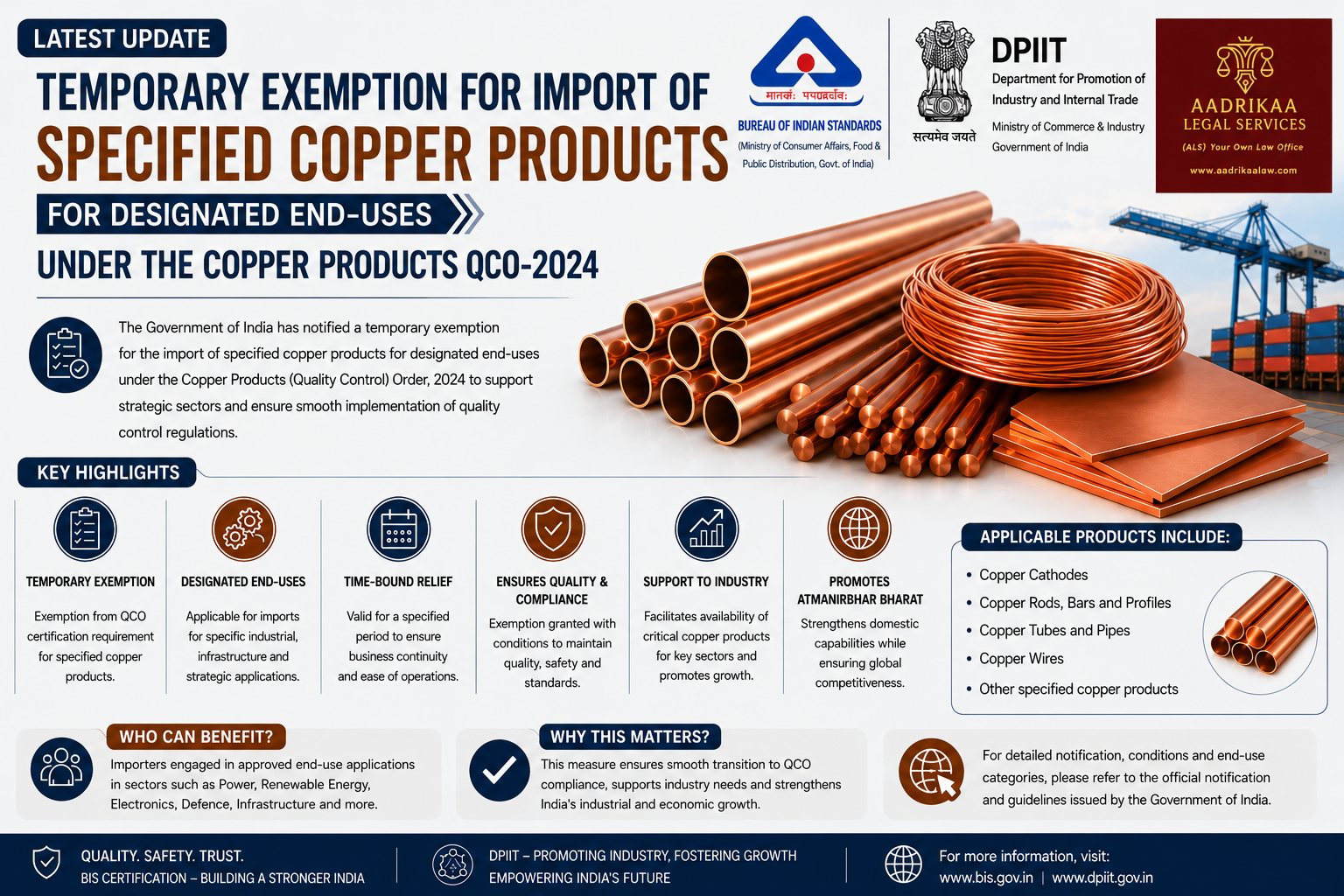
  • Temporary Exemption for Import of Specified Copper Products for Designated End-Uses under the Copper Products QCO-2024

    Temporary Exemption for Import of Specified Copper Products for Designated End-Uses under the Copper Products QCO-2024

    Date: 13.08.2026

    The Government of India has issued a significant order granting temporary exemptions for the import of specific copper products, addressing the needs of various industrial sectors. This move aims to bridge the gap between domestic supply and specialized requirements not currently met by Indian manufacturers or covered under the Copper Products (Quality Control) Order, 2024.

    Background and Rationale

    Industry stakeholders and associations highlighted challenges in sourcing certain high-purity and specialized copper products domestically, either due to lack of standards coverage or insufficient quality and quantity. Responding to these concerns, the Department for Promotion of Industry and Internal Trade (DPIIT), in consultation with the Bureau of Indian Standards (BIS), has provided a one-year exemption for select copper products, strictly for designated end-uses.

    List of Exempted Copper Products and Their End-Uses

    The exemption covers a range of copper products, each tied to a specific industrial application. Here’s a summary of the key products and their permitted uses:

    1. Oxygen Free Copper rods, bars, strips, and sheets (min. purity 99.995%, max. oxygen 5 PPM)
      • End-use: Vacuum interrupters
    2. Silver bearing Oxygen Free Copper, Zirconium Copper, High Conductivity Phosphorous-Deoxidised Copper rods, bars, and strips
      • End-use: Generator rotor coils, generators, electrical shunts
    3. Beryllium Alloy Copper Bar (End Wadge/Rotor Center Wedge-material grade)
      • End-use: Generators
    4. Oxygen Free Copper strips (min. purity 99.995%, max. oxygen 5 PPM)
      • End-use: Automotive bus bars for battery packs
    5. OFC Grade Copper Tape (0.18 mm x 81 mm and 0.095 mm x 85 mm)
      • End-use: RF feeder cables
    6. Billet & Section of Copper Alloy Grades (CuCr 90:10, CuZr 50:50, CuSi 90:10, CuP 85:15, CuTe 50:50)
      • End-use: Electrical contacts, short circuit rings, rotor bars for industrial and traction motors
    7. Copper Alloys C15000 (Zirconium Copper) and C18150 (Chromium Zirconium Copper) billets
      • End-use: Short circuit rings and rotor bars for traction and industrial motors
    8. Copper Alloy Strips (TRKFC 4, C151, DK Alloy, DSC-3N 1/2H, DK-3)
      • End-use: Bus bars for automobiles
    9. ETP Copper Plate in Coils (Grade C11000, Cu-ETP)
      • End-use: Electrical applications
    10. Hard Drawn Grooved Copper Tin alloy (150 sqmm and above, GT-SN)
      • End-use: Overhead electrical conductors
    11. Hard-Drawn Copper Wire (Dia 2.6mm, 99.9%+ purity)
      • End-use: Wiring harnesses for the automobile industry
    12. Enameled Copper Wire/Magnet Wire (0.01 to 0.16 mm, various grades)
      • End-use: Electrical wound components
    13. Copper Finned Tubes (externally and internally finned, various grades)
      • End-use: Chillers
    14. High Strength Copper Alloy Tubes (multiple grades)
      • End-use: Air-conditioning systems and electrical applications

    Conditions for Availing the Exemption

    To ensure traceability and promote future indigenization, importers must comply with the following conditions:

    1. Notification to BIS: Inform the Bureau of Indian Standards within 7 days of consignment clearance, using company letterhead and authorized signatory, via email.
    2. Quarterly Reporting: Maintain and submit quarterly records of imported goods to Central Government authorities, again on company letterhead and signed, via email.
    3. Indigenization Plan: Submit a plan for local manufacturing (indigenization) of the imported goods to the Central Government.

    Scope and Limitations

    • The exemption is valid for one year from the date of the order’s publication.
    • It applies strictly to the products and end-uses listed, and only to actual users (not traders or resellers).
    • The government reserves the right to review and amend the list of products and end-uses as needed.

    Implications for Industry

    This exemption provides immediate relief to sectors reliant on specialized copper products, such as electrical, automotive, and industrial equipment manufacturers. It also encourages importers to plan for future domestic production, aligning with the government’s broader Make in India initiative.

    For further details or compliance queries, stakeholders should contact the relevant government departments as specified in the official order.

    This proactive measure is expected to support critical industries while paving the way for enhanced domestic capabilities in the copper sector.

    Aadrikaa Legal Services is a trusted legal and regulatory support partner providing end-to-end legal solutions to law firms, corporate organizations, and businesses across India. We specialize in paralegal services, litigation support, tax and regulatory matters, delivering reliable, efficient, and result-oriented legal assistance.

    Our services include comprehensive paralegal support, drafting and documentation, legal research, case management, litigation handling, and representation support across various judicial and quasi-judicial forums. We also assist in direct and indirect tax matters, customs, GST, corporate regulatory compliance, and legal advisory.

    Handy Download:

  • MP High Court Holds BIS Clarificatory Circular Cannot Be Applied Retrospectively to Imported Alloy Steel Consignments

    MP High Court Holds BIS Clarificatory Circular Cannot Be Applied Retrospectively to Imported Alloy Steel Consignments

    Date: 23.05.2026

    In a significant legal victory, Anik Industries Limited successfully challenged the customs authorities’ refusal to clear its imported alloy steel deformed bars. The High Court of Madhya Pradesh, Indore Bench, delivered a detailed judgment on June 14, 2016, addressing complex issues of customs regulations, retrospective application of government circulars, and territorial jurisdiction.

    Background of the Case

    Anik Industries Limited, a private company engaged in importing alloy steel deformed bars, placed orders with Chinese manufacturers in mid-2014. The goods were shipped and arrived at Indian ports (Mumbai and Chennai) before a crucial customs circular (No. 450/176/2014-Cus-IV dated 7/11/2014) was issued. This circular, along with amendments to the Steel Products (Quality Control) Order, imposed new requirements for Bureau of Indian Standards (BIS) certification on certain steel imports.

    When Anik Industries sought clearance for its consignments, customs authorities refused, citing the new circular and amendments. Anik Industries argued that these requirements could not be applied retrospectively to goods contracted and shipped before the circular’s issuance.

    Key Legal Issues

    1. Retrospective Application of Circulars
      • The central question was whether the customs circular and amended quality control orders could be applied to shipments contracted and dispatched before their effective dates.
      • The court held that no clarificatory circular or amendment can operate retrospectively to affect transactions already completed. The contract and shipment predated the circular, so the new requirements could not be imposed on Anik Industries’ consignments.
    2. Jurisdiction of the Indore High Court
      • Customs authorities and intervenors argued that the Indore Bench lacked jurisdiction since the goods were at Mumbai and Chennai ports and the circular was issued in Delhi.
      • The court found that since Anik Industries’ corporate office was in Indore, the order was placed and payment made from Indore, and the goods were intended for Indore, a part of the cause of action arose within its jurisdiction. Thus, the writ petition was maintainable at Indore.
    3. Validity and Scope of the Customs Circular
      • The court examined whether the circular could extend the scope of the Steel Products (Quality Control) Order to cover alloy steel deformed bars without a formal amendment to the schedule.
      • It concluded that only a proper amendment, not a departmental clarification, could expand the order’s coverage. The circular could not add new conditions or apply to products not explicitly listed.

    The Court’s Decision

    The High Court dismissed the appeals by customs authorities and industry associations, upholding the writ court’s earlier order. Key directions included:

    • Customs authorities were ordered to allow clearance of Anik Industries’ goods covered by commercial invoices dated September 4 and 18, 2014.
    • The court clarified that it was not making any observation on the application of BIS standards to future imports under the impugned circular.
    • If, after release, authorities still doubted the goods’ compliance with BIS standards, they could investigate further, and Anik Industries was directed to cooperate.

    Implications of the Judgment

    This judgment sets an important precedent for importers facing retrospective application of regulatory changes. It reinforces the principle that government circulars and amendments cannot retroactively affect completed transactions. The decision also clarifies the scope of High Court jurisdiction in writ matters involving national regulations and cross-state transactions.

    Conclusion

    Anik Industries Limited’s victory underscores the importance of legal safeguards against retrospective regulatory actions and affirms the rights of businesses to challenge arbitrary administrative decisions. The case serves as a reference point for future disputes involving customs regulations and the importation of goods into India.

    Handy Download:

  • Cost of Non-Compliance in Trade Compliance

    Cost of Non-Compliance in Trade Compliance

    Date: 23.03.2026

    Adv Ravi Shekhar Jha
    Adv Ravi Shekhar Jha

    Trade compliance is a critical aspect of international business, ensuring adherence to regulations and laws governing the import and export of goods. ​ However, non-compliance can lead to severe consequences, including fines, litigation, reputational damage, operational disruptions, and financial losses. ​ This article delves into the importance of trade compliance, the legal implications of misclassification, and the findings from two empirical surveys on exemption notifications and HSN classification disputes. ​

    Why Choose Trade Companion

    When you use the Trade Companion tool, we ensure accurate and defensible classification outcomesβ€”helping you remain compliant across regulatory frameworks, irrespective of your industry.

    Legal Perspective: Classification-Related Disputes

    Let us examine this from a legal standpoint.

    Short Answer

    Yesβ€”incorrect classification under the Customs Tariff can result in:

    • Demand of differential duty
    • Interest liability
    • Imposition of penalties
    • Confiscation of goods (in serious cases)
    • Prosecution (in cases involving fraud or intent to evade duty)

    However, the extent of consequences depends on whether the error is bona fide or intentional.

    1. Why Classification is Legally Critical

    Classification is the foundation of trade compliance, as it determines:

    • Basic Customs Duty (BCD)
    • Integrated GST (IGST)
    • Anti-dumping duty
    • Safeguard duty
    • Import policy status (Free / Restricted / Prohibited)
    • Applicability of BIS/QCO and other allied regulations
    • Eligibility for exemptions and concessions

    Any error in classification directly impacts duty liability, regulatory obligations, and legal exposure.

    Legal Framework Governing Classification

    Classification under Indian Customs law is governed by:

    • Customs Tariff Act, 1975
    • Customs Act, 1962
    • General Rules for Interpretation (GRI)

    These laws collectively form the backbone of classification principles and compliance obligations.

    Key Takeaway

    Misclassification = Non-compliance.
    But the legal consequences ultimately depend on:

    • Intent
    • Disclosure
    • Conduct

    The Cost of Non-Compliance in Trade Compliance ​

    Non-compliance with trade regulations can have devastating effects on businesses. ​ The repercussions include:

    • Demand for duty payments: Incorrect classification can lead to demands for additional duty payments. ​
    • Interest and penalties: Businesses may face interest charges and penalties for non-compliance. ​
    • Confiscation of goods: In severe cases, goods may be confiscated due to false or incorrect declarations. ​
    • Prosecution: Fraudulent misclassification can result in legal action and prosecution. ​

    Severity of Consequences ​

    The severity of penalties depends on the intent and nature of the misclassification:

    • Bona fide errors: Typically result in duty and interest payments. ​
    • Negligent misclassification: May lead to duty, interest, and penalties. ​
    • Intentional misclassification: Can result in duty, interest, 100% penalty, and confiscation. ​
    • Fraudulent evasion: May lead to duty, penalties, and even prosecution. ​​

    Statutory Provisions Triggered by Misclassification ​

    Section 17 β€” Self-Assessment ​

    Importers are responsible for self-assessing the classification of goods. ​ Errors can lead to re-assessment and duty demands. ​

    Section 28 β€” Demand of Duty ​

    Duty short-paid due to misclassification triggers two scenarios:

    • Bona fide error: Duty and interest are payable within a 2-year time limit. ​
    • Fraud or suppression: Duty, interest, and heavy penalties are imposed within a 5-year time limit. ​

    Section 111(m) β€” Confiscation ​

    Goods are liable for confiscation if declarations are false or incorrect, making misclassification a serious compliance issue. ​

    Section 112 β€” Penalty ​

    Improper importation can result in penalties up to the duty amount or more in cases of fraud. ​

    Section 114A β€” Mandatory Penalty ​

    Fraudulent misclassification involving suppression, willful misstatement, or intent to evade duty results in a penalty equal to 100% of the duty. ​

    Judicial Perspective on Misclassification ​

    Indian courts have consistently emphasized the distinction between bona fide classification disputes and deliberate evasion. ​ Courts recognize that classification often involves technical interpretation, competing headings, HSN notes, and exemption conditions. ​ Mens rea (intent) plays a crucial role in determining the severity of consequences. ​

    When Misclassification Becomes Serious Non-Compliance ​

    Misclassification is treated as a serious violation under certain circumstances, such as:

    1. Ignoring clear tariff headings. ​
    2. Misusing exemption notifications. ​
    3. Hiding product specifications. ​
    4. Changing product descriptions across shipments. ​
    5. Repeated misclassification despite queries. ​
    6. Evasion of import policy (e.g., restricted goods declared as free). ​
    7. Avoidance of BIS/QCO certification or anti-dumping duties. ​

    Empirical Survey Analysis: Exemption Notifications ​

    Overview

    A survey titled β€œEmpirical Data Survey – Exemptions under Section 25 of the Indian Customs Act, 1962” collected responses from 12 trade professionals, including importers, exporters, consultants, and legal practitioners. ​ The survey aimed to understand the practical impact of exemption notifications, litigation trends, compliance burdens, and views on judicial review and reforms. ​

    Key Findings

    1. High litigation exposure: 75% of respondents faced disputes related to exemption notifications. ​
    2. Interpretation disputes dominate: 75% of disputes arise from ambiguous interpretations. ​
    3. Judicial remedies are critical: 58.3% of disputes escalate to High Courts, with 75% of outcomes favorable to businesses. ​
    4. Time-consuming litigation: 33.3% of cases take over three years for resolution.
    5. Business impact: Financial losses, working capital blockage, and supply chain disruptions are common. ​
    6. Excessive discretionary power: 66.7% of respondents believe Section 25 grants excessive power to the government. ​

    Empirical Survey Analysis: HSN Classification Disputes ​

    Overview

    The β€œHSN Classification Empirical Survey” collected responses from 14 professionals to understand challenges in HSN classification, dispute patterns, financial impact, and reform suggestions. ​

    Key Findings

    1. Common disputes: 57.1% of respondents faced classification disputes, primarily related to customs duty rates (64.3%). ​
    2. Knowledge gaps: Awareness of WCO HS explanatory notes is low, despite their importance in classification. ​
    3. Reliance on consultants: 64.3% of respondents rely on consultants or lawyers for dispute resolution. ​
    4. Digital tools are underutilized: Manual processes and online portals dominate, with limited use of integrated digital tools. ​
    5. Financial impact: Classification disputes lead to significant cash flow issues and penalty exposure. ​

    Suggested Reforms

    Legislative Reforms

    • Introduce clear statutory guidelines for classification disputes. ​
    • Strengthen advance ruling mechanisms. ​
    • Mandate explanatory notes for major tariff changes. ​

    Administrative Reforms

    • Develop a national HSN guidance portal. ​
    • Conduct regular training sessions by CBIC and DGFT. ​
    • Harmonize Customs and DGFT classification practices. ​

    Technological Reforms

    • Implement AI-based classification tools. ​
    • Create a single-window digital classification platform. ​
    • Develop a public database of classification rulings. ​

    Conclusion

    Trade compliance is a cornerstone of international business, but non-compliance can lead to severe financial and reputational consequences. ​ Misclassification of goods under the Customs Tariff is a major source of disputes, often driven by ambiguous regulations and knowledge gaps. ​ Empirical surveys highlight the need for legislative, administrative, and technological reforms to reduce disputes, improve compliance, and safeguard businesses from financial risks. ​ Judicial review remains a critical mechanism to ensure fairness and accountability in trade compliance.

    Handy Download:

  • BIS can be enforced through QCO only on Scheduled Industry under the IDR Act, 1951

    BIS can be enforced through QCO only on Scheduled Industry under the IDR Act, 1951

    Date: 11.06.2025

    The Industries (Development and Regulation) Act, 1951 (IDRA) is a cornerstone in the legal and regulatory architecture of industrial policy in India. Enacted on 8th October 1951, the Act was passed under Entry 52 of the Union List of the Constitution of India, which empowers the Central Government to regulate industries declared by Parliament to be under its control in public interest.

    The IDRA laid the legislative foundation for India’s planned economic growth in the post-independence era. It served as the backbone of industrial licensing, control, and regulation, commonly referred to as the β€œLicense Raj.”

    Even though economic liberalization in 1991 significantly relaxed licensing controls, the Act continues to apply in critical sectors such as defence, hazardous chemicals, and atomic energy, and was last substantively amended in 2016.

    The key objectives of the IDRA, 1951 include:

    • Government intervention in mismanaged or non-performing industrial units
    • Regulation and development of scheduled industries in accordance with national policy
    • Equitable distribution of resources and balanced regional development
    • Control over production, quality, pricing, and distribution of essential industrial goods
    • Preventing monopolistic and unfair trade practices

    Handy Download: