

Aadrikaa Legal Services (ALS)- Law I Litigation I Arbitration
Date: 27.11.2026
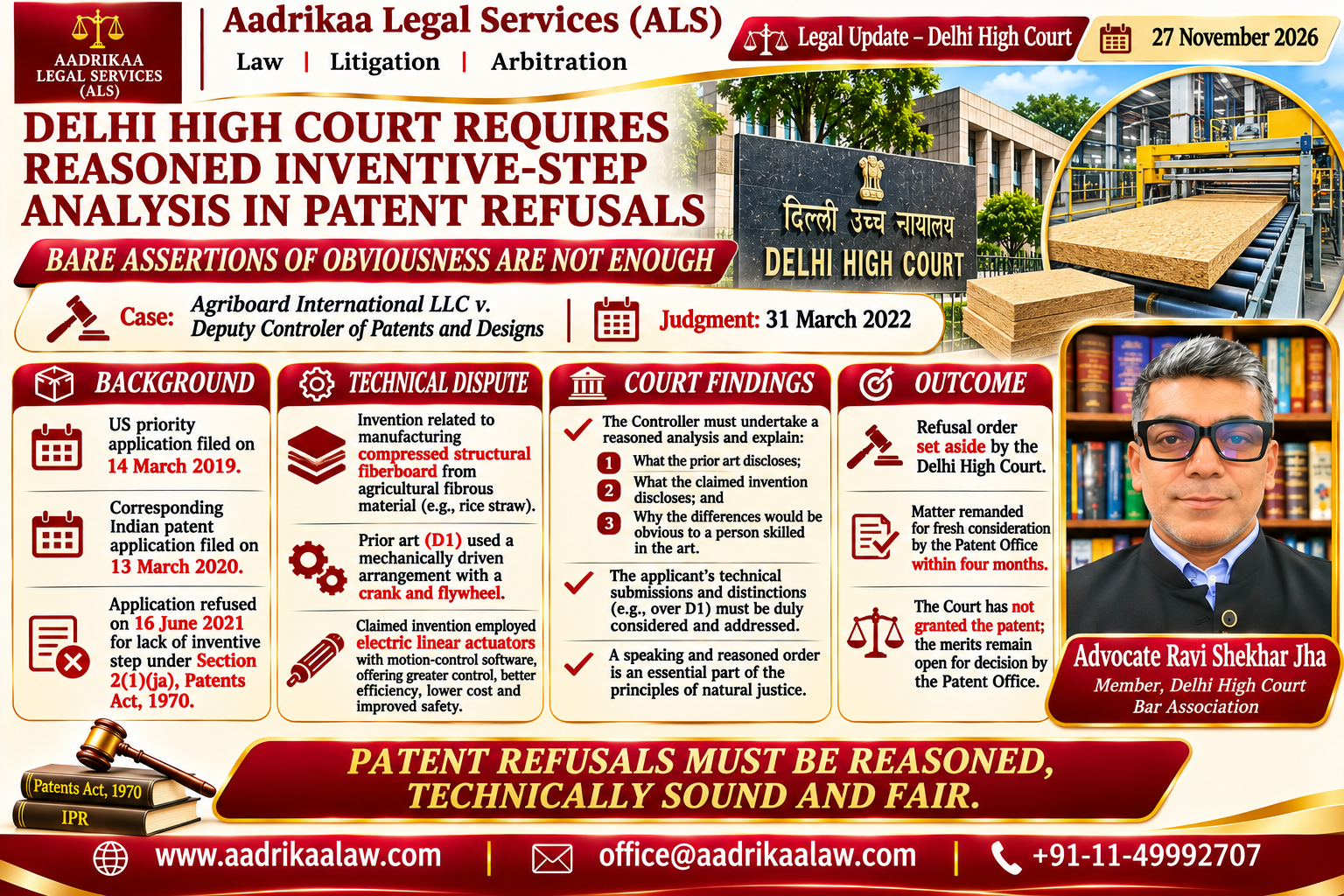
Delhi High Court Requires Reasoned Inventive-Step Analysis in Patent Refusals
This Short Article has been prepared & written by Advocate Ravi Shekhar Jha-Delhi High Court, New Delhi. The views expressed are based on his interpretation of the law. He can be reached at his email id intelconsul@gmail.com .

The Delhi High Court has reaffirmed that a patent application cannot be rejected for lack of inventive step through a conclusory order: the Controller must explain the prior art, the claimed invention, and why a skilled person would find the claimed advance obvious.
The dispute: a fiberboard-production patent refused for alleged obviousness
In Agriboard International LLC v. Deputy Controller of Patents and Designs, decided on 31 March 2022, the Delhi High Court reviewed the rejection of Agriboard International LLC’s Indian patent application for an “Efficient Method and Apparatus for Producing Compressed Structural Fiberboard.”
Agriboard had filed its priority application in the United States on 14 March 2019 and its corresponding Indian application on 13 March 2020. The invention concerned equipment and a process for manufacturing compressed structural fiberboard from agricultural fibrous material, including rice straw.
The Indian Patent Office refused the application on 16 June 2021 on the ground that the claims lacked an inventive step under Section 2(1)(ja) of the Patents Act, 1970. The refusal principally referred to an earlier US patent, identified as D1, and stated that the claimed technology would be obvious in view of that document and conventional technical means.
The claimed advance: electrically driven linear actuators
The core technical dispute concerned the extruder mechanism used to compress agricultural fibers into fiberboard.
According to Agriboard, the prior-art system used a conventional mechanically driven arrangement involving a connecting rod, crank connection, and drive flywheel. Its application instead disclosed a cyclic ram actuated by electric linear actuators and controlled through motion-control software.
The application stated that this arrangement could provide:
- Greater control over the ram’s timing and force during compression cycles;
- Adjustable stroking speed and timing in relation to mill speed;
- Lower energy use, cost, and maintenance requirements; and
- Reduced safety risks compared with extruders using rotating equipment.
The Court noted that the apparatus also included conveyors, a heat-sink track cooler, a water-jet cutting system, and an air table. However, the asserted novelty and inventive contribution were concentrated in the electrically actuated extruder configuration.
Why the Court found the rejection inadequate
The Court held that the Patent Office’s order did not provide adequate reasons for rejecting the application. It largely reproduced an objection from the First Examination Report and then reached a bare conclusion that the invention lacked an inventive step.
Crucially, the order did not analyze:
- What D1 specifically disclosed;
- How Agriboard’s claimed invention differed from D1; and
- Why those differences would have been obvious to a person skilled in the art.
The Court emphasized that Agriboard had expressly distinguished its electric linear-actuator system from D1’s mechanically operated ram. Yet the Controller did not address that response or explain why replacing the conventional mechanism with electric linear actuators was merely an obvious workshop modification.
The Court also observed that the US Patent Office had considered D1 and concluded that the prior art did not disclose or motivate the use of electric linear actuators in place of the conventional crank-and-flywheel arrangement.
The US examiner considered the modification a significant change in the ram’s operating principle. The Delhi High Court did not treat that finding as determinative, but considered it relevant to the missing analysis in the Indian refusal order.
A clear three-part test for inventive-step rejections
The judgment provides a practical framework for patent examination in India. When rejecting an invention for lack of inventive step, the Controller must consider:
- The invention disclosed in the prior art;
- The invention disclosed in the application under examination; and
- The reasoning showing how the claimed invention would be obvious to a person skilled in the art.
The Court linked this requirement to the statutory definition of “inventive step” in Section 2(1)(ja), which requires a technical advance over existing knowledge, economic significance, or both, and non-obviousness to a skilled person.
A decision that skips the comparison between existing knowledge and the claimed invention, the Court held, is inconsistent with the statutory test. A bare assertion of obviousness will not suffice unless the conclusion is self-evident.
Reasoned orders are part of natural justice
Beyond patent law, the ruling underscores an administrative-law principle: a reasoned or speaking order is an essential part of natural justice.
Relying on Supreme Court precedent, the Court stated that audi alteram partem requires more than an opportunity to be heard. The decision-maker must also follow a fair and transparent process, apply its mind to the submissions, and issue a reasoned decision.
This obligation is particularly important in patent matters, where the decision turns on a technical comparison between the claimed invention and the cited prior art. An applicant’s explanations, claim distinctions, and technical evidence must be substantively addressed rather than simply recorded and disregarded.
Outcome: refusal set aside and matter remanded
The High Court set aside the Patent Office’s refusal order and remanded the application for fresh consideration. It allowed the Patent Office to consider D1, other prior-art references, and the International Search Report under the Patent Cooperation Treaty that had been cited during the appeal.
Importantly, the Court did not grant the patent or make a final finding that Agriboard’s invention was inventive. Its decision was procedural and analytical: the Patent Office must conduct a proper inventive-step assessment and issue a reasoned order. The Court also clarified that its observations concerning D1 would not bind the Controller during reconsideration.
The Patent Office was directed to complete the fresh consideration and issue its order within four months.
Key implications for patent applicants and examiners
For applicants, the decision highlights the value of clearly documenting the technical distinction between an invention and prior art, including the practical advantages produced by the claimed configuration. In this case, the difference was not simply that one machine used an electrical component; Agriboard argued that electric linear actuators changed the operating principle, controllability, efficiency, maintenance profile, and safety characteristics of the extrusion process.
For patent examiners, the ruling confirms that an inventive-step objection must be more than a catalogue of known features. The examination record should show a disciplined comparison of the references and claims, followed by an explanation of the skilled person’s path from the prior art to the claimed invention.
Conclusion
The decision establishes that inventive-step refusals must be technically reasoned, responsive to the applicant’s submissions, and anchored in a clear explanation of obviousness. It strengthens procedural accountability in Indian patent examination without predetermining whether the underlying fiberboard technology ultimately satisfies the inventive-step requirement.
Connected Matter
Listen to this on our #YouTube Channel
Aadrikaa Legal Services is a trusted legal and regulatory support partner providing end-to-end legal solutions to law firms, corporate organizations, and businesses across India. We specialize in paralegal services, litigation support, tax and regulatory matters, delivering reliable, efficient, and result-oriented legal assistance.
Our services include comprehensive paralegal support, drafting and documentation, legal research, case management, litigation handling, and representation support across various judicial and quasi-judicial forums. We also assist in direct and indirect tax matters, customs, GST, corporate regulatory compliance, and legal advisory.
Source: Delhi High Court
Handy Download:
Write to us at office@aadrikaalaw.com
Tel: +91-11-4999 2707
Ravi Shekhar Jha – Advocate, Bar Council of Delhi