

Aadrikaa Legal Services (ALS)- Law I Litigation I Arbitration
Date: 27.11.2026
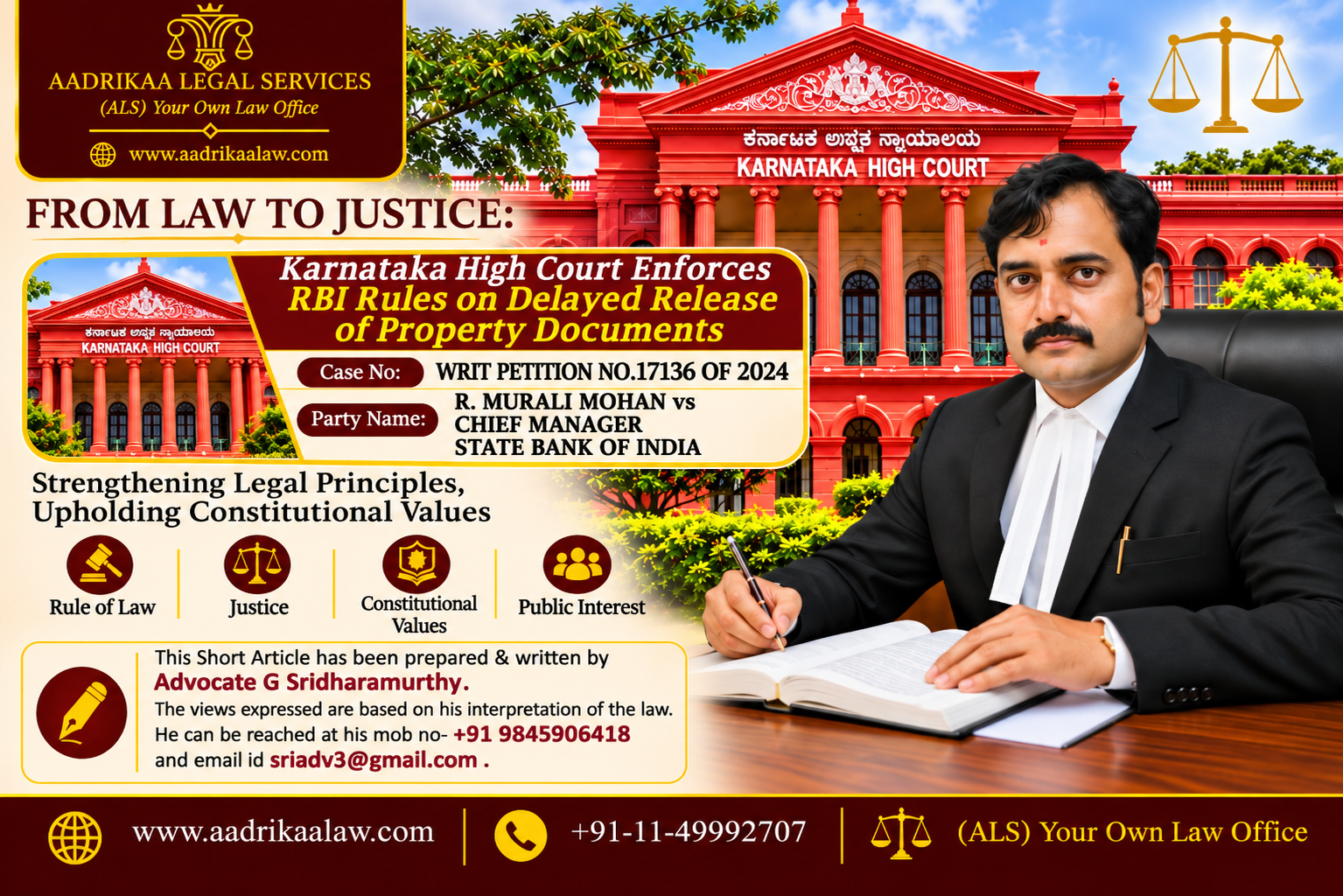
Karnataka High Court Enforces RBI Rules on Delayed Release of Property Documents

A High Court has held that a bank cannot treat certified copies as a substitute for lost original title deeds without completing the required reconstruction process, and directed payment of ₹5,000 per day for the delay.
Background of the dispute
The borrower had obtained two housing-related loans from the respondent bank, securing them through an equitable mortgage created by depositing original property title documents. The mortgage record showed that 15 original documents had been handed over as security.
The borrower fully repaid the first loan in April 2021 and the second loan in May 2022. After both loan accounts were closed, the borrower repeatedly asked the bank to return the original title deeds. Despite representations and a request made under the Right to Information Act, the bank did not return the documents.
Instead, the bank offered certified copies of one sale deed and an encumbrance certificate. The borrower objected, stating that these copies had been obtained without authorisation and could not replace the original documents deposited with the bank.
Bank’s response and delayed disclosure
For a prolonged period, the respondent bank stated that it was searching for the original documents. It did not clearly disclose that the documents had been lost.
Only much later, during the court proceedings, the bank lodged a police complaint, issued a public notice and filed an affidavit referring to the loss of the title documents. The Court noted serious deficiencies in this process, including an apparent error in the public notice, which referred to a document that had not been deposited as security.
The bank also offered limited compensation based on the period between December 2023 and January 2024. It argued that its offer of certified copies should bring the compensation period to an end.
Why certified copies alone were insufficient
The Court rejected the bank’s position. It observed that original title deeds are essential for an owner to freely deal with property, including selling it or using it as security for a fresh loan. A prospective purchaser may hesitate to buy a property without originals or may seek a substantial reduction in price.
The Court found that merely supplying a certified copy of a sale deed and an encumbrance certificate did not amount to compliance because:
- The borrower had originally deposited 15 documents, while the bank offered copies of only limited records.
- The bank had not promptly admitted the loss of the original documents.
- It had not initially taken the necessary steps to reconstruct the title record.
- It had not provided the declarations, affidavits, indemnities and endorsements needed to allow the borrower to establish title before authorities, housing societies or prospective purchasers.
RBI directions treated as binding
The decision relied on the Reserve Bank of India’s directions concerning the release of property documents after repayment or settlement of personal loans.
Under those directions:
- If a regulated entity delays release of original movable or immovable property documents beyond 30 days after full repayment, it must explain the reason for the delay.
- Where the delay is attributable to the bank, it must pay the borrower ₹5,000 for every day of delay.
- If original documents are lost or damaged, the bank must assist the borrower in obtaining duplicate or certified copies, bear the related cost, and pay the prescribed compensation after the additional permitted period.
- The borrower’s right to seek other relief available under applicable law remains protected.
The Court emphasised that RBI directions issued under statutory powers are binding on banks, not merely advisory guidelines.
Court’s findings
The Court held that the bank’s liability did not end when it first offered certified copies. The necessary formal steps recognising the loss and reconstructing the borrower’s title record were undertaken only in November 2026.
Accordingly, the Court concluded that the daily compensation continued from 1 December 2023 until November 2026. The Court noted that this amount would exceed ₹50 lakh.
Because the compensation awarded was substantial, the Court also held that the borrower would not be entitled to claim additional compensation under the separate residual-compensation clause of the RBI directions.
Directions issued to the respondent bank
The Court disposed of the writ petition with the following directions:
- Title-record reconstruction: The respondent bank must issue declarations, indemnities, endorsements and affidavits confirming the loss of the original title deeds.
- Enable future property dealings: These documents must be sufficient to enable the borrower to deal with the property.
- Daily compensation: The bank must pay compensation at ₹5,000 per day from 1 December 2023 until November 2026.
- Time for compliance: The bank must comply within six weeks from receiving a certified copy of the order.
- No additional claim under the RBI residual clause: In view of the compensation awarded, the borrower cannot seek further compensation under that clause.
Legal significance
This ruling reinforces that banks have a serious custodial responsibility when they hold original property documents as loan security. Once a loan is fully repaid, a borrower is entitled to timely release of the originals. If those documents are lost, the bank must do more than provide isolated certified copies: it must formally acknowledge the loss, reconstruct the title documentation and compensate the borrower for the delay.
The decision also highlights that a borrower may invoke writ jurisdiction where the loan repayment, non-return of documents and resulting delay are undisputed, and where the bank’s obligations arise directly from binding RBI directions.
Aadrikaa Legal Services is a trusted legal and regulatory support partner providing end-to-end legal solutions to law firms, corporate organizations, and businesses across India. We specialize in paralegal services, litigation support, tax and regulatory matters, delivering reliable, efficient, and result-oriented legal assistance.
Our services include comprehensive paralegal support, drafting and documentation, legal research, case management, litigation handling, and representation support across various judicial and quasi-judicial forums. We also assist in direct and indirect tax matters, customs, GST, corporate regulatory compliance, and legal advisory.
Source: Karnataka High Court
Handy Download:
Write to us at office@aadrikaalaw.com
Tel: +91-11-4999 2707
Leave a Reply