

Aadrikaa Legal Services (ALS)- Law I Litigation I Arbitration
Date: 27.11.2026
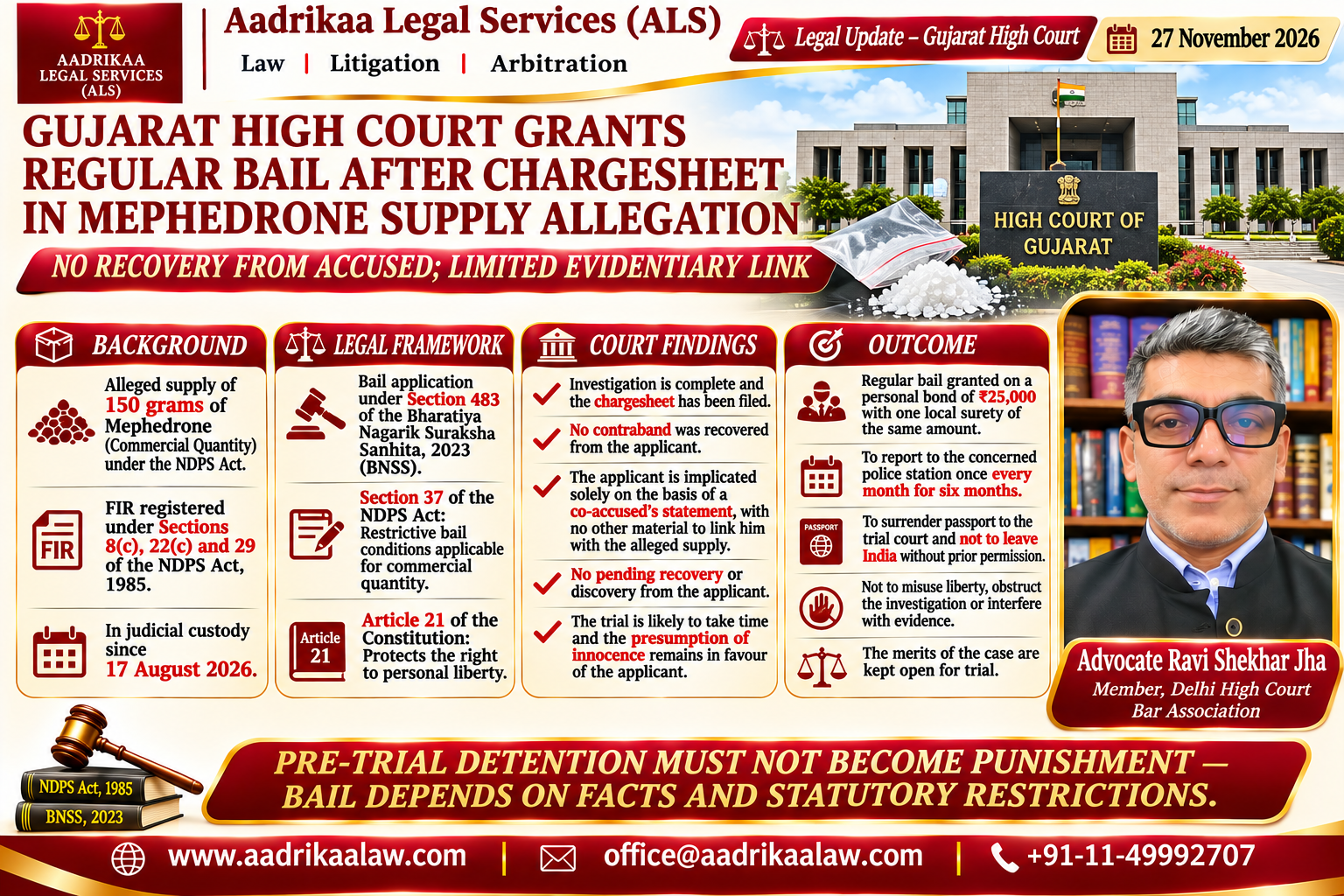
Regular Bail Allowed After Chargesheet in Mephedrone Supply Allegation
This Short Article has been prepared & written by Advocate Ravi Shekhar Jha-Delhi High Court, New Delhi. The views expressed are based on his interpretation of the law. He can be reached at his email id intelconsul@gmail.com .

The High Court granted regular bail to an accused in an NDPS Act case, finding that the investigation had concluded, no contraband was recovered from the accused, and the prosecution case against the accused rested solely on a co-accused’s statement.
Background of the case
A regular bail application was moved before the High Court under Section 483 of the Bharatiya Nagarik Suraksha Sanhita, 2023. The applicant had been booked in an FIR registered at a police station in Ahmedabad City for alleged offences under Sections 8(c), 22(c), and 29 of the Narcotic Drugs and Psychotropic Substances Act, 1985.
The prosecution allegation was that the accused had supplied 150 grams of Mephedrone. As the alleged quantity falls within the category of commercial quantity, the restrictive conditions under Section 37 of the NDPS Act were applicable.
The accused had remained in judicial custody since 17 August 2026. By the time the bail application was heard, the investigation had been completed and the chargesheet had already been filed.
Submissions before the Court
Counsel for the applicant argued that the accused was innocent and had been falsely implicated. It was submitted that there was no pending recovery or discovery from the accused and that regular bail could be granted subject to appropriate safeguards.
The prosecution opposed the application, relying on the seriousness of the alleged NDPS offence and the accused’s asserted involvement. It urged the Court not to exercise its discretion in favour of bail.
Factors considered by the High Court
The Court reiterated that bail decisions must be based on established principles and the particular facts of each case. The relevant considerations include:
- the nature and seriousness of the accusation and the possible punishment;
- the material relied upon by the prosecution;
- the possibility of witness tampering or threats to witnesses or the complainant;
- the likelihood that the accused may abscond or fail to attend trial;
- the conduct, background, and individual circumstances of the accused; and
- the wider interests of the public and the State.
In this matter, the Court placed weight on the following circumstances:
- Investigation was complete: The chargesheet had been filed, reducing the need for further custodial interrogation.
- No recovery from the accused: No contraband was recovered from the applicant’s possession.
- Limited material connecting the accused: The applicant was implicated solely on the basis of a statement made by a co-accused. Apart from that statement, the Court noted that no other material was available to link the accused with the alleged supply of contraband.
- No pending recovery or discovery: The Court found that nothing remained to be recovered or discovered from the applicant.
- Presumption of innocence: Although the applicant had past antecedents, the Court emphasised that an accused remains presumed innocent unless proven guilty in accordance with law.
- Delay inherent in trial: The Court observed that the commencement and conclusion of the trial would take time. Continued detention in these circumstances could amount to pre-trial punishment.
Bail principles applied
The Court referred to Supreme Court decisions concerning personal liberty and bail jurisprudence. It reaffirmed the principle that bail is ordinarily the rule and jail the exception, subject to the facts of the case and statutory restrictions.
The Court also relied on the protection of personal liberty under Article 21 of the Constitution. It held that prolonged detention before the conclusion of trial should not become a substitute for punishment, particularly where the investigation is over and the evidentiary link to the accused is limited at the bail stage.
Without making any final assessment of the evidence, the Court found it appropriate to exercise its discretion and release the accused on regular bail.
Bail conditions imposed
The accused was directed to execute a personal bond of ₹25,000 with one local surety of the same amount, subject to the satisfaction of the trial court. The release was made conditional upon the accused:
- not misusing the liberty granted by bail;
- not obstructing the investigation or interfering with evidence;
- surrendering any passport to the trial court within one week;
- not leaving India without prior permission from the trial court;
- reporting to the concerned police station once every month for six months, between 11:00 a.m. and 2:00 p.m.;
- providing Aadhaar details, email address, and current residential address to the investigating officer and the court at the time of executing the bond;
- not changing residence or contact details without prior approval of the trial court; and
- refraining from any unlawful activity.
The order further provides that breach of any bail condition may result in cancellation of bail or other appropriate action. The accused may be released only if not required in any other case.
Significance of the order
The order illustrates that even in cases involving commercial quantities under the NDPS Act, the Court must assess the actual material connecting the accused to the alleged offence. Completion of investigation, absence of recovery from the accused, lack of corroborative material beyond a co-accused’s statement, and the prospect of a prolonged trial were material considerations supporting regular bail.
The trial court has also been directed not to treat the High Court’s preliminary observations at the bail stage as findings on the merits of the criminal case.
Aadrikaa Legal Services is a trusted legal and regulatory support partner providing end-to-end legal solutions to law firms, corporate organizations, and businesses across India. We specialize in paralegal services, litigation support, tax and regulatory matters, delivering reliable, efficient, and result-oriented legal assistance.
Our services include comprehensive paralegal support, drafting and documentation, legal research, case management, litigation handling, and representation support across various judicial and quasi-judicial forums. We also assist in direct and indirect tax matters, customs, GST, corporate regulatory compliance, and legal advisory.
Source: Gujarat High Court
Handy Download:
Write to us at office@aadrikaalaw.com
Tel: +91-11-4999 2707
Ravi Shekhar Jha – Advocate, Bar Council of Delhi
Leave a Reply