

Aadrikaa Legal Services (ALS)- Law I Litigation I Arbitration
Date: 23.11.2026
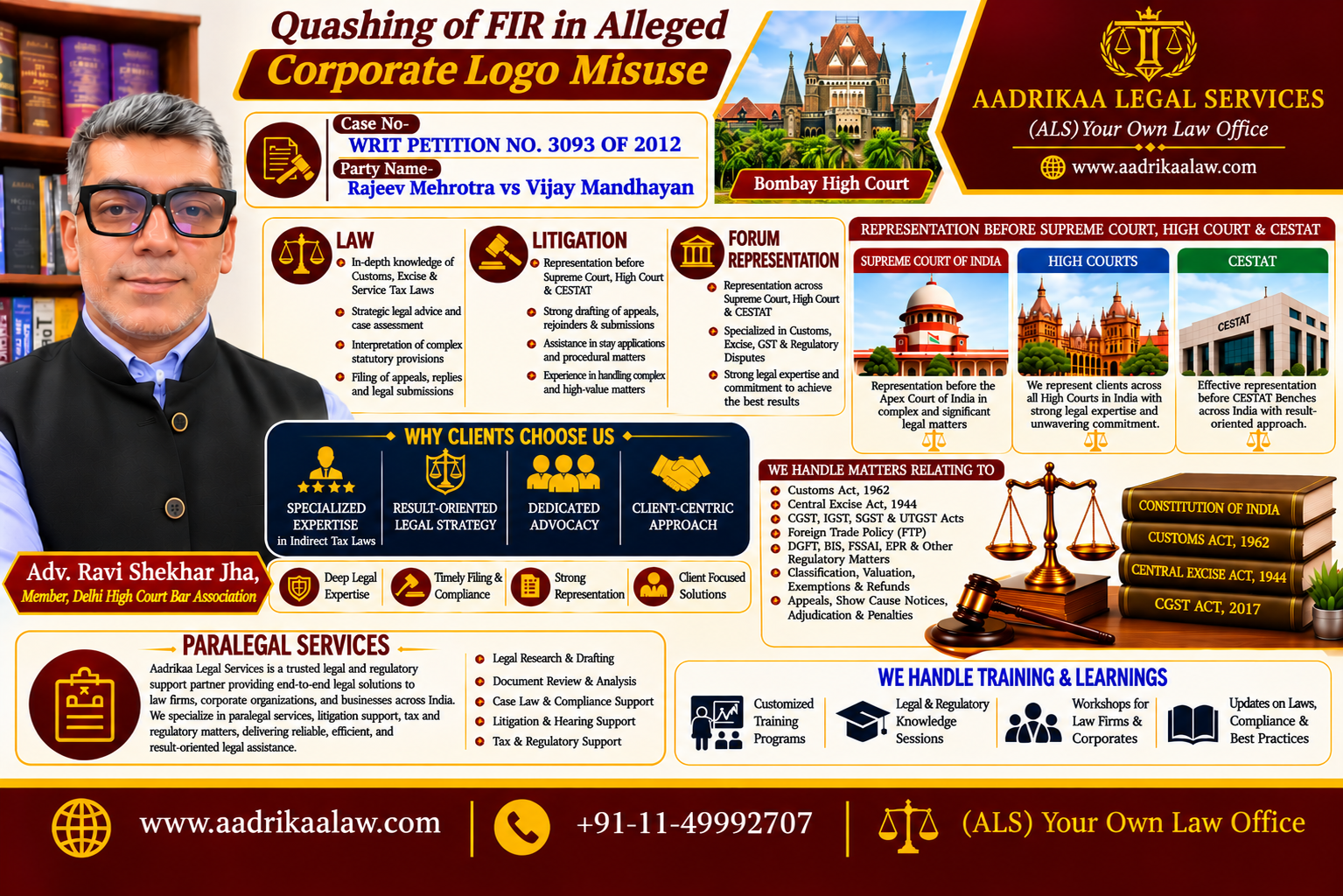
Quashing of FIR in Alleged Corporate Logo Misuse
This Short Article has been prepared & written by Advocate Ravi Shekhar Jha-Delhi High Court, New Delhi. The views expressed are based on his interpretation of the law. He can be reached at his email id intelconsul@gmail.com .

A former senior employee of a financial-services company resigned from employment, and the company issued a relieving communication confirming the end of the employment relationship. Shortly thereafter, media reports stated that the former employee intended to establish a new investment-related business.
The reports were based on a press release circulated through a public-relations agency. The press release carried the former employer’s logo and slogan. The company alleged that this was an unauthorised use of its registered mark and that the document falsely created the impression that it had been issued or approved by the company.
On this basis, a complaint was registered against the former employee and persons associated with the public-relations agency. The allegations included cheating, forgery, use of a forged document, conspiracy, cyber offences, trademark infringement, and copyright offences. The accused persons approached the High Court under Articles 226 and 227 of the Constitution and Section 482 of the Code of Criminal Procedure, seeking quashing of the FIR.
Core Allegations in the FIR
The complaint alleged that the accused persons had:
- used the company’s logo and slogan without prior approval;
- created a false press release suggesting that it came from, or had the authority of, the company;
- caused the release to be circulated to the media;
- sought to obtain an improper advantage for the former employee while causing loss and reputational harm to the company; and
- committed offences under the Indian Penal Code, Information Technology Act, Trade Marks Act, and Copyright Act.
The central issue before the Court was whether these allegations, even if considered at face value, disclosed the necessary ingredients of the alleged criminal offences.
Court’s Assessment
1. No material showing defamation or reputational injury
The Court found no material indicating how the company had been defamed by the news reports. The fact that the former employee had resigned and had been relieved by the company was undisputed. Further, the reports did not contain statements damaging to the company’s reputation.
On the contrary, the publication referred positively to the former employee’s prior role and indicated that the employee’s work had contributed to the company’s business success. A statement that a former employee intends to start an independent venture, without more, does not establish reputational harm to the previous employer.
2. No deception, wrongful gain, or wrongful loss
For cheating-related offences, it must be shown that deception induced a person to deliver property, part with a valuable security, or act in a manner causing legally recognised harm. The Court held that these elements were absent.
The press release primarily conveyed the former employee’s future business plans. There was no material showing that the company had been deceived into doing or omitting anything, that it suffered a wrongful loss, or that the accused secured a wrongful gain through deception. Mere publication of a press release, without a demonstrable fraudulent consequence, could not sustain charges of cheating.
3. Forgery allegations lacked a prima facie foundation
The company asserted that the logo on the press release had been forged. However, the Court found no material showing that a false document was created with the requisite intent to cause damage, support a claim, induce an act, or commit fraud.
The document did not establish that the company had issued the release, nor did the record reveal any fraudulent transaction or concrete harm resulting from its circulation. Accordingly, the essential basis for offences concerning forgery, use of forged documents, and conspiracy was not made out on a prima facie basis.
4. Intellectual-property provisions were not attracted
The Court concluded that the available material did not demonstrate infringement, misuse, or malicious use of the company’s logo or trademark sufficient to invoke criminal liability under the Trade Marks Act or Copyright Act.
Unauthorised inclusion of a logo may raise issues in an appropriate civil or intellectual-property context depending on the facts. However, criminal provisions require the statutory conditions to be clearly met. In this case, the allegations did not establish the form of dishonest or unlawful conduct required for criminal prosecution.
5. Absence of the required guilty intent for cyber offences
The FIR also invoked provisions of the Information Technology Act. The Court held that the required mens rea, or guilty intention, was not established. There was no sufficient material to show that the accused used computer resources or electronic means with the dishonest or fraudulent intent required by the cited provisions.
Legal Principle Applied
The High Court exercised its inherent jurisdiction to prevent abuse of the criminal process. Criminal proceedings may be quashed where the FIR and supporting material do not disclose the essential ingredients of any cognisable offence, even when the allegations are taken at their highest.
The judgment reinforces that criminal law cannot be used merely because a commercial or reputational disagreement exists. Allegations must show specific conduct satisfying each statutory requirement, including deception, fraudulent intent, wrongful loss or gain, reputational injury, or unlawful misuse as required by the relevant law.
Outcome
The Court held that, apart from the undisputed resignation, the issuance of a relieving communication, and the subsequent publication of the news reports, no specific criminal act could be attributed to the accused persons. The FIR was therefore found to have been wrongly registered and its continuation was held to be an abuse of the process of law.
The High Court quashed and set aside the FIR and allowed the petitions seeking relief.
Significance
This ruling emphasises that a post-employment press release does not automatically become a criminal matter merely because it refers to a former employer or includes its branding. To justify prosecution, the complainant must show more than unauthorised use or dissatisfaction with publication.
There must be credible material demonstrating the precise legal elements of the offences alleged. The decision also distinguishes between a possible private or civil dispute and conduct that warrants criminal prosecution, ensuring that criminal proceedings are not used where the factual foundation for the alleged offences is missing.
Aadrikaa Legal Services is a trusted legal and regulatory support partner providing end-to-end legal solutions to law firms, corporate organizations, and businesses across India. We specialize in paralegal services, litigation support, tax and regulatory matters, delivering reliable, efficient, and result-oriented legal assistance.
Our services include comprehensive paralegal support, drafting and documentation, legal research, case management, litigation handling, and representation support across various judicial and quasi-judicial forums. We also assist in direct and indirect tax matters, customs, GST, corporate regulatory compliance, and legal advisory.
Source: Bombay High Court
Handy Download:
Write to us at office@aadrikaalaw.com
Tel: +91-11-4999 2707
Ravi Shekhar Jha – Advocate, Bar Council of Delhi
Leave a Reply