

Aadrikaa Legal Services (ALS)- Law I Litigation I Arbitration
Date: 24.11.2026
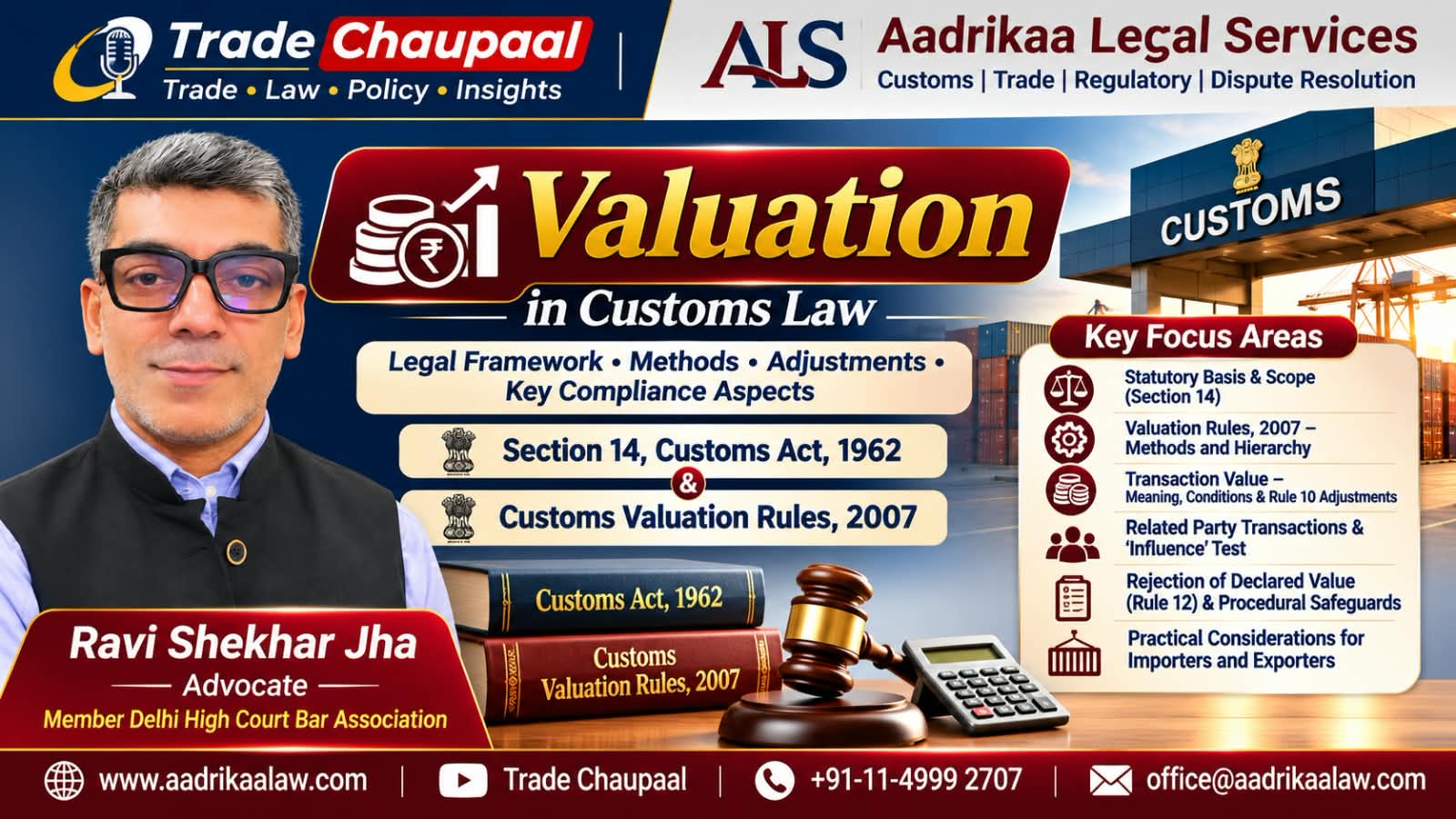
Customs Valuation under the Customs Act, 1962: Understanding Transaction Value and Valuation Rules
Adv. Ravi Shekhar Jha, a practising Advocate at the Delhi High Court with 20 years of experience in Customs & Allied Laws, shares his legal expertise and practical insights through Trade Chaupaal Youtube channel, simplifying complex Customs laws for trade professionals and businesses, students, academia and Industry at large. He can be reached at his email id intelconsul@gmail.com.
Trade Chaupaal | Where Trade Meets Law, Policy & Practice!
Introduction
Customs valuation is one of the most critical aspects of international trade compliance, as it determines the assessable value of imported goods for calculating applicable customs duties. Incorrect valuation can lead to duty disputes, reassessment, penalties and prolonged customs clearance.
In this episode of Trade Chaupaal, we explore the legal framework governing Customs Valuation in India, with particular emphasis on Section 14 of the Customs Act, 1962 and the Customs Valuation (Determination of Value of Imported Goods) Rules, 2007.
Understanding Customs Valuation
Under Section 14 of the Customs Act, 1962, customs valuation is primarily based on the transaction value, representing the price actually paid or payable for imported goods when sold for export to India, subject to statutory conditions and prescribed adjustments.
The Customs Valuation Rules, 2007 establish a structured methodology for determining the assessable value of imported goods.
Key aspects include:
- Transaction Value (Rule 3): The primary basis for determining the assessable value of imported goods.
- Related-Party Transactions: Examination of whether the relationship between buyer and seller has influenced the declared price.
- Valuation Adjustments (Rule 10): Inclusion of specified costs, royalties, licence fees and other applicable additions.
- Rejection of Declared Value (Rule 12): Circumstances in which Customs may question and reject the declared transaction value after following prescribed procedures.
- Alternative Valuation Methods (Rules 4–9): Sequential application of prescribed methods where transaction value cannot be determined under Rule 3.
Why Customs Valuation Matters
Proper customs valuation is essential for importers, exporters and trade professionals to ensure accurate duty assessment, avoid unnecessary disputes and maintain regulatory compliance.
A clear understanding of valuation principles also helps businesses respond effectively to Customs inquiries involving undervaluation, related-party transactions and reassessment proceedings.
Watch the Full Discussion on Trade Chaupaal
Explore the principles of Customs Valuation, transaction value and the legal framework governing assessment of imported goods.
Watch Video:
Like | Share | Subscribe to Trade Chaupaal for practical insights into Customs Law, international trade and regulatory compliance.
Aadrikaa Legal Services is a trusted legal and regulatory support partner providing end-to-end legal solutions to law firms, corporate organizations, and businesses across India. We specialize in paralegal services, litigation support, tax and regulatory matters, delivering reliable, efficient, and result-oriented legal assistance.
Our services include comprehensive paralegal support, drafting and documentation, legal research, case management, litigation handling, and representation support across various judicial and quasi-judicial forums. We also assist in direct and indirect tax matters, customs, GST, corporate regulatory compliance, and legal advisory.
Source: Customs Act, 1962
Write to us at office@aadrikaalaw.com
Tel: +91-11-4999 2707
Ravi Shekhar Jha – Advocate, Bar Council of Delhi
Leave a Reply