

Aadrikaa Legal Services (ALS)- Law I Litigation I Arbitration
Date: 26.11.2026
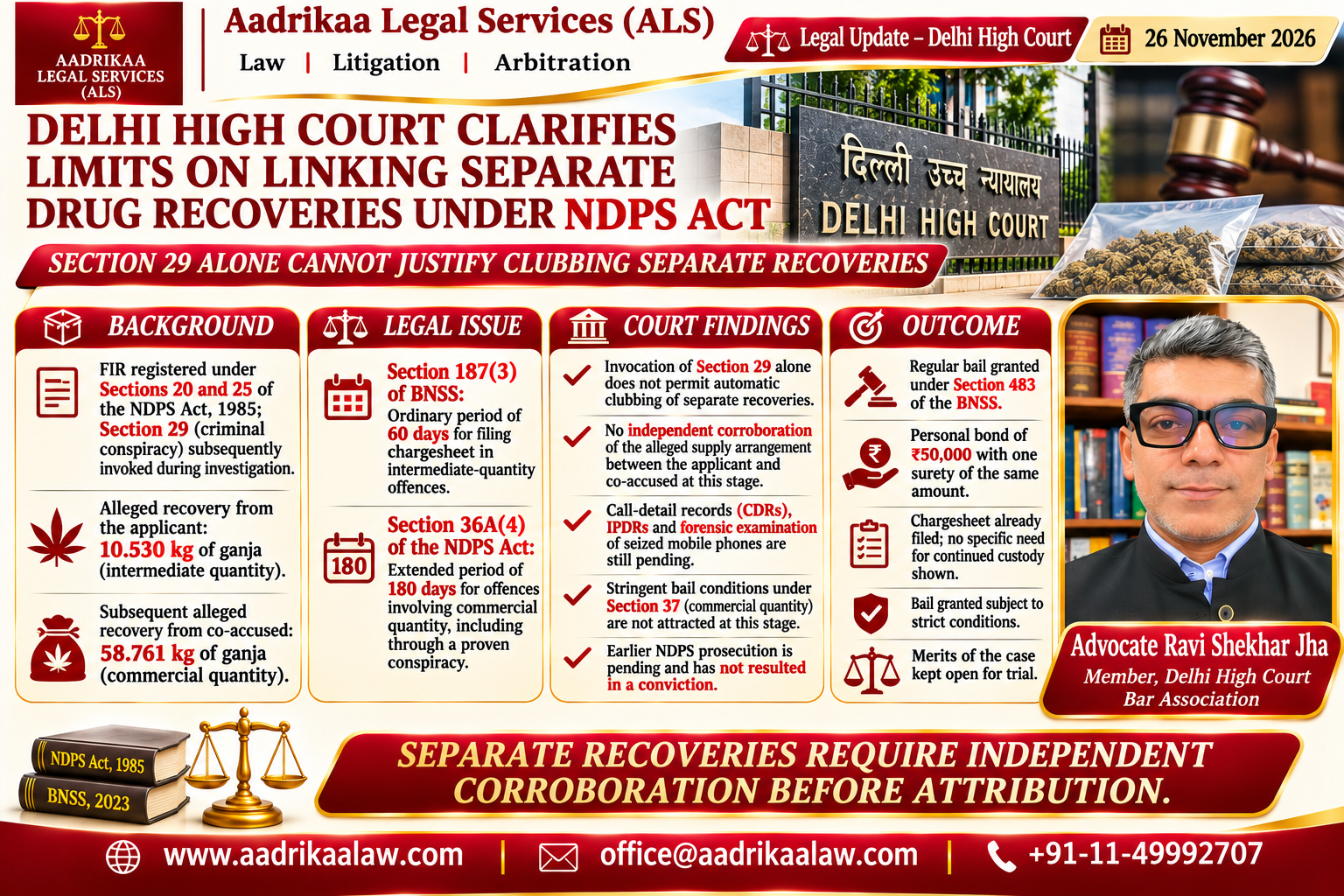
Delhi HC Clarifies Limits on Linking Separate Drug Recoveries Under NDPS Act
This Short Article has been prepared & written by Advocate Ravi Shekhar Jha-Delhi High Court, New Delhi. The views expressed are based on his interpretation of the law. He can be reached at his email id intelconsul@gmail.com .

The Delhi High Court granted regular bail to an accused in an NDPS case after holding that a commercial-quantity recovery allegedly made from a co-accused could not be automatically attributed to the applicant without independent corroborative material.
Background of the case
The bail application arose from an FIR registered at Adarsh Nagar police station under Sections 20 and 25 of the Narcotic Drugs and Psychotropic Substances Act, 1985 (NDPS Act). During investigation, Section 29 of the NDPS Act, dealing with abetment and criminal conspiracy, was also invoked.
According to the prosecution, a search at a residential premises led to the alleged recovery of 10.530 kg of ganja from a bag said to be concealed beneath a folding cot. The police also alleged recovery of an electronic weighing machine, plastic pouches, and other packing material. The accused was arrested and remained in judicial custody.
During the subsequent investigation, the prosecution alleged that the accused identified a co-accused as a supplier. The co-accused was later arrested, and police claimed to have recovered 58.761 kg of ganja from a different location at the co-accused’s instance. The State sought to connect the applicant with this later recovery by alleging a supply arrangement between them.
Core issue: Can separate recoveries be combined?
The principal issue before the Court was whether the subsequent recovery from the co-accused could be attributed to the bail applicant. This was significant because the alleged recovery from the applicant was classified as an intermediate quantity, whereas the later recovery from the co-accused was a commercial quantity.
For an intermediate-quantity offence under Section 20(b)(ii)(B) of the NDPS Act, the ordinary statutory period for filing a chargesheet is 60 days under Section 187(3) of the Bharatiya Nagarik Suraksha Sanhita, 2023 (BNSS).
The extended detention period of 180 days under Section 36A(4) of the NDPS Act, along with the stricter bail conditions under Section 37, may apply where the accused is shown to be involved in an offence concerning commercial quantity, including through a proven conspiracy.
Court’s reasoning on Section 29 and alleged conspiracy
The Court held that invocation of Section 29 alone does not permit the prosecution to aggregate quantities recovered from separate accused persons. It noted that such attribution depends on the facts of each case and on incriminating material that independently supports the alleged conspiracy.
The prosecution relied on the allegation that the applicant and co-accused had a supplier relationship and communicated through WhatsApp. However, the Court found that the status report did not identify independent evidence corroborating this alleged arrangement at that stage.
Important investigative material was still pending, including:
- call-detail records (CDRs);
- internet protocol detail records (IPDRs); and
- forensic examination of the seized mobile phones.
In the absence of corroborative material, the Court ruled that the later commercial-quantity recovery could not be mechanically attributed to the applicant. Therefore, the stringent conditions governing bail for commercial-quantity offences under Section 37(1)(b)(ii) of the NDPS Act were not attracted at that stage.
Previous NDPS case did not by itself defeat bail
The State also referred to another pending NDPS prosecution involving an alleged recovery of 24.68 kg of ganja, in which the applicant had previously received bail. It argued that the present offence was allegedly committed while the applicant was on bail in that earlier matter.
The Court acknowledged that this created a legitimate concern regarding possible involvement in similar activities. However, it also noted that the earlier prosecution was still pending and had not resulted in a conviction. The Court weighed this concern against the intermediate quantity alleged in the present case and the absence of material linking the applicant to the co-accused’s later recovery.
Chargesheet filed; no specific need for further custody shown
The chargesheet had already been filed in the present case. While investigation into the alleged supply network continued, the State did not show a specific reason requiring the applicant’s continued detention for that purpose.
The Court held that concerns about interference with the investigation, influencing witnesses, or involvement in further offences could be addressed through strict bail conditions.
Bail granted subject to safeguards
The High Court granted regular bail under Section 483 of the BNSS on a personal bond of ₹50,000, with one surety of the same amount. The applicant was required to comply with conditions that included:
- appearing before the trial court on each hearing date unless exempted;
- providing current residential and mobile-contact details to the investigating officer;
- cooperating with further investigation when reasonably required;
- not leaving India without prior permission of the trial court and surrendering any passport;
- not contacting, threatening, or influencing prosecution witnesses;
- not interfering with evidence or the investigation; and
- not engaging in criminal activity while on bail.
The Court also clarified that breach of these conditions could enable the State to seek cancellation of bail.
Legal significance of the order
This order highlights an important principle in NDPS bail matters: a separate recovery from a co-accused cannot be used to impose the stricter commercial-quantity bail standard unless the prosecution produces material that independently connects the accused to the alleged conspiracy or recovery.
The ruling does not decide the merits of the prosecution’s case. Questions relating to conscious possession, the alleged supply arrangement, and criminal conspiracy remain open for determination during trial.
Aadrikaa Legal Services is a trusted legal and regulatory support partner providing end-to-end legal solutions to law firms, corporate organizations, and businesses across India. We specialize in paralegal services, litigation support, tax and regulatory matters, delivering reliable, efficient, and result-oriented legal assistance.
Our services include comprehensive paralegal support, drafting and documentation, legal research, case management, litigation handling, and representation support across various judicial and quasi-judicial forums. We also assist in direct and indirect tax matters, customs, GST, corporate regulatory compliance, and legal advisory.
Source: Delhi High Court
Handy Download:
Write to us at office@aadrikaalaw.com
Tel: +91-11-4999 2707
Ravi Shekhar Jha – Advocate, Bar Council of Delhi
Leave a Reply