

Aadrikaa Legal Services (ALS)- Law I Litigation I Arbitration
Date: 28.11.2026
Punjab & Haryana High Court Balances Stringent NDPS Provisions with Personal Liberty
This Short Article has been prepared & written by Advocate Ravi Shekhar Jha-Delhi High Court, New Delhi. The views expressed are based on his interpretation of the law. He can be reached at his email id intelconsul@gmail.com .

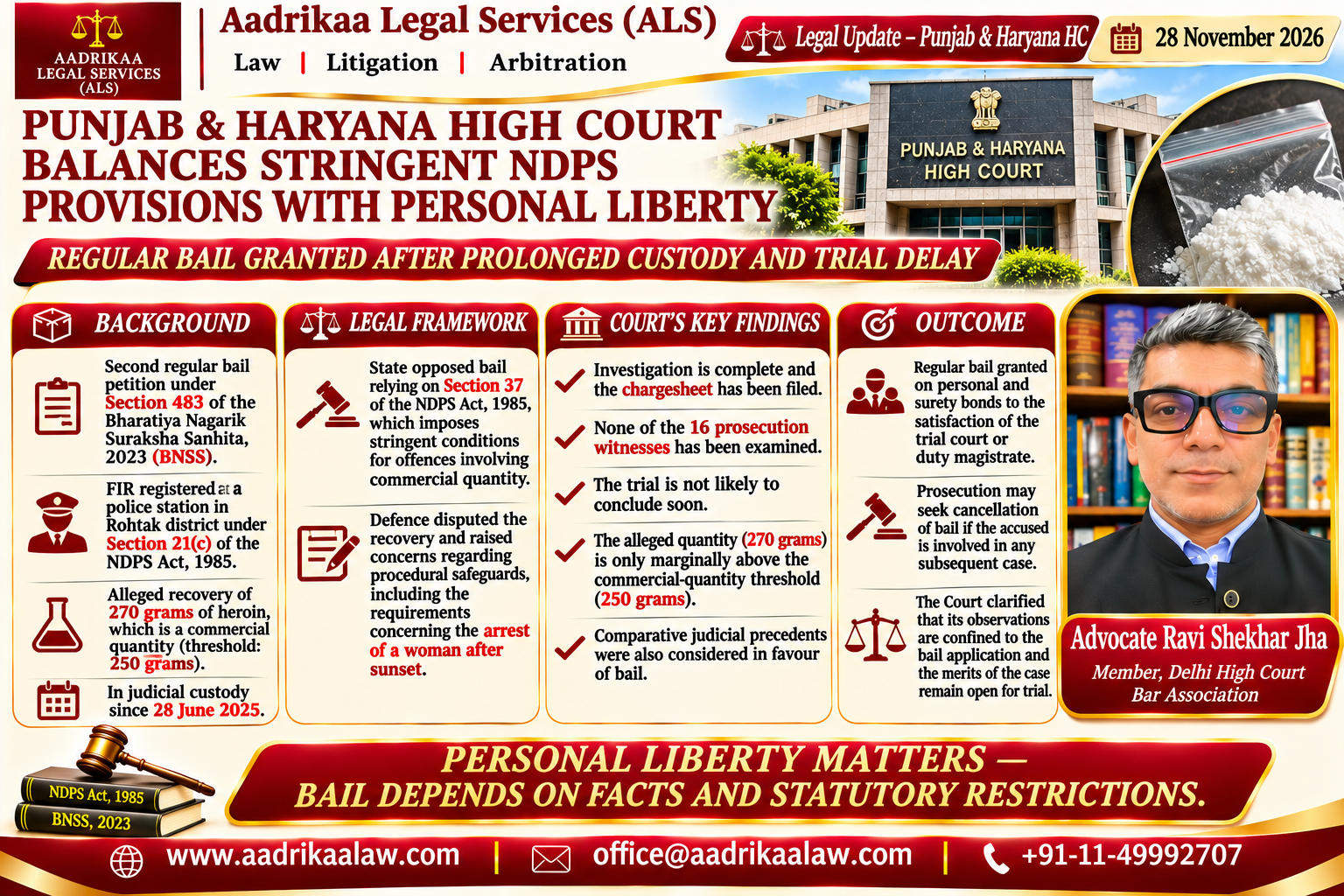
The Punjab and Haryana High Court has granted regular bail to an accused in an NDPS Act case, noting prolonged custody, a likely delay in trial, and the fact that the alleged heroin recovery was only marginally above the notified commercial-quantity threshold.
Background of the case
The accused filed a second petition for regular bail under Section 483 of the Bharatiya Nagarik Suraksha Sanhita, 2023. The case arose from an FIR registered at a police station in Rohtak district under Section 21(c) of the Narcotic Drugs and Psychotropic Substances Act, 1985.
According to the prosecution, the police received secret information that the accused was present near a bridge and intended to sell narcotic substances. A raiding party was formed, the accused was apprehended, and a polythene bag allegedly being carried by the accused was searched. The police claimed to have recovered 270 grams of heroin.
The investigation was complete and the police report had already been filed before the trial court.
Arguments raised for bail
Counsel for the accused disputed the prosecution version and submitted that the recovery had been falsely planted. The defence also raised concerns regarding compliance with procedural safeguards, including the requirements concerning the arrest of a woman after sunset and the statutory requirements under the NDPS Act.
The bail plea further relied on these circumstances:
- The alleged recovery of 270 grams was only slightly higher than the commercial-quantity benchmark of 250 grams for the substance concerned.
- The accused had remained in custody since 28 June 2025.
- The investigation had concluded, so further custodial interrogation was not indicated.
- None of the 16 prosecution witnesses had been examined.
- The trial was not likely to conclude soon.
- The accused was stated to have no prior criminal antecedents.
State’s objection under Section 37 of the NDPS Act
The State opposed bail on the ground that the alleged recovery was of commercial quantity. It argued that the stringent conditions under Section 37 of the NDPS Act applied and that the accused should therefore not be released.
Section 37 places heightened restrictions on bail in cases involving commercial quantities of narcotic drugs or psychotropic substances. However, the Court considered the specific facts of the matter while assessing the request for regular bail.
Why the High Court granted bail
The Court observed that the alleged quantity was only marginally above the commercial threshold. It also referred to earlier decisions in which bail had been granted where the recovered contraband was marginally above commercial quantity.
While observing that the allegations disclosed a prima facie case, the Court gave significant weight to the following factors:
- Extended pre-trial detention: The accused had been in custody for a substantial period.
- Delay in trial: No prosecution witness had yet been examined, making an early conclusion of trial unlikely.
- Completed investigation: The police investigation and filing of the charge-sheet were complete.
- Comparable judicial precedents: Prior rulings supported grant of bail in cases involving quantities only marginally exceeding the commercial limit.
On this basis, the High Court held that continued custody was not justified at that stage and allowed the regular-bail petition.
Bail conditions and effect of the order
The accused was directed to be released on regular bail upon furnishing personal and surety bonds to the satisfaction of the trial court or the duty magistrate.
The Court also preserved the prosecution’s right to seek cancellation of bail if the accused becomes involved in any subsequent case. Importantly, it clarified that its observations were confined to deciding the bail application and would not affect the merits of the criminal trial.
Key legal takeaway
The order illustrates that, even in an NDPS case involving an alleged commercial quantity, bail may be granted when the quantity is marginally above the threshold, the investigation is complete, the accused has spent substantial time in custody, and the trial is unlikely to conclude within a reasonable period. The final determination of guilt or innocence remains for the trial court.
Aadrikaa Legal Services is a trusted legal and regulatory support partner providing end-to-end legal solutions to law firms, corporate organizations, and businesses across India. We specialize in paralegal services, litigation support, tax and regulatory matters, delivering reliable, efficient, and result-oriented legal assistance.
Our services include comprehensive paralegal support, drafting and documentation, legal research, case management, litigation handling, and representation support across various judicial and quasi-judicial forums. We also assist in direct and indirect tax matters, customs, GST, corporate regulatory compliance, and legal advisory.
Source: Punjab & Haryana High Court
Handy Download:
Write to us at office@aadrikaalaw.com
Tel: +91-11-4999 2707
Ravi Shekhar Jha – Advocate, Bar Council of Delhi
Leave a Reply