

Aadrikaa Legal Services (ALS)- Law I Litigation I Arbitration
Date: 24.11.2026
Andhra Pradesh HC Quashes Customs Orders Denying MOOWR Benefits
This Short Article has been prepared & written by Advocate Ravi Shekhar Jha-Delhi High Court, New Delhi. The views expressed are based on his interpretation of the law. He can be reached at his email id intelconsul@gmail.com .

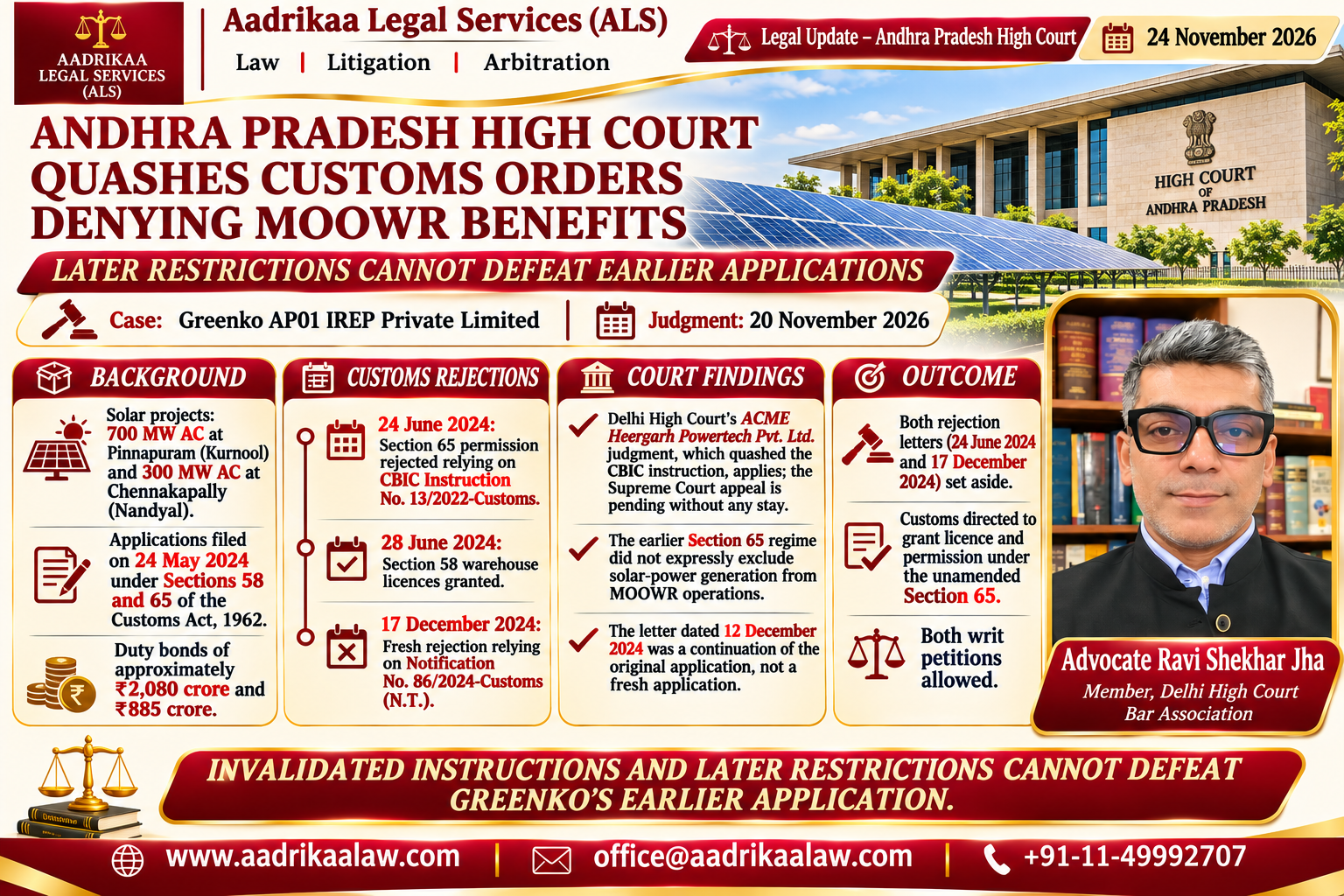
The Andhra Pradesh High Court has set aside Customs authorities’ refusals and directed them to grant Greenko AP01 IREP Private Limited permission under the pre-amendment Section 65 of the Customs Act, enabling its solar-power operations under the MOOWR framework.
Court upholds eligibility under the earlier legal regime
In a common judgment dated 20 November 2026, a Division Bench of Justices allowed two writ petitions filed by Greenko AP01 IREP Private Limited. The dispute concerned the company’s proposed solar projects in Andhra Pradesh and its applications to use the Manufacture and Other Operations in Warehouse (MOOWR) scheme.
Greenko had entered into power purchase agreements with the Solar Energy Corporation of India (SECI) for the supply of 900 MW AC of aggregated solar power. The projects included a 700 MW AC plant at Pinnapuram in Kurnool district and a 300 MW AC plant at Chennakapally in Nandyal district.
The company sought licences for private bonded warehousing under Section 58 of the Customs Act, 1962, along with permission under Section 65 to undertake manufacturing and other operations in the warehouse. This structure would allow imported capital goods, including solar equipment and related accessories, to be used in the solar projects within the bonded-warehouse framework.
Customs rejections based on 2022 instruction
On 24 May 2024, Greenko applied for the required permissions through the Invest India portal. Customs authorities subsequently conducted site verification and accepted substantial duty bonds: approximately Rs. 2,080 crore for one plot and Rs. 885 crore for the other.
Despite granting Greenko separate private bonded warehouse licences under Section 58 on 28 June 2024, Customs rejected its Section 65 applications on 24 June 2024. The authorities relied on CBIC Instruction No. 13/2022-Customs, dated 9 July 2022, which directed officers not to grant further Section 65 permissions for solar-power units.
Greenko challenged the instruction and the rejection letters, arguing that the instruction had already been invalidated by the Delhi High Court in ACME Heergarh Powertech Pvt. Ltd. v. CBIC.
Delhi High Court ruling applied across India
The Andhra Pradesh High Court held that the Delhi High Court’s decision in the ACME case applied to Greenko’s pending applications. The Delhi High Court had found that the 2022 CBIC instruction improperly dictated the outcome to licensing authorities, preventing them from independently exercising their quasi-judicial powers.
The Court observed that the Customs Act, as it stood before the later amendment, did not expressly exclude solar-power generation from Section 65 or the MOOWR Regulations. It also accepted the reasoning that electricity being intangible or not physically warehousable did not, by itself, disqualify a solar project under the scheme.
Importantly, the Court held that the CBIC instruction had ceased to have legal effect after being quashed by the Delhi High Court. The fact that an appeal was pending before the Supreme Court did not change that position because no stay of the Delhi High Court judgment had been granted.
Later notification could not defeat the earlier application
The second dispute arose after the Central Government issued Notification No. 86/2024-Customs (N.T.), effective from 17 December 2024. The notification excluded goods imported for solar-power generation projects that supply electricity from the scope of Section 65 operations.
Greenko had written to Customs on 12 December 2024 seeking implementation of an interim order that had stayed the earlier rejection. Customs treated that letter as a fresh application and rejected it on 17 December 2024 by applying the newly effective notification.
The High Court rejected this approach. It found that Greenko’s 12 December letter was a continuation of its original 24 May application and a request to implement the Court’s interim directions, not a new application. Since the notification was not in force when Greenko made that request, it could not be used retrospectively to deny relief.
Key directions issued by the Court
The Court:
- set aside the Customs rejection letter dated 24 June 2024;
- set aside the subsequent rejection letter dated 17 December 2024; and
- directed the relevant Customs authorities to issue Greenko the licence and permission under the unamended Section 65 regime that applied when its original application was rejected.
This permits Greenko to conduct solar-power generation operations under the MOOWR Regulations on the legal basis that existed before the later exclusion notification took effect.
Why the ruling matters
The decision reinforces two core principles. First, administrative authorities cannot rely on an invalidated central instruction to mechanically deny statutory permissions. Second, a later legal restriction cannot ordinarily be applied retrospectively to defeat rights arising from an earlier application and a court’s interim order.
For solar developers that had submitted MOOWR applications before the December 2024 notification, the judgment underscores the importance of the applicable legal framework on the relevant application date and the limits on retrospective administrative action.
Listen to this on our #YouTube Channel
Aadrikaa Legal Services is a trusted legal and regulatory support partner providing end-to-end legal solutions to law firms, corporate organizations, and businesses across India. We specialize in paralegal services, litigation support, tax and regulatory matters, delivering reliable, efficient, and result-oriented legal assistance.
Our services include comprehensive paralegal support, drafting and documentation, legal research, case management, litigation handling, and representation support across various judicial and quasi-judicial forums. We also assist in direct and indirect tax matters, customs, GST, corporate regulatory compliance, and legal advisory.
Source: Andhra Pradesh High Court
Handy Download:
Write to us at office@aadrikaalaw.com
Tel: +91-11-4999 2707
Ravi Shekhar Jha – Advocate, Bar Council of Delhi
Leave a Reply