

Aadrikaa Legal Services (ALS)- Law I Litigation I Arbitration
Date: 27.11.2026
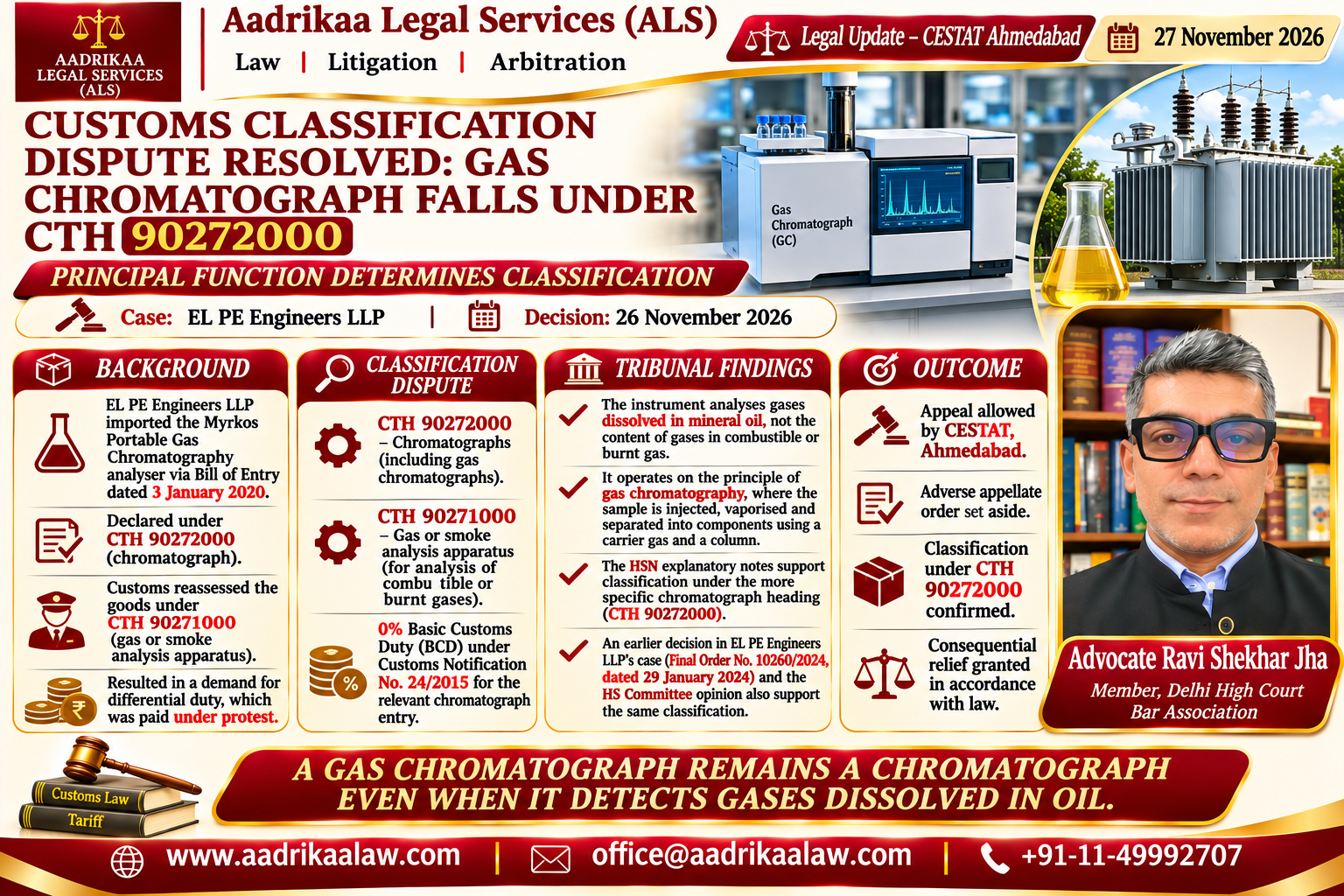
Customs Classification Dispute Resolved: Gas Chromatograph Falls Under CTH 90272000
This Short Article has been prepared & written by Advocate Ravi Shekhar Jha-Delhi High Court, New Delhi. The views expressed are based on his interpretation of the law. He can be reached at his email id intelconsul@gmail.com .

The Customs, Excise and Service Tax Appellate Tribunal (CESTAT), Ahmedabad, has held that a Myrkos Portable Gas Chromatography analyser used to monitor dissolved gases in mineral oil must be classified as a chromatograph under Customs Tariff Heading (CTH) 90272000, not as a gas or smoke analysis apparatus under CTH 90271000.
The ruling allowed EL PE Engineers LLP’s appeal, set aside the adverse appellate order, and granted consequential relief in accordance with law.
Case Background: Dispute Over the Correct Tariff Heading
EL PE Engineers LLP imported the Myrkos Portable Gas Chromatography analyser through a bill of entry dated 3 January 2020. The importer declared the equipment under CTH 90272000, the heading covering chromatographs. This classification attracted 0% basic customs duty under Customs Notification No. 24/2015.
Customs authorities, however, took the view that the equipment should fall under CTH 90271000, which covers gas or smoke analysis apparatus. According to the department, the device was a diagnostic gas analyser using gas-chromatography principles, rather than a complete chromatography system.
The reassessment resulted in a demand for differential duty, which the importer paid under protest. The Commissioner of Customs (Appeals), Ahmedabad, upheld the department’s classification. EL PE Engineers LLP then appealed to CESTAT.
The Central Question: Gas Analyser or Gas Chromatograph?
The key issue was not whether the equipment detects gases. Instead, it was whether its principal function, sample type, and operating method matched the description of a gas or smoke analyser or a chromatograph.
The department argued that the product analyses gases and is used as a transformer fault gas analyser. On that basis, it claimed that CTH 90271000 applied.
The importer argued that the equipment is a gas chromatograph that examines dissolved gases in mineral oil. It relied on an earlier CESTAT decision in its own case, issued on 29 January 2024, which had already addressed the same classification issue.
Why CESTAT Preferred the Chromatograph Classification
The Instrument Analyses Mineral Oil, Not Combustible or Burnt Gas
CESTAT relied on the Harmonized System of Nomenclature (HSN) explanatory notes for Heading 90.27. These notes describe gas or smoke analysis apparatus under CTH 90271000 as equipment that determines the content of gases in combustible gases or burnt gases—for example, gases from coke ovens, gas producers, or blast furnaces.
The Tribunal found that the imported equipment operates differently. Its sample is mineral oil, and it monitors gases dissolved in that oil. It does not examine the composition of combustible or burnt gas as contemplated under CTH 90271000.
Gas Chromatography Is the Equipment’s Principal Function
The Tribunal also highlighted the process used by the instrument. In gas chromatography, the sample is injected, vaporised, carried by a carrier gas through a column, and separated into components according to their interaction with the stationary phase.
This process is materially different from the methods associated with conventional gas or smoke analysers, such as absorption techniques, infrared sensors, thermal conductivity, or heating effects on electrodes.
The Tribunal clarified an important point: the word “gas” in “gas chromatography” refers to the carrier gas used in the analytical process. It does not mean the device necessarily analyses a gaseous sample. Therefore, the presence of the word “gas” in the product description cannot, by itself, justify classification as a gas analyser.
Earlier Tribunal Decision Controlled the Outcome
The Tribunal noted that the question had already been decided in EL PE Engineers LLP’s favour in Final Order No. 10260/2024. In that decision, CESTAT held that gas chromatographs used for monitoring dissolved gases in mineral oil fall under CTH 90272000.
That earlier ruling considered the following factors:
- The technical specifications confirmed the use of gas chromatography technology.
- The instrument monitors gases dissolved in mineral oil, rather than gases contained in combustible or burnt-gas samples.
- The HSN explanatory notes do not exclude gas chromatographs from the chromatograph heading.
- Classification under the more specific chromatograph heading was appropriate.
Because the facts and classification issue were the same, the Tribunal held that the matter was no longer open for fresh debate.
Significance of the HS Committee’s View
The Tribunal also referred to a decision of the HS Committee concerning an online dissolved gas analysis apparatus used for monitoring gases in transformer oil. That apparatus incorporated a gas chromatography system.
The HS Committee treated gas chromatography as the apparatus’s principal function and classified the equipment under CTH 902720, rather than CTH 902710.
CESTAT observed that judicial precedent treats HS Committee opinions as having substantial persuasive value and that they should ordinarily be followed. This reinforced the conclusion that dissolved-gas monitoring equipment based principally on chromatography should be classified as a chromatograph.
Final Order and Customs Duty Implication
CESTAT Ahmedabad allowed the appeal on 26 November 2026. It set aside the Commissioner (Appeals)’ order and confirmed classification of the imported goods under CTH 90272000.
As a result, EL PE Engineers LLP became entitled to consequential relief as permitted by law. Since goods under this tariff entry attracted 0% basic customs duty under the relevant notification, the classification outcome directly affected the importer’s duty liability.
Practical Takeaway for Importers
This ruling shows that customs classification must be determined by an instrument’s actual principal function and technical method, not simply by broad wording in its name or by the fact that it detects gases.
For analytical equipment involving dissolved-gas analysis, importers should preserve technical literature, operating descriptions, manufacturer invoices, and expert certificates that clearly establish whether the product performs chromatography. Where the equipment analyses samples such as transformer or mineral oil through a chromatographic process, this decision supports classification under CTH 90272000 rather than the heading for gas or smoke analysis apparatus.
The decision reinforces that a gas chromatograph remains a chromatograph even when it is used to detect gases dissolved in oil.
Aadrikaa Legal Services is a trusted legal and regulatory support partner providing end-to-end legal solutions to law firms, corporate organizations, and businesses across India. We specialize in paralegal services, litigation support, tax and regulatory matters, delivering reliable, efficient, and result-oriented legal assistance.
Our services include comprehensive paralegal support, drafting and documentation, legal research, case management, litigation handling, and representation support across various judicial and quasi-judicial forums. We also assist in direct and indirect tax matters, customs, GST, corporate regulatory compliance, and legal advisory.
Source: CESTAT Ahmedabad
Handy Download:
Write to us at office@aadrikaalaw.com
Tel: +91-11-4999 2707
Ravi Shekhar Jha – Advocate, Bar Council of Delhi
Leave a Reply