

Aadrikaa Legal Services (ALS)- Law I Litigation I Arbitration
Date: 18.11.2026
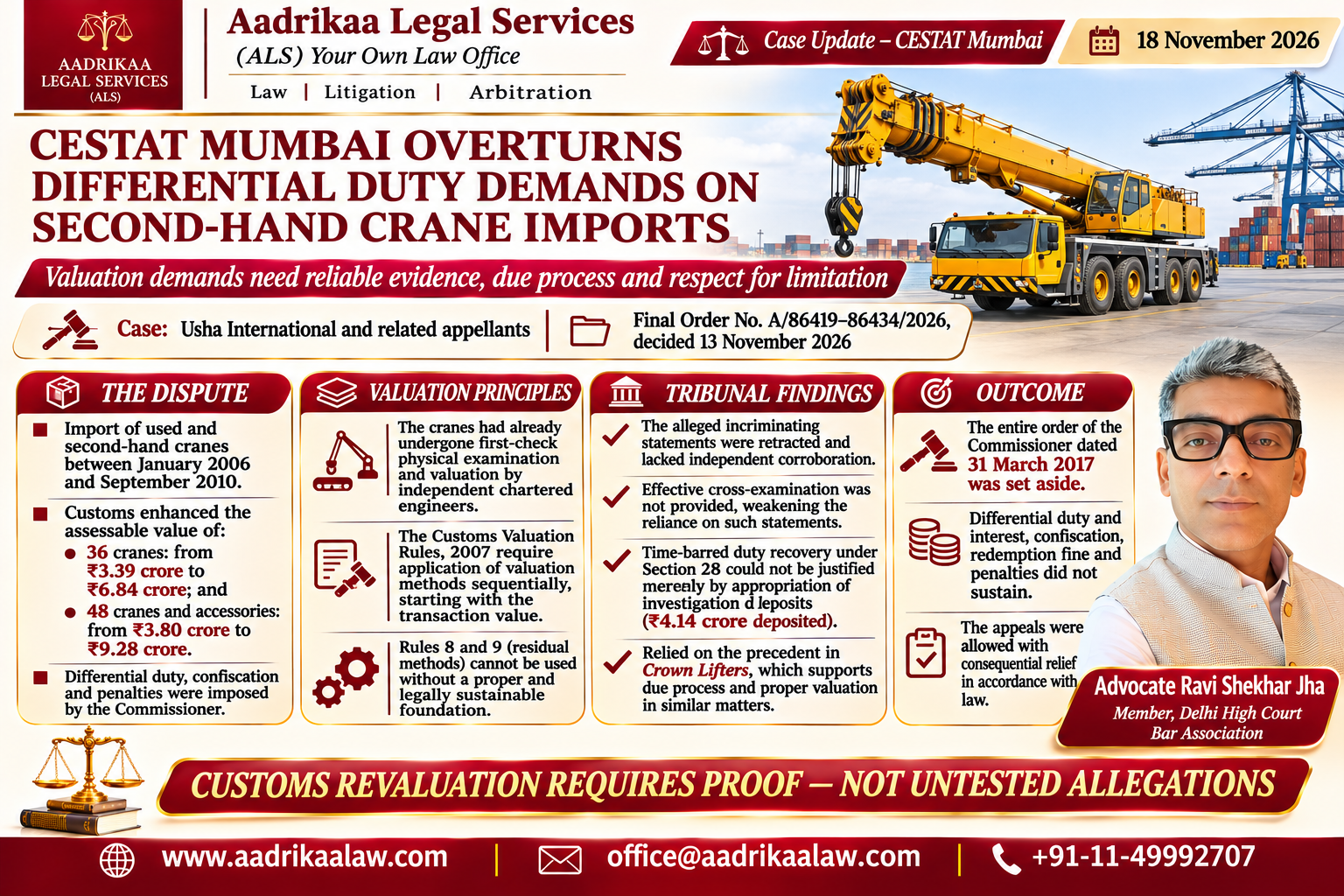
CESTAT Mumbai Overturns Differential Duty Demands on Second-Hand Crane Imports

This Short Article has been prepared & written by Advocate Ravi Shekhar Jha-Delhi High Court, New Delhi. The views expressed are based on his interpretation of the law. He can be reached at his email id intelconsul@gmail.com .
The Mumbai CESTAT has allowed the appeals of Usha International and related parties, holding that the Customs Department could not sustain a later enhancement of value, differential-duty demands, confiscation, or penalties without legally reliable valuation evidence and procedural safeguards.
Overview of the dispute
In Final Order No. A/86419-86434/2026, decided on 13 November 2026, the Customs, Excise & Service Tax Appellate Tribunal (CESTAT), Mumbai, examined a group of appeals arising from the import of used and second-hand cranes between January 2006 and September 2010.
The principal appellant, Usha International, Kolkata, and several co-noticees, including high-sea-sale buyers, customs-related intermediaries and individuals, challenged an order of the Principal Commissioner of Customs (Import-I), Mumbai. The original order had substantially increased the assessable value of the imported cranes, demanded differential customs duty with interest, ordered confiscation, and imposed penalties.
The Tribunal set aside the entire adjudication order and granted consequential relief in accordance with law.
What the Customs Department alleged
The investigation began after the Directorate of Revenue Intelligence (DRI) received intelligence suggesting that certain importers of used cranes were undervaluing their imports. The alleged practices included:
- Declaring a lower value for imported cranes;
- Suppressing or manipulating freight and insurance elements;
- Using allegedly fabricated shipping, invoice and remittance documents;
- Making alleged differential payments through unofficial channels; and
- Relying on a benchmark valuation based on the crane’s weight to secure clearance.
Following searches, document collection and recorded statements, the Department issued a show-cause notice in November 2013. The Commissioner subsequently re-determined the value of:
- 36 cranes directly imported by Usha International, increasing their declared value from about Rs. 3.39 crore to Rs. 6.84 crore; and
- 48 cranes and one consignment of accessories sold through high-sea-sale arrangements, increasing the value from about Rs. 3.80 crore to Rs. 9.28 crore.
The order also confirmed differential duty, appropriated sums deposited during investigation, and imposed penalties on Usha International’s representative and other co-noticees.
Why the Tribunal ruled for the importers
1. Earlier customs assessments had been completed after physical examination
The Tribunal noted that the used cranes had been physically examined at the port of import on a first-check basis. Local independent chartered engineers had assessed their condition and value, and Customs officers had assessed duty on that basis before clearance.
The importers had paid duty based on the enhanced values determined during these original assessments. The Tribunal found that a subsequent re-determination of value required specific and legally sustainable evidence showing that duty had escaped assessment or had been short-levied.
2. Customs valuation rules must be applied sequentially
Under the Customs Valuation Rules, 2007, transaction value is the starting point. If Customs rejects that value, it must proceed through the prescribed valuation methods in sequence.
The Tribunal emphasized that the Department could not simply rely on the residual valuation methods under Rules 8 and 9 without a valid foundation. The Board’s guidance on valuation of second-hand machinery likewise requires Customs to reject the declared transaction value on proper grounds before moving to another valuation method.
In this case, the Tribunal found that the later valuation exercise did not meet this legal standard.
3. Retracted statements could not be the sole basis for demand
A key part of the Department’s case relied on a statement attributed to Usha International’s representative regarding the alleged actual transaction values. However, the statement was retracted at an early stage before a judicial authority, with an allegation that it had been obtained through force, threat and coercion.
The Tribunal held that a retracted statement cannot be relied upon to confirm duty demands without proper corroboration. It also noted that the Department had not addressed the retraction through a fresh statement or by providing an effective opportunity for cross-examination.
The decision reinforces that allegations of undervaluation cannot rest solely on untested statements, particularly where the witness testimony is disputed and procedural requirements for relying on statements have not been followed.
4. No effective cross-examination weakened the Department’s evidence
The Tribunal found that the statements of persons relied upon by Customs were not tested through cross-examination. This was especially significant because the statements formed an important part of the alleged undervaluation case.
Relying on prior Tribunal authority that had been upheld when the Supreme Court dismissed the Revenue’s appeal, the Bench held that statements cannot be used as conclusive evidence without following the applicable statutory procedure and allowing cross-examination where necessary.
5. Time-barred imports could not be used for duty recovery through appropriation
The show-cause notice was issued on 11 December 2013. Some of the relevant imports fell outside the five-year statutory period for recovery under Section 28 of the Customs Act.
Although Rs. 4.14 crore had been deposited voluntarily during the investigation, the Tribunal held that this did not permit Customs to appropriate amounts toward duty demands that were beyond the statutory limitation period, particularly when there was no documented admission of liability or express consent for such adjustment.
The Tribunal also noted that the original adjudication order had not confirmed the duty demand for certain time-barred imports. Accordingly, the later appropriation of deposits for those imports was not legally sustainable.
Reliance on the Crown Lifters precedent
The Tribunal treated its earlier decision in Karim Haria and Crown Lifters Pvt. Ltd. v. Commissioner of Customs as materially relevant. That decision involved comparable allegations concerning used-crane imports, alleged undervaluation and reliance on statements without adequate corroboration or cross-examination.
In the earlier matter, the Tribunal had ruled that:
- Actual purchase prices had not been properly established;
- Alleged unofficial payment arrangements had not been sufficiently corroborated;
- Reassessment and recovery of differential duty could not stand on unreliable evidence; and
- Confiscation and penalties could not be imposed merely on the basis of a subsequent valuation dispute.
The Revenue’s challenge to that order had not resulted in a stay or reversal by the Bombay High Court. The CESTAT therefore found no basis to depart from the same legal approach in Usha International’s case.
Final outcome
The CESTAT set aside the Commissioner’s order dated 31 March 2017 in full. As a result:
- The re-determined values of the imported used cranes were not sustained;
- The differential-duty demands and related interest did not survive;
- The appropriation of investigation deposits for time-barred imports was not upheld;
- The proposed confiscation and redemption-fine consequences failed; and
- Penalties imposed on Usha International’s representative and other co-noticees were set aside.
Key legal takeaway
The ruling underscores that Customs authorities must follow the statutory valuation sequence, rely on corroborated and procedurally admissible evidence, respect limitation periods, and provide fair opportunities to challenge witness evidence. A completed customs assessment of used machinery cannot be reopened through a later valuation theory based principally on retracted or untested statements.
Aadrikaa Legal Services is a trusted legal and regulatory support partner providing end-to-end legal solutions to law firms, corporate organizations, and businesses across India. We specialize in paralegal services, litigation support, tax and regulatory matters, delivering reliable, efficient, and result-oriented legal assistance.
Our services include comprehensive paralegal support, drafting and documentation, legal research, case management, litigation handling, and representation support across various judicial and quasi-judicial forums. We also assist in direct and indirect tax matters, customs, GST, corporate regulatory compliance, and legal advisory.
Source: CESTAT Mumbai
Handy Download:
Write to us at office@aadrikaalaw.com
Tel: +91-11-4999 2707
Ravi Shekhar Jha – Advocate, Bar Council of Delhi
Leave a Reply