

Aadrikaa Legal Services (ALS)- Law I Litigation I Arbitration
Date: 19.11.2026
Customs Cannot Invoke Extended Limitation After Delay, Holds CESTAT Chennai

This Short Article has been prepared & written by Advocate Ravi Shekhar Jha-Delhi High Court, New Delhi. The views expressed are based on his interpretation of the law. He can be reached at his email id intelconsul@gmail.com .
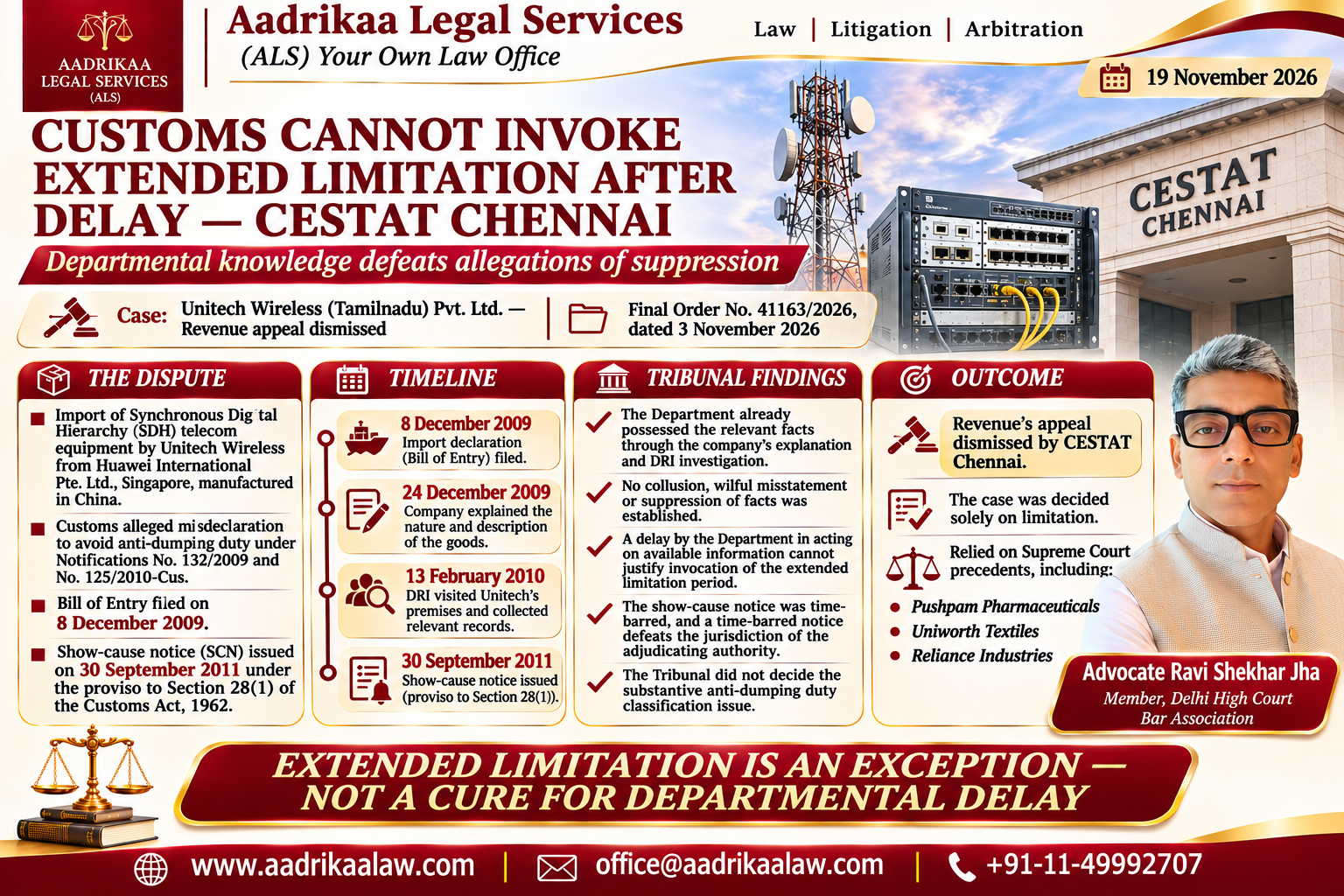
The Chennai Bench of CESTAT dismissed the Revenue’s appeal against Unitech Wireless (Tamilnadu) Pvt. Ltd., holding that the show-cause notice seeking anti-dumping duty was barred by limitation and that the extended period could not be invoked.
Background of the dispute
The case arose from imports of Synchronous Digital Hierarchy (SDH) telecom equipment by Unitech Wireless from Huawei International Pte. Ltd., Singapore. The equipment was manufactured by Huawei Technologies Co. Ltd., China.
Customs authorities alleged that Unitech had misdeclared the imported goods by using a technical description without stating their trade name. According to the Department, this was intended to avoid anti-dumping duty under Notification No. 132/2009 and the subsequent Notification No. 125/2010-Cus.
A show-cause notice dated 30 September 2011 was issued under the proviso to Section 28(1) of the Customs Act, 1962. It proposed recovery of anti-dumping duty, confiscation of goods, and penal action. The Commissioner of Customs, Chennai-II later dropped the proceedings. Revenue challenged that decision before the Customs, Excise and Service Tax Appellate Tribunal (CESTAT).
Revenue’s position: Equipment could attract anti-dumping duty
The Department argued that the Commissioner had incorrectly interpreted Note 2 to Notification No. 125/2010-Cus. It submitted that the word “essentially” should not be read as “exclusively.”
On this interpretation, the Department contended that equipment capable of transmitting signals through media other than optical fibre, including microwave radio or electrical copper media, should not automatically fall outside the anti-dumping-duty levy. Revenue therefore sought reversal of the Commissioner’s order and confirmation of the proposed duty demand.
Unitech’s defence: No misdeclaration and no basis for extended limitation
Unitech challenged the very validity of the show-cause notice on limitation. It argued that the relevant Bill of Entry had been filed on 8 December 2009, while the notice was issued only on 30 September 2011, beyond the normal statutory period.
The company maintained that it had correctly declared both the value and description of the imported equipment. The notice did not identify any false declaration in the Bill of Entry; instead, it alleged that adequate technical details had not been made available. Unitech argued that this did not establish collusion, wilful misstatement, or suppression of facts, which are necessary conditions for invoking the extended limitation period under Section 28(1).
On the merits, Unitech also maintained that the imported equipment used microwave antennas and was not intended for transmission through optical fibre. It argued that the products therefore came within the exclusion in Note 2 to Notification No. 125/2010-Cus.
Tribunal’s findings: Department already knew the relevant facts
CESTAT found that the central issue was whether Revenue could validly invoke the extended limitation period. The Tribunal noted that Directorate of Revenue Intelligence officials had visited Unitech’s premises in Hyderabad on 13 February 2010 and had collected relevant import-related documents and details.
The Tribunal also recorded that Unitech had explained the nature and description of the goods as early as 24 December 2009. These facts showed that the Department was already aware of the relevant factual position well before issuance of the show-cause notice in September 2011.
Because the Department had access to the relevant information, the Tribunal held that Unitech could not be accused of collusion, wilful misstatement, or suppression of facts. A delay by the authorities in acting on available information could not justify use of the extended limitation period.
Why limitation decided the case
The Tribunal emphasized that a challenge based on the show-cause notice being time-barred goes to the jurisdiction of the adjudicating authority. If the notice is issued outside the legally permissible period, the authority lacks jurisdiction to decide the demand. Such a defect cannot be corrected later in appellate proceedings.
Relying on Supreme Court precedents cited by Unitech, including Pushpam Pharmaceuticals, Uniworth Textiles, and Reliance Industries, CESTAT concluded that the appeal had to fail on limitation alone. It therefore did not need to rule further on the substantive anti-dumping-duty dispute.
Outcome and legal significance
By Final Order No. 41163/2026 dated 3 November 2026, CESTAT Chennai dismissed Revenue’s appeal. The Tribunal also disposed of Unitech’s miscellaneous application for additional evidence and the cross-objections filed in the appeal.
The ruling reinforces an important customs-law principle: the extended limitation period is an exceptional remedy, not a mechanism to cure departmental delay. Where customs authorities already possess material information about an import, they must act within the normal limitation period unless they can establish deliberate concealment, wilful misstatement, or another statutory ground for extension.
For importers, the decision highlights the value of maintaining clear, timely records of product descriptions, technical specifications, and communications with investigating authorities. For the Department, it underscores that prior knowledge of the facts can defeat a later allegation of suppression.
Aadrikaa Legal Services is a trusted legal and regulatory support partner providing end-to-end legal solutions to law firms, corporate organizations, and businesses across India. We specialize in paralegal services, litigation support, tax and regulatory matters, delivering reliable, efficient, and result-oriented legal assistance.
Our services include comprehensive paralegal support, drafting and documentation, legal research, case management, litigation handling, and representation support across various judicial and quasi-judicial forums. We also assist in direct and indirect tax matters, customs, GST, corporate regulatory compliance, and legal advisory.
Source: CESTAT Chennai
Handy Download:
Write to us at office@aadrikaalaw.com
Tel: +91-11-4999 2707
Ravi Shekhar Jha – Advocate, Bar Council of Delhi
Leave a Reply