

Aadrikaa Legal Services (ALS)- Law I Litigation I Arbitration
Date: 21.11.2026
Supreme Court Clarifies Limitation Rules for Appeals Under FEMA

This Short Article has been prepared & written by Advocate Ravi Shekhar Jha-Delhi High Court, New Delhi. The views expressed are based on his interpretation of the law. He can be reached at his email id intelconsul@gmail.com .
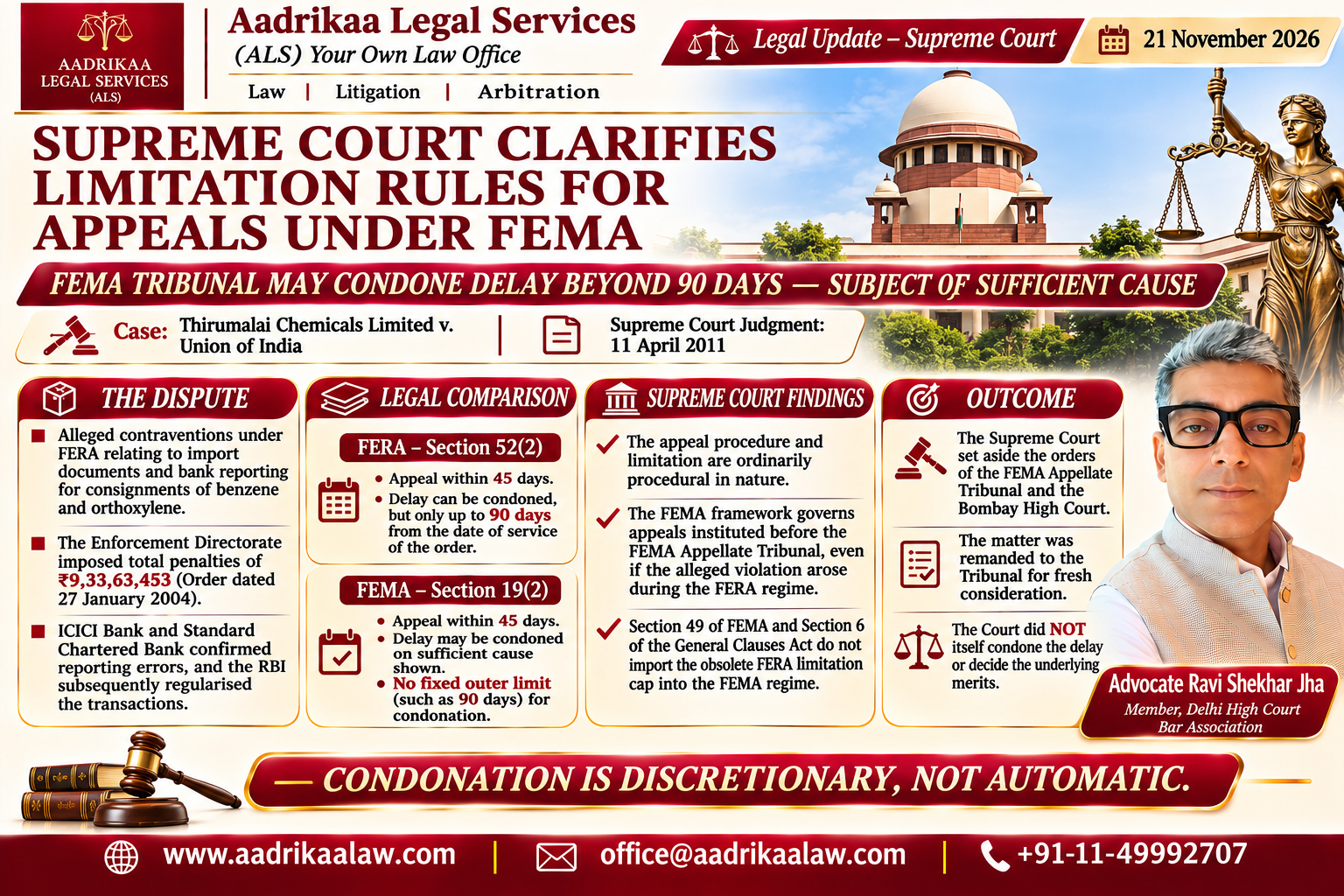
The Supreme Court ruled for Thirumalai Chemicals Limited, holding that the FEMA Appellate Tribunal may condone delay beyond 90 days when sufficient cause is shown, even where the underlying alleged violation arose under the repealed FERA regime.
Overview of the Decision
In Thirumalai Chemicals Limited v. Union of India, decided on 11 April 2011, the Supreme Court addressed an important procedural issue created by the transition from the Foreign Exchange Regulation Act, 1973 (FERA) to the Foreign Exchange Management Act, 1999 (FEMA).
The central question was straightforward: where an alleged contravention occurred when FERA was in force, but the adjudication order and appeal were made after FEMA took effect, which law governs the time limit for filing the appeal?
The Court held that the appeal procedure under FEMA applies. As a result, the Tribunal was not constrained by FERA’s former 90-day outer limit for condoning delay.
The Dispute: Import Documents and Foreign-Exchange Compliance
Thirumalai Chemicals had imported consignments including benzene and orthoxylene for home consumption. It submitted Exchange Control Copies of bills of entry to its authorised dealer banks, ICICI Bank and Standard Chartered Bank.
Under the Exchange Control Manual, the banks were expected to forward these documents to the Reserve Bank of India (RBI). The company believed this had occurred. However, the Enforcement Directorate later alleged that the required documentation had not been furnished and initiated proceedings for contraventions connected with Sections 8(3) and 8(4) of FERA.
On 27 January 2004, the Enforcement Directorate imposed total penalties of Rs. 9,33,63,453 on the company. The company stated that it received copies of these orders only on 22 April 2004, after requesting them.
The Banks’ Error and RBI Regularisation
After receiving the penalty orders, Thirumalai Chemicals contacted its banks. Both banks confirmed that they had received the relevant bills of entry from the company but had made reporting errors.
- ICICI Bank confirmed receipt of the documents, although it noted a value difference, and sought RBI permission to accept them.
- Standard Chartered Bank stated that it had received the relevant Exchange Control Copy but had inadvertently reported in its return that the bill of entry had not been submitted.
The RBI subsequently informed the Enforcement Directorate that, based on the banks’ documents and evidence, it had deleted the entries from its records and regularised the transactions. The company asked the Enforcement Directorate to drop the proceedings, maintaining that any lapse resulted from the banks’ mistakes rather than its own conduct.
Why the Appeal Was Filed Late
The company initially believed that the Enforcement Directorate would close the matter after the RBI regularised the transactions. When that did not happen, it filed four appeals before the Appellate Tribunal for Foreign Exchange on 2 August 2004, together with applications seeking condonation of delay.
The Tribunal did not examine the merits. It dismissed the appeals as time-barred, applying Section 52(2) of FERA. That provision allowed an appeal within 45 days and permitted condonation only up to 90 days from service of the order.
The Bombay High Court upheld that approach, reasoning that it could not use its constitutional writ jurisdiction to bypass a statutory appeal remedy that had become barred by delay.
The Legal Issue: FERA or FEMA?
FERA was repealed when FEMA came into force on 1 June 2000. The two statutes had materially different rules on delayed appeals:
- FERA Section 52(2): Appeal within 45 days; delay could be excused, but only up to 90 days from service of the order.
- FEMA Section 19(2): Appeal within 45 days; the Tribunal may admit a delayed appeal if sufficient cause is shown. The provision imposes no fixed outer limit on condonation.
The Tribunal and High Court treated the FERA limitation rule as applicable because the alleged contraventions related to the period when FERA was in force. The Supreme Court rejected that reasoning.
Supreme Court’s Reasoning: Limitation Is Procedural
The Court drew a critical distinction between a right of appeal and the procedure for exercising it.
A right to appeal is a substantive statutory right. In contrast, the rules governing the forum, manner of filing, and limitation period are ordinarily procedural. Procedural law generally applies to proceedings instituted after the new law comes into force, unless the statute indicates otherwise.
The Supreme Court held that the appeal was filed before the Tribunal created under FEMA, not before the former FERA Appellate Board. Therefore, the procedural rule in FEMA Section 19(2), including its power to condone delay, governed the appeal.
The Court also explained that a time-bar defence can be an accrued right once the former limitation period has fully run. But on the facts, there was no accrued right in favour of the respondents that prevented FEMA’s procedural rule from applying.
Why the FERA Provision Could Not Be Imported
Section 52(2) of FERA dealt specifically with appeals to the FERA Appellate Board. That Board was dissolved when FEMA took effect.
The Supreme Court found that the Tribunal and the High Court had incorrectly imported the old FERA time cap into an appeal that had to be filed before the FEMA Tribunal. The limitation rule applicable when the company instituted its appeal was FEMA Section 19(2), not FERA Section 52(2).
Accordingly, the FEMA Tribunal had jurisdiction to consider an appeal filed after 45 days if sufficient cause for the delay was established, without a 90-day statutory ceiling.
Effect of FEMA’s Repeal and Saving Clause
The Court also examined Section 49 of FEMA, the repeal-and-saving provision, together with Section 6 of the General Clauses Act, 1897.
These provisions preserved liabilities and proceedings connected with FERA, subject to FEMA’s two-year sunset period for initiating proceedings concerning FERA contraventions. But they did not preserve FERA’s old procedural limitation rule for an appeal that was required to be filed before the FEMA Tribunal.
In short, FERA could continue to govern the alleged underlying contravention, while FEMA governed the procedural route and limitation framework for the subsequent appeal.
The Final Ruling
The Supreme Court set aside the orders of both the Appellate Tribunal and the Bombay High Court. It remitted the matter to the Tribunal for fresh consideration in accordance with law.
The Court did not itself decide whether the company had established sufficient cause for the delay. Instead, it confirmed that the Tribunal had the legal authority to consider that question under FEMA Section 19(2).
Key Legal Principles From the Case
1. The law in force when an appeal is filed generally governs limitation
Where limitation and filing procedure are procedural matters, the applicable law is ordinarily the law in force when the appeal is instituted, not necessarily the law in force when the original cause of action arose.
2. A new procedural law may apply to older disputes
A procedural provision can apply to matters arising under a repealed statute, provided that doing so does not take away an accrued substantive right or an accrued time-bar defence.
3. FEMA permits wider condonation of delay than FERA
Under FEMA Section 19(2), the Tribunal can entertain a delayed appeal if sufficient cause is shown. Unlike FERA Section 52(2), FEMA does not impose a fixed 90-day outer limit.
4. Saving provisions preserve rights and liabilities, not necessarily old procedure
The repeal of FERA did not eliminate proceedings for earlier FERA violations. However, an appeal filed after FEMA came into force had to follow the appeal procedure established by FEMA.
Significance of the Judgment
The ruling prevents a party from losing access to appellate review merely because an obsolete procedural time limit is applied to an appeal governed by a new statutory framework. It also confirms that courts must carefully distinguish between the substantive law governing an alleged contravention and the procedural law governing how a later appeal is filed and considered.
For appeals to the FEMA Tribunal, the decisive issue is whether the appellant can show sufficient cause for delay, rather than whether the delay exceeds the 90-day cap that existed under FERA.
Connected Matter
Aadrikaa Legal Services is a trusted legal and regulatory support partner providing end-to-end legal solutions to law firms, corporate organizations, and businesses across India. We specialize in paralegal services, litigation support, tax and regulatory matters, delivering reliable, efficient, and result-oriented legal assistance.
Our services include comprehensive paralegal support, drafting and documentation, legal research, case management, litigation handling, and representation support across various judicial and quasi-judicial forums. We also assist in direct and indirect tax matters, customs, GST, corporate regulatory compliance, and legal advisory.
Source: Supreme Court
Handy Download:
Write to us at office@aadrikaalaw.com
Tel: +91-11-4999 2707
Ravi Shekhar Jha – Advocate, Bar Council of Delhi
Leave a Reply